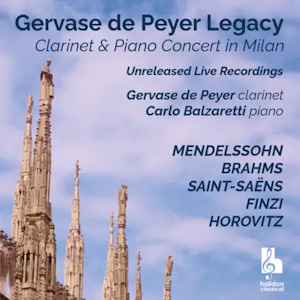
Gervase de Peyer (clarinet)
Legacy – Clarinet and Piano Recital in Milan
Gerald Finzi (1901-1956)
Five Bagatelles, Op.23 (1938-45)
Johannes Brahms (1833-1897)
Clarinet Sonata No.2, Op 102 No.2 (1894)
Camille Saint-Saëns (1835-1921)
Clarinet Sonata, Op.167 (1921)
Joseph Horovitz (1926-2022)
Clarinet Sonatina (1981)
Felix Mendelssohn (1809-1847)
Andante from Clarinet Sonata in E flat major, MWMV Q 15 (1821)
Carlo Balzaretti (piano)
rec. live, 29 November 1996, Milano-Centro Asteria, Italy
Halidon Classical HC1005 [65]
As well as his well-documented musical relationship with Gwenneth Pryor, clarinettist Gervase de Peyer collaborated with other musicians, not least when he was on tour. One such was the young Italian, Carlo Balzaretti, winner of the Maria Canals International Music Competition in 1982, with whom de Peyer performed for almost 25 years, from the late 1980s until 2012. The disc under review documents that partnership, presenting a recital from 1996 given at Milano-Centro Asteria.
It’s a commonplace these days to note that live recitals are heard in audience-free purity – no coughs, splutters, sneezes or programme-rustling – but this one really does sound pristine. There’s also no applause. It sounds as good as a studio product, in fact, and is extremely well-balanced.
The programme is a typical de Peyer one and reflects his promotion of British works – Finzi and Horovitz – as well as the Franco-German pairing of Saint-SaënsandBrahms. Finzi’s Bagatelles offer five rich examples of his songful gifts and de Peyer and Balzaretti respond admirably. The interpretation is very similar to de Peyer’s Chandos recording with Pryor and only the Fughetta, which is here a touch – but only a touch – slower offers any surprises. In his warm and wry booklet reminiscences, Balzaretti recalls the clarinettist and Joseph Horovitz having an animated debate, as late as 2006, concerning the interpretation of the latter’s Clarinet Sonatina which was dedicated to de Peyer. This is again on Chandos, but de Peyer’s tonal subtlety in its airy opening, the warmth of his playing of the central Lied and the madcap wit of the finale offer an object lesson to others taking on this repertoire – Nicholas Daniel is his most obvious successor.
When he recorded the Brahms sonatas with Daniel Barenboim he was tempted to somewhat expansive tempi, something he refined when re-recording them with Gwenneth Pryor. Here, too, with Balzaretti one feels a more naturally flowing series of tempo decisions, the music’s fluid lyricism flexibly dispatched and the performance better at meshing together the central movement’s stormy and reflective panels than was the case with Barenboim. Saint-Saëns’ Sonata was one of his last completed works and both performers locate pert wit in the opening movement and vivacity in the finale. In the central slow movement, the pianist’s antique-tinged rolled chords are beautifully played. The slow movement from Mendelssohn’s Sonata provides an apt warm encore.
It ends a characteristic de Peyer recital. There are no startling revisions, the repertoire has been honed to perfection but still offers subtlety of phrasing and much tonal variety. In no small measure, Balzaretti plays his part with digital and expressive understanding.
Jonathan Woolf
Buying this recording via the link below generates revenue for MWI, which helps the site remain free