
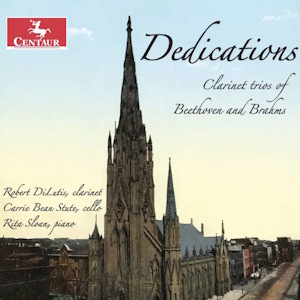
Dedications
Ludwig van Beethoven (1770-1827)
Clarinet Trio in B flat Major Op. 11 (1797)
Johannes Brahms (1833-1897)
Clarinet Trio in A Minor Op. 114 (1891)
Robert DiLutis (clarinet)
Carrie Bean Stute (cello)
Rita Sloan (piano)
rec. 2024, First & Franklin Presbyterian Church, Baltimore, USA
Centaur CRC4150 [46]
The Beethoven and Brahms clarinet trios make a natural pairing, as each was composed for the combination of clarinet, cello and piano. (Mozart’s clarinet trio, K 498. which one might have thought would make a third, is ruled out because the string instrument there is a viola not a cello.) Each was inspired by a clarinet player who impressed the composer: Josef Bähr, a court musician, for Beethoven and Richard Mühlfeld, from the Meiningen Orchestra, for Brahms. In other ways they are contrasted. Beethoven’s trio is one of his earliest works, dating from the time when he was a young lion and the coming man in Viennese music. The early signs of his impending deafness had not yet begun to impede his performing in public. Brahms’s trio, on the other hand is one of his last works and is rather melancholy in tone.
Beethoven’s trio is in three movements and is predominantly cheerful. The first movement is a vigorous sonata allegro in the composer’s characteristc first period manner, and is easily followed. The Adagio second movement features a theme remarkably like that in the Septet and also in the piano sonata Op. 49 No.2. The finale is a set of variations on the aria ‘Pria ch’io l’impegno’ from the opera L’amor marinaro by Joseph Weigl. Thisi is quite jolly, but Beethoven later said he wished he had composed something entirely his own. The listener will not mind. However, I should say that the clarinet writing is not particularly idiomatic for the instrument, and does not exploit its lowest register except in one place in the first movement. This is because Beethoven wanted the part also to be playable also on the violin, and it was published as being suitable for either. Instrument.
Brahms’s trio is one of the four works inspired by Mühlfeld, the others being the clarinet quintet Op. 115 and the two.clarinet sonatas Op 120. There are four movements. The cello opens, immediately followed by the clarinet with a wistful theme which leads into a closely worked sonata allegro . The second subject is nore equable, even cheerful. The development is notable for the way the cello folows the clarinet in scale passages. The slow movement comes second and exploits the whole range of the clarinet while also giving the cello opportunities for a singing line. The third movement is marked Andantino – Brahms rarely wrote scherzos – and is a gentle, easy-going waltz, whch some have thought rathet trivial. The finale is, unusually, in sonata form and returns to the serious, even sombre mood of the first movement. Again we have the scale passages. In this work the writing for the clarinet is thoroughly idiomatic, while the cello is kept high in its range. The piano writing is, as always with Brahms, very rich and full.
The performing team here is American, all very experienced. However, although their biographies are given, I could not work out what brought them together or whether they had played together before making this recording. Be that as it may, their playing is idiomatic and vivid, and they work well together. The recording is excellent. There are, of course, other recordings of both works, coupled in various combinations, and I should mention one by Richard Stolzman, Yo-Yo Ma and Emanuel Ax (Presto reissue from Sony), which adds in the Mozart trio, with Ma playing the viola part on his cello. However, if you don’t fancy that, this will do very nicely.
Stephen Barber
Buying this recording via the link below generates revenue for MWI, which helps the site remain free













