
Maurice Ravel (1875-1935)
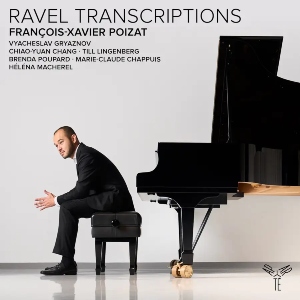
Transcriptions
François-Xavier Poizat (piano)
rec. 2026, Little Tribec at Cité de la musique et de la danse, Soissons, France
Aparté AP430 [65]
If anyone has the right to record a new CD of Ravel, it has to be François-Xavier Poizat, who has genuinely recorded the complete Ravel. Other pianists tend to bandy that phrase about even if what they provide is actually incomplete (Bertrand Chamayou, for example, whose Ravel is nevertheless very fine), whereas Poizat knows what complete means, having recorded everything that Ravel wrote for piano. In this new recording he turns his attention to piano and other varied transcriptions of Ravel pieces, and why not? In this venture he is joined by an adventurously varied group of musicians, who include fellow pianist and longtime colleague and arranger Vyacheslav Gryaznov, percussionists Chiao-Yuan Chang and Till Lingenberg, mezzo-sopranos Brenda Poupard and Marie-Claude Chapuis, and flautist Héléna Macherel. I will say straight away that all of them are very fine indeed; Poizat clearly picks his colleagues carefully.
The obvious question to a pianist who has been a self-confessed Ravel nut from an early age, is what is it about Ravel that continues to attract and intrigue you? After all, Ravel wrote only a limited amount of solo piano music, barely enough to fill two CDs. The pianist’s own thoughts would, I daresay, pretty much echo those of many a Ravel fan. In the thoughtful and revealing interview in the booklet from apartemusic.com which replaces the usual notes, Poizat has this to say:
“It’s very difficult to explain. Of course, there are typical harmonic turns, characteristic colours and melodic gestures. But what really stands out is the perfection of his writing. With Ravel, nothing is superfluous. Even in the densest of textures, every note is necessary. He demonstrates absolute mastery of the art of composition. Perhaps that is ultimately his signature: a form of perfection.”
The moment I first heard this CD on a streaming platform, I wanted to own it, and one of the main reasons for that, apart from Poizat’s reputation with Ravel, is that it constantly surprises you. Expecting a fairly standard two piano rendition of both the last section of Daphnis and Chloé and Rapsodie espagnole, you may be surprised to hear a low and slow drumbeat throbbing into the suite’s second and shortest movement, the Malagueña. In the third movement, the sort of wonderfully sleezy Habanera, which would seduce Carmen, the key switches between F sharp minor and F minor as more and more percussion and drumbeats fill in, but subtly, as if you may be imagining them. Those occasional percussive signatures are the first real signs that Poizat and company are attempting to do something different, and that this CD has been carefully thought out. The castanets come out for the final movement, and the whole piece is gently, but never less than excitedly, unleashed.
It seems, however, that our concert of varieties has only just begun. The background to Ravel’s group of three songs opus 69 is rather sombre, as they were composed between 1914 and 1915 while he waited to join the military. The first, Nicolette, in A minor, is an every-day-tale of a princess, who is captured by a wolf and saved by a rich nobleman who is nevertheless too old for her, before being finally being reunited with her shepherd love. In total contrast, Trois beaux oiseaux du paradis, in F minor is an anti-war piece, where the birds illustrate the tricolour of the French flag. Ronde is a much happier affair, written in A major, is a fast-paced circle dance.
The first of our two mezzos, Brenda Poupard, is well accompanied by Poizat here; her voice is full, if with a somewhat mature edge. Thus, you would think she would probably suit the first two songs, Nicolette and Trois beaux oiseaux du paradis, but it is in the last song Ronde, that she seems to be having most fun.
For all the pianistic skill, the highlight of this disc for me is a unique rendition of Ravel’s famous song-cycle Shéhérazade (M41) by the French mezzo-soprano Marie-Claude Chappuis, with Poizat providing the sole accompaniment, instead of the more usual lush Ravel orchestration. It becomes more of a revelation and a delight the more I hear it. By removing the lush and exotic from the music, it pares things down to the essence of the trilogy of songs by Klingsor, and perhaps achieves something more like what it was supposed to be. The three songs are “Asie“, “La flûte enchantée“, and “L’indifférent“, so it makes some sense to hear an actual magic flute, here played with suitable enchantment by Héléna Macherel. In fact, one of the few disappointments of this CD is that such a fine flautist doesn’t get to do more. I shall look out for her elsewhere.
Returning to Marie-Claude Chappuis, I find I enjoy her performance more and more on repeated hearings. In places where she is required to sing girlishly and plaintively, she sounds a little like Natalie Dessay, and how wonderful it would have been to hear her version of this. She almost cancels herself out from the start with an uncertain first few bars, but she soon gains in confidence. Although at times the sound may come across as a little too deliberately naïve, the fact that it is the diametric opposite to the likes of Janet Baker and Susan Graham is one of the things which most attracts me to this version by Chappuis and Poizat. It is more of a match with earlier recordings by Susanne Danco and Janine Micheau, which, like this, were unashamedly French. Another more recent example is Marie-Nicole Lemieux.
If the first song – that lushly exotic and often verging on bombastic evocation of the Asiatic – is a bit of a challenge at times, it is still beautifully sung, rising to its two great climaxes in a markedly delicate way which suits the subtlety of the accompaniment. It is in the two shorter songs that follow, however, that Chappuis really makes her mark. Here, she is equally tender and moving, delicate and subtle. It goes without saying that her French is excellent, but that goes even more for her word-pointing. These three poems by Tristan Klingsor have always, like their writer, been a bit of an odd duck. Traditionally sung with the pomp and grandeur of a full orchestra, Marie-Claude Chappuis and Poizat make the case for the lighter version, and it might just be one instance where less does indeed turn out to be more.
The remaining three items are a bit of a mixed bag, with the very short piece for flute and piano, Là-bas, vers l’église (MA9)from the five Greek melodies, again providing merely a tease for the flautist’s lovely tone. The remaining two return us to Poizat’s solo skills, with a lovely, bouncy version of Five o’ Clock Foxtrot, the rag-time dance number from L’enfant et les sortilèges (m71). Finally, just as a filler, there is a rather endearing improvisation of The Lamp is Low adapted by DuRose and Shelter from Ravel’s Pavane for a Dead Princess. Considering its subject matter, you could be forgiven if you found this jolly, jazz-driven version to be in poor taste, but you soon get over it!
In general, I found this a fine issue of great variety, with thoughtful, careful playing and Poizat the unswerving director of this sumptuous feast.
Stephen John Wray Gladwin
Contents
Danse légère et gracieuse de Daphnis (Daphnis et Chloé} M57, arranged for piano Ravel
Daphnis et Chloé Suite no 2 M57, arranged for two pianos Vyachesnav Gryaznov
Rapsodie espangnole M54, arranged for two pianos and percussion Ravel/Lingenberg
3 Chansons M69, arranged for voice and piano Ravel
Shéhérazade M41, arranged for voice, flute and piano Ravel
Là-bas, vers l’église from Les Cinq mélodies populaires grecques MA 9
Five O’clock Foxtrot – L’enfant et les sortilèges M71, arranged for piano Henri Gil Marchex
Bonus: Improvisation on ‘The Lamp is Low’ after Derose and Shefter
Other performers
Vyacheslav Gryaznov (piano]
Chiao-Yuan Chang (percussion)
Till Lingenberg (percussion)
Brenda Poupard (mezzo-soprano)
Marie-Claude Chappuis (mezzo soprano)
Héléna Macherel (flute)
Buying this recording via the link below generates revenue for MWI, which helps the site remain free













