
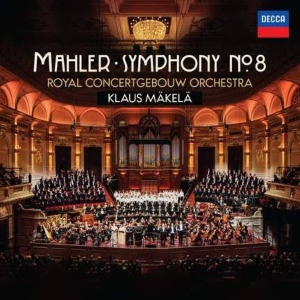
Gustav Mahler (1860-1911)
Symphony No. 8 in E Flat
Magna Peccatrix – Hailey Clark (soprano), Una Poenitentium – Golda Schultz (soprano), Mater Gloriosa – Miriam Kultrowatz (soprano), Mulier Samaritana – Jennifer Johnson (contralto), Maria Aegyptiaca – Okka von der Damerau (contralto), Doctor Marianus – Giorgio Berrugi (tenor), Pater Ecstaticus – Michael Nagy (baritone), Pater Profundus – Tareq Nazmi (bass)
Netherlands Radio Choir, Choeur de l’Orchestre de Paris, Laurens Symfonisch, Nationaal Kinderkoor, Nationaal Jongenskoor
Royal Concertgebouw Orchestra, Amsterdam/Klaus Mäkelä
rec. live, 16-18 May 2025, Concertgebouw Amsterdam
Decca 4871679 [79]
The Decca Record Company has a proud lineage with Mahler’s Eighth Symphony, with accounts by Georg Solti and Riccardo Chailly already in the catalogue; it says much about where they feel their future lies that the conductor they have chosen for their latest recording is Klaus Mäkelä, who was a mere four years old when Chailly was setting down their previous account. Both the Solti (review) and Chailly recordings can legitimately claim to be classics of the gramophone, as well as being sonic blockbusters of their time, even if both are not without controversy, some finding Solti’s turbo-charged brilliance short-changing the transcendence in this music, while Chailly is not above the criticism of being somewhat cool and, on occasion, ‘quirky’ in his Amsterdam account. Happily, there is nothing cool or quirky about Mäkelä’s new recording and, likewise, the sonics are way up to the standards of the house, too, and are hugely impressive.
This recording has already been released earlier in 2026, albeit as a download only without a digital booklet, but a physical release on a single CD is due this November which, I have been assured, will have one.
The background to this release is two concerts that were given at the Mahler Festival in 2025, only the third time this festival has taken place since 1920, with one on Friday evening and another the following Sunday afternoon, the 18th of May, the anniversary of Mahler’s death, which was also given in the presence of his granddaughter, Marina Mahler. In addition to the usual huge orchestra and eight soloists, five choirs were involved, bringing together over 400 participants and necessitating the extension of the orchestral stage into the front four rows of seats at the Concertgebouw. For a live concert, the sound is very impressive, well balanced with the organ nicely, if not overwhelmingly caught. The massed choirs are simply magnificent, with a spirited children’s chorus too while, unsurprisingly since this is the Concertgebouw, the orchestra play superbly over the seventy-nine-minute duration of the performance with a quiet, if not silent, audience, whose applause has been retained at the end, after a respectful moment’s silence, surely in acknowledgement that a recording is taking place.
On the other hand, the soloists are something of a mixed bag. If Giorgio Berrugi brings an Italianate warmth to his tenor part in the symphony, his German is somewhat unique, to put it politely, and his voice is far too small for the part; too often, he is either drowned out by the children’s chorus during his paean to the Mater Gloriosa, or by the orchestra in ‘Blicket Auf’. There is something ironic about this, since the remainder of his colleagues generally tend to sing very loudly indeed, with the Pater Ecstaticus of Peter Nagy especially blustery.
I suspect the soloists’ generally unrefined behaviour (they certainly don’t operate as a team) had something to do with the conductor’s overall enthusiasm which, while commendably infectious, does rather preclude refinement and makes everything sound simply loud. While I suspect a contributory factor to this could have been the engineers’ decision to closely mike the performers in an attempt to try and mitigate any noises from the auditorium, likewise there are hardly any moments in this performance that sound genuinely reverential or hushed. There are many consequences to this, so while ‘Accende lumen sensibus’ is exciting, its climax, when the entire chorus, orchestra and soloists thunder out ‘Veni, Creator Spiritus’, fails to hit home with the impact it surely needs, since there is nothing to differentiate it from the equally noisy fire and brimstone that has gone before. To my ears, there is a failure of interpretation here, whereby the climax of the movement has not been identified and/or musically it has not been properly prepared; it just goes past almost unnoticed. There are similar issues in Part II; for example, the poco adagio orchestral introduction is both played and paced very well, except it is also too loud and, as a consequence, has little sense of mystery, light and shade, nor direction. This is symptomatic of this performance, where too often there is a significant lack of subtlety and attention to detail in the quieter music; the bell in Part I is virtually non-existent, while the three penitent ladies’ section in Part II is as dull as it can be in the wrong hands – just listen to Gielen in Frankfurt (review) at this point to encounter sheer delight in Mahler’s daring orchestration, allied to judicious pacing. Instead, everything in this performance is all sound and fury, signifying not very much at all – and it pains me to say that it all points to an inexperienced young head on young shoulders with the podium.
In the end, reaction to this recording will probably be rocket-fuelled by the superb playing of the orchestra and Decca’s brilliant, full sound, which while is very good, still yields to Boulez’s 2008 studio recording in Berlin for Deutsche Grammophon in sonic splendour. To my ears, though, Boulez loses his way a little in Part II with the results becoming rather studio-bound, a charge that, in fairness, cannot be levelled at the always eager Mäkelä. Ultimately, as a performance, I commend this new release for its enthusiasm, although my own is tempered by the performance’s lack of subtlety – this is just a well-played and well recorded run-through of the work, with a certain generalised excitement during the usual purple passages. Consequently, then, at the end of this recording you may well be shaken, but certainly not stirred, since it neither plumbs the depths, nor reaches the heights of the greatest recordings of all and the ones I personally consider to be the best will be revealed in my upcoming Survey on Mahler’s Eighth Symphony to be published this December.
Lee Denham
Buying this recording via the link below generates revenue for MWI, which helps the site remain free















I have yet to attend a concert by my hometown orchestra, The Chicago Symphony, which has chosen Klaus Mäkelä as its music director. From the reviews of his recordings that I’ve seen, I am not encouraged. I tried streaming his Berlioz Fantastique, opulently recorded but uninspired. (Lee Denham, as with this Mahler 8th, was similarly underwhelmed.)
David Hurwitz can’t stand Mäkelä, but maybe that’s just David Hurwitz being David Hurwitz, who takes gleeful pleasure in puncturing inflated reputations. Sometimes I have to admit he’s right. At others, I am reminded of the poet and critic Randall Jarrell’s remark about a censurious colleague who “is always crying ‘but he hasn’t any clothes on!’ about an emperor who half the time is surprisingly well-dressed.”
If any of you have been favorably impressed by a recording or concert featuring this conductor, please reply to this post. I’m sure that every member of the Chicago Symphony has more advanced musical attainments than I have, and they didn’t rise up in arms when he was appointed. But before I shell out for parking downtown and the cost of two good tickets, I’d like to see some evidence that Mäkelä was a wise choice.
Clarification to previous: I have of course attended many CSO performances in previous years, but not since the Mäkelä era began.
Manfred Honeck will be guest conducting later in the season – now for that I will certainly show up!
My colleague John Quinn was very positive about a couple of Mäkelä recordings – the Sibelius and Prokofiev violin concertos (https://musicwebinternational.com/2024/09/sibelius-prokofiev-violin-concerti-decca/) and three Shostakovich symphonies (https://musicwebinternational.com/2024/09/shostakovich-symphonies-nos-4-5-6-decca/) while I thought much of his Sibelius set (https://musicwebinternational.com/2024/03/sibelius-symphonies-nos-1-7-tapiola-decca/) had merit even though it was excoriated by DH – but it is also true that he is over-exposed, over-hyped and has produced some dull recordings. Honeck is so much more impressive and of course vastly more experienced; I am looking forward to his arrival here in London as Principal Conductor of the Philharmonia.