
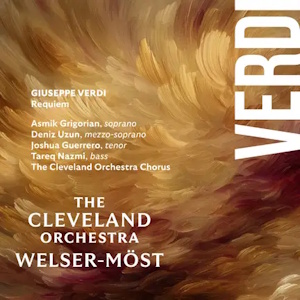
Giuseppe Verdi (1813-1901)
Requiem
Asmik Grigorian (soprano)
Deniz Uzun (mezzo-soprano)
Joshua Guerrero (tenor)
Tareq Nazmi (bass)
The Cleveland Orchestra Chorus
The Cleveland Orchestra/Franz Welser-Möst
rec. live 2026, Cleveland, Ohio,
Booklet in English; text in Latin and English.
Reviewed as a download.
Cleveland Orchestra TCO0019-D [75]
My attention was drawn to this recording by the presence of Asmik Grigorian, whose success in a broad repertory has been remarkable. This particular performance, built around the Cleveland Orchestra and Chorus under their conductor Franz Welser-Möst was put together in 2026, for some performances in Cleveland (at which this recording was made), followed by a short tour including the Carnegie Hall. Grigorian has only performed this work a couple of times otherwise, and this is the first time she has recorded it. But, irrespective of her presence, it is, of course, always interesting to listen to a new recording of Verdi’s Requiem.
The hushed opening is taken at a relatively fast pace, but the impression is plaintive, and one is immediately struck by the quality of the choir. The different sections produce a unified timbre, which results in a very pleasing sound. The soloists immediately have the opportunity to show what they are capable of. The tenor, Joshua Guerrero, has a penetrating, slightly strident, delivery; one notices a certain wobbliness in the bass, Tareq Nazmi; the soprano, Asmik Grigorian, has a rich voice, though with some vibrato; and the richness of the mezzo, Deniz Uzun’s, voice is immediately evident. The overall impression is of a performance which will tend more towards subtlety than to grand gestures.
The Dies Irae confirms this impression: the chorus is remarkably precise, but the cascading strings could be more furiously apocalyptic. The Tuba Mirum is not delivered with as much effect as in some recordings either, (by Solti, for example); I do not feel the same sense of growing urgency in the trumpet dialogue, though there is a big, rich sound and an effective climax.
Another passage where more could, in my view, have been made of Verdi’s writing, is in the Rex Tremendae. At the moment of the surging climax on ‘Salva me’, it is possible to give the passage extra impact by adhering strictly to Verdi’s direction allargando stendando, which involves ‘broadening’ the tempo, and making each note sound laboured, thus giving it an impressive heaviness. Reiner does this admirably in his 1960 recording, but so do others, like Solti and Bernstein. Here, this passage falls relatively flat.
This work is, of course, a considerable challenge for the four soloists, who, from the tenor’s exposed entrance in the Kyrie to the soprano’s extended solo in the Libera me, have a lot of singing to do, and nowhere to hide. Asmik Grigorian’s ability to use the voice expressively is clearly put to good use, in many solo moments – particularly the piano passages – which are done very touchingly, and in, for example, the Recordare duet with the mezzo, in which they coordinate their phrasing very nicely, particularly in the Quarens me passage. But at the moments when the soprano has to show a very wide range of dynamics, moving from a floated, delicate note to a sound which soars above and dominates the other forces, Grigorian – to my ear – shows her limits. At these moments, she sounds pushed and slightly flappy, compared with some illustrious forbears like Leontyne Price and Monserrat Caballé. It is the case in passages such as the ‘Salva Me’ in the Rex tremendae, when her tone can be on the thin side, and the vibrato not the most attractive, and also in the final Libera me, where the vibrato occasionally spreads a little, and the attack is not that clean; but there is also some lovely delicate singing, and she brings out the terrifying feeling of solitude which Verdi creates in this last section.
For me, the weak link in the soloists is the bass, Tareq Nazmi, who often lacks the required warmth and richness, and can wobble and sound a little muffled. The other two soloists have weaknesses, but also saving graces: the singing of the mezzo, Deniz Uzun, could be tidier at times, but she has a rich, smooth timbre, and the voice sounds large, while the tenor, Joshua Guerrero, is steady, and has what it takes in terms both of power (while sometimes erring on the side of hardness) and delicacy.
The orchestra plays, as I have already suggested, with considerable delicacy; the timbre of the woodwind at the start of the Quid sum miser, is, for example, very attractive. This is matched by the subtlety and unified sound of the choir, which all adds up to a remarkably precise, but rather cautious, rather than hair-raising, reading. Many listeners might prefer an older version, whether it be the fabulous, deeply moving Reiner version, whose 1960 sound is showing its age, or a more dramatic rendering by Solti, Bernstein or Mehta, whose soloists are all excellent, and whose performances are genuinely thrilling.
David James
Buying this recording via the link below generates revenue for MWI, which helps the site remain free














Just a note to say that the 1960 Reiner recording has been remastered by High Definition Tape Transfers and sounds much better than it did, almost but not quite on a par with the very well recorded Solti (I have the analogue, not the digital remake). The HDTT Reiner has much better sound than the Bernstein, which is a great performance but suffers from a slightly swimmy, unfocused recording. HDTT has also remastered the Ormandy recording. I have heard neither the performance nor the remastering, but it has its adherents and might be worth considering.
I assume the timing indicated as 75 minutes is an error, rather than indicating the fastest performance in modern history.
I am complimentary about that Ormandy recording in my survey of the Verdi Requiem, Paul. Yes; HDTT remasterings are often excellent and mark a real improvement in sound.
David, I have asked reviewer David James to check that timing but suspect that he is right and your assumption that it is “the fastest in history” is also correct…