
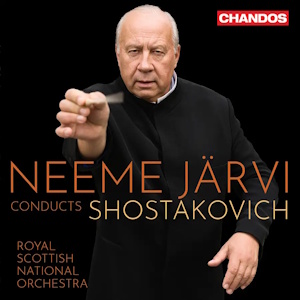
Dmitri Shostakovich (1906-1975)
Järvi Conducts Shostakovich
Lydia Mordkovich (violin)
Royal Scottish National Orchestra/Neeme Järvi
rec. 1984-89, Grand Hall, City Halls, SNO Centre & Henry Wood Hall, Glasgow; Caird Hall, Dundee, UK
Chandos CHAN20439 [8 CDs: 553]
When approaching reviewing any Shostakovich box, and especially one this substantial, my main priority is to try to understand how I view the music of the composer, (of which this is a clear representative sample) and how well here conductor and orchestra manage to fulfil that. Having your own view of a composer’s music can of course act against the success of a review if the reviewer is hidebound and attached to certain conditions, interpretations and a limited insight, maybe due to an over reverence for the composer, orchestra, conductor or artist. Therefore, we must not only adopt a clean slate approach, but remain open to surprises and nuances, and yes, the occasional shock approach which might even in the end convert us.
I say this, because I know that many people’s ideas about Shostakovich’s music, including for a long time my own, have concentrated on the rhythm of war and the nihilistic, the tragedies of Russia before, during and after Stalinism, and maybe above all, a little too much on the relationship between composer and despot, which nevertheless is always in the background.
However, if we’re not careful, in the middle of all this concentration on the darker sight of his music, we are all too clearly in danger of dismissing or even ignoring both the romantic and the humorous. Instead, what we get in these eight well-filled CDs is a collection which at times can be as much about fun as nihilism and beauty as much as discordant gritted teeth atonality. Not only do we get his early student first symphony, then after a short leap over the sheer propaganda of symphonies two and three, the remainder of the 4-10 symphonies, but the sheer exuberance, quirkiness and even sometimes Tom and Jerry back-and forth of the five ballet suites, the ebullient Festival Overture, Tahiti Trot, and the contrasting two light and dark violin concertos played by Lydia Mordovich. Indeed, some people might think who needs the later stuff, when you have a collection like this. (N.B. Järvi went on to complete the cycle with the Gothenburg Symphony Orchestra.) You also have the fact that you know what you’re buying is an interpretation of Shostakovich’s works by a partnership which was, and still is, widely acclaimed – so surely, you can’t go wrong.
The Järvi set has for a long time had the reputation of being fast and furious, and that this remains one of its obvious strengths is made clear on this splendid re-release. What I don’t accept, however, is that much of the weightiness departs with that pace and fury. Perhaps once or twice, the breathlessness might just overbalance the need for cogent consideration, but in my case, perhaps never having heard this part-cycle before helps me to make a cleaner judgement. Of the two Shostakovich cycles I actually possess, one is the splendid, but maybe sometimes a little sluggish Rudoph Barshai set with the WDR Sinfonie Orchestra, and the other the very recent bright and fresh series with Vassily Petrenko and the Royal Liverpool Orchestra, which has been widely praised.
I believe that it is all too easy to get bogged down with the whole business of Stalin’s notorious condemnation of the composer in Pravda, his feelings, as portrayed in totally different ways in the repressed Fourth, and the strident and possibly unapologetic Fifth, and the whole controversy about what the final movement of the latter means. My point is that if you are willing to look at every symphony from the Fourth to the Twelfth as a response to Stalin’s comments in Pravda and the ongoing danger which might so easily have put Shostakovich in the Gulag, then you are seeing and hearing an artist on a tightrope. Anything he writes from the Fourth onward – a symphony which didn’t even see the light of day until many years later – is written under the awareness of microscopic examination.
What reasons Neeme Järvi had for playing many of these pieces at such a furious and electric pace, who knows, but for me this approach is completely validated by Shostakovich’s own personal and artistic life. How many of symphonies 4-10 begin with a march? Marches are ever present in these works as if their presence were unavoidable, as presumably the march of Stalinist intransigence was for any artist who even thought about not toeing the line. Often a dominant sound in these marches is the high screaming of the flutes and piccolos, for if there was anyone who could turn a supposedly gentle instrument like a flute into a weapon of war, it was Shostakovich. Likewise, every time a brass entry is made it is there to punctuate, point out and yes, even invade. Or the strings, which one moment might be there to propel all those marches as an important part of the rhythm of progress or nihilistic destruction, will, in slow movements, be just as likely take on something like a sobbing reminder of the human tragedies which lie behind the marching and parading. This was a composer who could move between great tableaux with ease, from the fierce growth of the relentless invasion march in the first moment of the seventh, The Leningrad symphony, to the equally moving bleak desolation the opening movement to the Eighth Symphony. The same occurs in the next pairing of symphonies, as with the contrast between the rather odd first movement of the Ninth and the growling power of its counterpoint in the Tenth, followed, of course, by the savagery of Stalin released in all its fury in the famous second movement. Even going forward to the Eleventh, we have the bleakest opening of a symphony yet before we reach Babi Yar – the quiet of the snowbound winter palace in St Petersburg before the massacre that follows, depicted with a savagery never bettered elsewhere in Shostakovich’s work. The controversial Twelfth seems to return to the triumphalism of the Second, and is generally regarded as a mess. Järvi’s mostly excellent recordings of symphonies 11-15 complete the cycle.
I feel that Neeme Järvi captures the sense of a terrifying journey in the eight symphonies here; you have to be looking constantly behind you and far from their weight being brushed aside for extra pace and vigour, the playing and conducting make for an urgency which still has time to include the whole gamut of emotions which Shostakovich clearly went through during those treacherous times.
In the First Symphony in F minor, opus 10, we are immediately in the mind of an evolving genius, but one who is immediately playful and mischievous. More than once, I was reminded of Micky Mouse in Dukas’ The Sorcerer’s Apprentice, aided by some quite splendid wind ensemble playing from the Royal Scottish National Orchestra – full-toned clarinets and gleaming flutes, in particular.
Like so many of Shostakovich’s movements, the First begins with a second subject march, but for once this is a benevolent, if a little mysterious, something which becomes abundantly clear when the brass crash in during the second theme, carrying all before them. So much of this symphony seems more akin to the later film and ballet music, and clearly to times when the young man was enjoying himself a great deal. The allegro second movement is also full of fun, that irrepressible clarinet and bassoon swapping rhythms with the unexpected piano, before the second subject is established by all of the wind as plaintive folk-dance in a minor key. Following a different balloon and clarinet into another burst of piano, this time with added glissando, the folksong theme hurtles on until it meets three stark piano chords, a quiet interlude, three more quieter crashes, and then fades to a plaintive rustle on the snare. The third movement is the first of the composer’s beautiful slow movements, which we will come to know and love, an aching melody on the oboe, which is then taken up by the clarinet, and then, (here quite exquisitely by the violin solo), with a mournful backing from brass and lower strings, until there is only room for one plaintive trumpet, sounding a valedictory last post, before the strings fade to leave room for the opening of the final movement on the drums.
Throughout the third movement in particular, the playing of the whole orchestra is both tight and excellent, with the playing of the woodwind again exemplary. Returning to the Fourth, it sounds as if we are back in the land of the Saturday matinee, where moments of piercing beauty briefly breach chaotic slapstick and no-one knows what is around the corner. But equally there are echoes of the sadness in the second movements. What nobody must have expected, for sure, was for the cliffhanger chase and cinematic ending to appear quite so splendidly, including the strong possibility that Shostakovich might have made and excellent composer of Hammer film scores. Having said that, it’s the subtle yearning of the cello theme that re-establishes itself in the end, echoed successively by flutes, then horns, before a brief snatch of trumpet is snatched away by the piano, which, in a final triumphant flourish is drowned by the march which started it all.
After the first, the opening of the Sixth Symphony in B minor, Opus 54, sounds positively religious to my ears, with that noble establishing theme. This is the only one of the fifteen symphonies which opens with a largo first movement. After about three minutes comes a second theme from the strings and winds, and again it’s the wind, especially the flutes, which carry that mysterious, icy tone. In places I can’t help thinking of the second movement in particular of Vaughan Williams Sinfonia Antartica, or equally Rautavaara’s Cantus Arcticus, for we are in a world that is equally hushed and chilly. Here, incidentally, is one of those examples where Järvi and the RSNO quite ably carry the weight while keeping enough pace to always engage the listener. This glacial movement exists entirely in its own world where outsiders seem to be not welcome and the orchestra and conductor hold this both exquisitely and powerfully.
After this, you could say that the allegro pace might be a relief, were it not for the fact that it is delivered by winds alternatively screaming or grumbling. Here there are more film music moments, heralded by burst of noble brass and Prokofiev style dance rhythms, brutal xylophone chinks and rattling brass, the rolling of timpani giving way to another wriggling dance from the flutes, including an upward screech from the piccolos. The final presto is one of those moments where Järvi and the orchestra show their true quality in both maintaining a high pace while remaining tight as a drum. The churning strings, the blaze of brass and driven xylophone, the cymbal crashes and drum rolls, all fill their spaces within the ensemble, adding to the sense that in this blaze of dance and joy; the glacial opening seems a long way away. The way this all comes together in a blaze of sheer pleasure is merely the decoration on the gateau.
Never is this clearer than in the Fifth, which for me has the advantage of already sounding both familiar and thrilling. Here, as the music builds out of that stern and familiar opening into a more jagged and chaotic version, everything is in full cry until the climactic drum crash brings us back to heel before the doom-laden tam-tam entry brings in the second subject with its serenity of flutes, and horns and then clarinets, oboes and bassoons. The nobility of the horn’s return is then followed by that eerie silence over which the ever-present flutes and now one solo violin plays, before being played out by a celesta straight from Gustav Holst’s Planet Suite. Neeme Järvi makes it into one of those heart-stopping moments. The swaggering brass of the second movement also has its fair share of irony and mischief, provided by flutes, piccolos and harp, followed by both solo violin and pizzicato strings. The orchestra shows its strength once again in the wind department in a perfectly subtle and elegiac third movement, with strings sobbing gently and stern cellos giving way to bursts of hope with more than an echo of Vaughan Williams’ Tallis Fantasia, before reaching up for that yearning top with shimmering strings, lower strings, glockenspiel and one great scream. Again, it’s the celesta, this time backed by gently sighing strings, which provides the last empty word. Onward to the final movement, where the brass swagger of the second returns, (the third movement having been entirely brass-less). As you would expect, the conductor sets a furious, hurtling pace for the magnificent layering of this movement, which sounds so like film music at times. The final twist, of course, is that just as we believe that the celesta is about to end things for the third time, back in creeps the first theme with marvellous tight precision from the strings and blaring brass, growing to that familiar triumphant climax – or is it?
The final movement of the Fifth is not the only symphony or part of to be questioned. Similar questions have applied to the Seventh, The Leningrad, but that doesn’t need to concern us. The Seventh is dominated by its opening march, but many forget that before it gets going, there is a more elegiac passage, which speaks more of the music that follows the tank-rolling impetus of the remainder of it. Once again, it is those clever, pesky high winds that deceptively invite us in, and by now I shouldn’t need to say how well this section is played by both them and the soaring solo violin. Then, that familiar tattoo begins, and this is not a moment for orchestral sloppiness. You wouldn’t expect Järvi to disappoint, and he doesn’t. By this time, I feel like giving the flutes and piccolos of the RSNO a prize. The rest of the winds aren’t bad either! All continues Bolero-like, as Shostakovich wrote deliberately, but Ravel’s masterpiece doesn’t have the stunning switch following the twelfth variation, when the brass invert the whole thing like something out of a nightmare, sounding like nothing so much as a brass band crashing into each other in an alley. Järvi, of course, is a master at this sort of organised chaos. This time it is the tam-tam and not the flute that leads us into quite different territory. The solo bassoon player has their rather sinister moment before the strings restate the march in a much more noble and lyrical moment, returning after short brass and wind interruptions. One final unexpected cheeky wriggle and the movement is done.
The Second is the shortest movement and is chirpy and a little jagged in places, but is again a cheerful piece for the magnificent RSNO winds to play – and this time it is the oboe’s turn. Shostakovich referred to this as a ‘very lyrical scherzo’, and so it is, and so this orchestra proves. In the middle those woodwinds return, this time in screaming mode, as good as that, as they are at anything else. The strings remain tight in their re-entry, while the bass clarinet purrs, both suggestive and sinister, until the strings hush it to a close. In contrast, the entry of the woodwinds is the shock it should be, which the ever-tight strings echo back magnificently. In the loud chaotic section that follows – perhaps the sort that would most test the non -Shostakovich fan – Järvi and the orchestra once again show that you can be loud without being unbearable, being carefully this side of frantic without losing control. The burning strings of the chaconne-like finale – all yearning and emptiness again – fade beautifully into the final movement, where a magnificent ending is in sight, presided over on one side by the brash power of the brass with percussive punctuations and burst of frenzied string playing. Both the growing to the final climax and the actual climax are paced by conductor and orchestra so well that I cannot ever imagine them ever being bettered.
To do justice to all of these performances would take a great deal of time and a review a lot longer than most people have the patience for. In dealing in more detail with four of the eight, I hope I have been able to give more than a representative sample. The simple truth is that Järvi rarely strays from the excellence of his chosen approach. After the devastating opening themes of the Eighth symphony, for example, he times the appearance of the cor anglais solo with careful precision. It is wonderful, of course, both poignant and stark, as so much of Shostakovich’s short solos (those for solo violin come particularly to mind). Yes; after nearly half an hour of churning darkness, you need the relief of something this calming, but again the way in which the music follows into a kind of tragic sadness makes another high point. One of the composer’s piercing trumpet interruptions, feeling more than a little like the last post. The last post returns at the end as an echo, as the as-ever controlled strings take us back into that sense of irredeemable sadness. The second movement allegretto returns us to familiar march territory, screaming woodwinds as ever to the fore. You won’t need me to tell you, either, that there is a faultless piccolo solo, later joined by the clarinet. Following the familiar toccata allegro with its familiar high screams from the woodwind and xylophone, there is a nicely muted passacaglia fourth movement, which has more of an echo of the final movement of Vaughan Williams nuclear landscape Sixth symphony. There is a sense of relief, of course, but in the aftermath the fury of battle remains as an echo in the background, with the piccolo perhaps an eerie reminder of it. This time it is the solo clarinet that winds us into the final movement, where there is ultimately no sense of triumph at the end; to have survived is all that can be expected.
How to displease the dictator in one easy lesson? The answer is Shostakovich’s case was to replace the required 1943 triumph-over-the-Nazis extravaganza with a seemingly frivolous piece of neo-classicism. If you take away its occurring braying trombone in the opening movement allegro, his Ninth Symphony possesses more than a passing resemblance to Prokofiev’s First Symphony. The flute and clarinet are once more at the sharp end in the second movement’s elegiac opening, and the third is one of those wind-driven and brass-backed hurtles that Järvi and the RSNO eat for breakfast. I keep waiting to catch them out in the tightness of their ensemble and I honestly can’t. The brass opening in the fourth movement is suitably arresting and terrifying, the sad bassoon response seeming like scarcely enough to banish it, and so it seems to prove as another bray crashes in. It is, however Järvi’s excellent bassoon soloist who this time is the chosen wind instrument to lead us into the fifth and final movement. This seems to evoke as close a feeling as you can imagine to the spit and sawdust of the Big Top, perhaps, though, with Shostakovich the one who was dicing with death on the high trapeze.
The obvious moment to point out in the Tenth Symphony in E minor, opus 9,3 may be the second, ‘Stalin’ movement, but the meat of this symphony clearly precedes it with the rich burnished opening of the strings in the opening movement, which is slow and majestic, despite the usual interruptions from the woodwind. Of all the composer’s such movements, it has a doom-laden sense of the inevitable about it. The so-called Stalin movement that follows is the sort of frenzied, ruthless skedaddle you might expect, but naturally, the conductor’s pedal on the accelerator is perfectly controlled. The remainder is played very skilfully.
So, on to the Fourth symphony, which I have left until last. I fully admit that I do have a problem with this piece, which I have always found a hard listen, especially the opening half hour long movement. Järvi and his orchestra don’t quite convert me to its charms, but once again, with the brass this time well to the fore, the Royal Scottish National Orchestra delivers a wonderfully paced and probably more exciting-than-usual performance.
The rest of the box set is for the most part a great deal lighter. Four of the ballet suites are on one disc, which also includes a suitably energetic and fun Festival Overture, and the familiar Tahiti trot. After all the Sturm and Drang it is a bit like finding a soft-centre in box of chocolates full of nuts and toffees. These suites show the Shostakovich of the film music; irrepressible, amused and experimental. There is also a clear harking back to the first couple of symphonies.
Lydia Mordkovich was a wonderful violinist with a deep, dark and yearning tone, as she shows elsewhere with Järvi in their Chandos pairing of the Khachaturian and Kabalevsky concertos. That tone probably suits the first violin concerto more than the second, whose more atonal nature can show her playing off better during the hushed moments, but rather seems to waste her depth. In the case of the first concerto, her intensity and the exquisiteness of that tone couldn’t help but remind me of Igor Oistrakh’s playing in his performance of the Khachaturian concerto from the Lucerne festival with Andre Cluytens, which I recently reviewed. Mordkovich is, however, equally capable of playing a devil’s jig of a burlesque in the fourth movement allegro without losing the bright sound and burnish which is a natural part of her tone. That tone is intense, driven, and above all committed. Here is a dance of death if ever there was one. In contrast the second concerto, which begins with a theme similar to the opening of the Twelfth Symphony, is all minor brooding and mournfulness, which at times seems to suit her less well at the start, but which she gets more of a grip of as the music becomes more atonal as it progresses. The second movement adagio is probably the highlight of her performance, and the sadness of the flute and clarinet, like birdsong, beautifully matches her playing. This whole section, like so many in the box, is a real highlight, and Mordkovich, an artist entirely new to me, who sadly died in 2014, has made me determined to seek her recordings out, beginning with that version of the Khachaturian concerto, where she shows the same mixture of burnished tone and exquisite angst. In the final adagio and allegro, she is fleet and jerky, but always to the music’s great advantage. These are two fine performances, then, which beautifully bring out all of the contrasts within and without these concertos.
Before I sum up my final thoughts, here is a memo for anyone reviewing a bunch of Shostakovich; listening to three symphonies, or even four in a day is something your mental health can get away with. Five is pushing it, especially if you leave one of the longest and least favourite until last!
Conclusions are simple. If you can afford the approximately £50 cost, then you have to have his box. A lot of these recordings of the symphonies are either reference recordings, or mighty close. For me the Fifth and the Seventh are the crowning glory. The ballet suites are one big, happy and joyful bonus, and Mordkovich’s beautiful dark tone admirably suits the two concertos, both of which are very different, but delivered with equal skill. Buy this wonderful box, yes, but you owe it to your mental health to explore and enjoy its intensity a little at a time.
There are, of course, many full cycles of this music and many opinions as to which is most valuable, engaging and authentically delivered. I am more than happy with the recent Petrenko cycle and what I have heard of some of Rostropovich’s cycle and his three separate recordings of the 5th, 8th and 11th on LSO Live. Barshai’s in a bit more studied and ponderous, but well worth a listen. But this isn’t a full cycle of symphonies, but something else entirely. As a souvenir of Neeme Järvi’s astonishingly fruitful relationship with the Royal Scottish National Orchestra, this box, (along with his much-lauded Prokofiev cycle) is the jewel in his crown.
Stephen John Wray Gladwin
Buying this recording via the link below generates revenue for MWI, which helps the site remain free
Contents
Symphony No 1 Opus 10
Symphony No 6 Opus 54
Symphony No 4 Opus 43
Symphony No 5 Opus 47
Ballet Suite No 5 Opus 27a
Symphony No 7 Opus 60 ‘The Leningrad)
Symphony No 8 Opus 65
Symphony No 9 Opus 70
Symphony No 10 Opus 93
Ballet Suite No 1
Ballet Suite No 2
Ballet Suite No 3
Ballet Suite No 4 (arr. Levon Atovm’yan)
Festive Overture Opus 96
Tahiti Trot Opus 16
Violin Concerto No 1 Opus 77
Violin Concerto No 2 Opus 129














When the Ballet Suites and Festive Overture (included in this set) were issued as a 2-disc set, the box included the five-movement Suite from Katerina Ismailova; that seems to have been overlooked when assembling this box, which seems a shame.
On a more general note, and further to some of the remarks early in this review, anyone who only likes Shostakovich for the darker, angst-ridden stuff – or anyone who doesn’t like his music for exactly that reason – is missing out on all sorts of funny, joyous, carefree stuff.
Much like one of his heroes, Beethoven, he really could do it all, and much like Beethoven, he suffers from being viewed through a distorting lens, which only allows us to think of them as deadly serious and nothing else.