
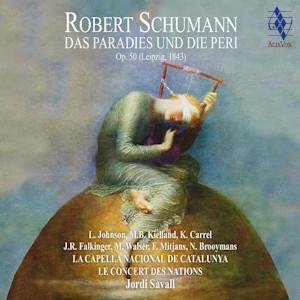
Robert Schumann (1810-1856)
Das Paradis und die Peri Op 50 for soloists, choir and orchestra
Lina Johnson (soprano), Johanna Falke Rosiger (soprano), Marianne Beate Kielland (mezzo-soprano), Kieran Carrel (tenor 1), Ferran Mitjans (tenor 2), Manuel Walser (baritone), Nichola Brooymans (bass).
La Capella Nacional de Cataluña
Le Concert Des Nations/Jordi Savall
rec. 2025 The Church of Sant Vicenç of Cardona
Alia Vox AVSA9968 SACD [99]
Das Paradis und die Peri is a secular oratorio composed by Schumann in 1843 (and therefore his Opus 50) which is regarded as one of his finest choral works. Written for soloists, choir and orchestra the story comes from a translation of a fairy story by the Irish poet Thomas Moore, translated into German by Schumann and his friend Emil Flechsig. The simple story tells of the Peri’s attempts to get into heaven, having been expelled from Paradise. She can do this only by offering a gift that is ‘most dear to heaven’. Having failed with her first two offerings of a hero’s death and a vision of selfless love, the Peri eventually succeeds when she brings to the gates of heaven the tear of a repentant man who has been moved by the sight of a child praying. Schumann’s biographer Peter Ostmann in Schumann: The Inner Voices of a Musical Genius reports how, when writing Das Paradis und die Peri confided to a friend how he heard an intermittent voice which said ‘what you are writing is not in vain’. This was a work which even attracted Wagner’s praise
Although it was regarded as a fine achievement, the work has probably been held back by its flowery libretto which is steeped in the popular orientalism at the time. Such trends can of course disappear as quickly as they have arrived, and this ninety-minute-plus work is certainly full of beautiful music. Schumann himself conducted the first performance in 1843 and it is shot through with recognisably Schumannesque themes and musical ideas, including many references to one of his greatest and most popular works, and another fairy work, A Midsummer Night’s Dream. It is often tender and careful, never more so than in the music given to the Peri and her lover. One small word of warning, however: if you choose to follow the libretto, very well set out by Alia Vox with the English text to the right of the German original, you may soon be put off by the excessively flowery text which would surely complement a whole mawkish range of Victorian flower faeries. Given that too close a viewing of both texts can make you sideline the music, it makes more sense to read the synopsis and keep that in your head so that you can enjoy it.
Speaking to his friend the musicologist and writer Eduard Krüger, Schumann was clearly very excited about this new work: “I am currently working on a major work, the largest I have ever undertaken; it is not an opera; I almost consider it a new genre for the concert hall. I plan to devote all my energy to it and finish it this year. It is an oratorio, not a religious one, but a secular one.” It was quite in keeping for Schumann to do something like this, as his musical life could often be dominated by his working extensively in a single genre. The greatest example of this had been his year of song in 1840, when, having laid down obstacle after obstacle to the future happiness of his daughter Klara and his would-be son-in-law, Robert Schumann, the latter’s teacher, Friedrich Wieck, finally consented to the marriage. In an astonishing outpouring of love for Klara, Robert composed in that single year no fewer than 136 of the 236 songs he wrote, including the tenderest cycle of all, Frauenliebe und Leben.By contrast ,1842 became known as his year of chamber music, when he composed the Three String Quartets, Opus 41, the sublime Opus 44 Piano Quintet, the equally fine Opus 47 Piano Quartet and the Fantasy for Piano, Violin and Cello, Opus 88. Having been consumed by both song and small orchestral works, it must have been both a challenge and a joy to put together all he had learned tin a secular work. As he said to Krüger, “I want to write a piece for happy people, not for a place of prayer.”He had also expressed great admiration for his friend Mendelssohn’s Die Erste Walpurgisnacht, which had premiered in February 1843. At more or less the same time, Schumann, who rarely did anything by halves, produced Das Paradis und die Peri between late February and mid-June. Clara considered it “the finest thing he has done so far, but he is throwing himself into it heart and soul, and with such intensity that I sometimes fear he might fall ill.”
Which brings us to the piece itself and this fine new recording by the experienced and generous Jordi Savall, La Capella De Catalunya and Le Concert De Nations. There have been quite a few recordings, one or two of them significant, including those by Nicholas Hanoncourt, John Eliot Gardiner and Simon Rattle. Any recording stands and falls not just by the standard of the orchestra, choir and soloists, but by how they combine. In this recording, the ensemble is fine throughout and the soloists are almost the icing on the cake.Marianne Beate Kiellanddoes a very fine job in the moving part of the angel, but is up against some stiff competition against two superb performances by Bernarda Fink for Harnoncourt and Rattle. It is a more difficult choice between candidates for the vital central role of the Peri. IfBarbara Bonneyis a little too ‘showy’, despite everything else vocally being fine, then Dorothea Röschmannis near faultless in the Peri role.
Indeed, a recording stands and falls by its Peri. The singer has to combine innocence, integrity, pity and wisdom, and of course there is a certain sort of soprano whose voice suits the role. Happily, the bright-voiced Norwegian soprano Lina Johnsonis one of them, her clear and clean voice conveying the picture of innocence tempered by wisdom. Her outburst of joy at the very end is positively life-affirming. She puts all she has into the part and the fine tenor Kieran Carrel matches her with his youthful, ardent and impassioned voice. Manuel Walser also has an especially fine baritone, at times reminiscent of Peter Mattei.
One small criticism I have is of the second soprano, Johanna Rosa Falkingerf, who occasionally inclines towards both the shrill and the slightly out of tune. The Catalan choir is quite splendid, certainly the first I’ve heard and I hope not the last. All in all, this is a real aural and artistic treat from Jordi Savall, but I advise you to give more time to the music than the libretto.
Stephen John Wray Gladwin
Buying this recording via the link below generates revenue for MWI, which helps the site remain free













