
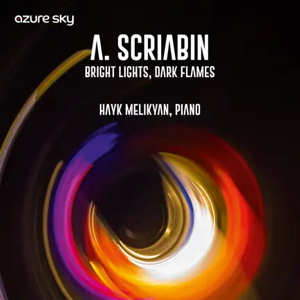
Alexander Scriabin (1872-1915)
Bright Lights, Dark Flames
Hayk Melikyan (piano)
rec. 2025, Komitas Museum-Institute, Yerevan, Armenia
Azure Sky Records AZ1030 [77]
In this collection of Scriabin’s piano works from throughout his years of composition for that instrument, the pianist Hayk Melikyan has sought to present what he calls a ‘multi-coloured Scriabin spectrum’. As Scriabin regarded his art and his life as part and parcel of each other, this is more appropriate than usual. His music for piano began with him as the post-Romantic inheritor of Chopin’s crown and soon evolved into something much more spiritual and, later, strange. At the heart of his music is the ancient dictum of self-knowledge or gnosis, where in order to understand the art you produce, you need to more fully know the you that is producing it. Sometimes, when you understand the art, but not necessarily the self, the results can end up being purely ego-driven, if brilliant, such as the works of Richard Wagner. The opposite is when an artist draws into himself too fully, resulting in the music consuming them to the detriment of their health. In the end, if they’re not careful, the shell of the man is all that remains and the art becomes everything else. Without it and maybe without the urgency of its creation, there is only a profound loss, which can eventually tip the artist into madness, like Schumann, or suicide, like Tchaikovsky. Another sad example of this was the poet John Clare, who, it would appear, needed to write about his experiences in order to live happily, either suppressing or releasing a poetic urge, which was all subsumed by an eventually disastrous fame.
This might seem an odd and rather inward way to begin a review of a new CD of Scriabin piano music, but his own journey and difficulties are well-known, not to mention his later mental deterioration. He was an artist who lived too close to the mystic and spiritual edge for his mind not to eventually give into it. How different it might all have been, however, if some ill-advised and over-zealous practice had not led to a permanent injury to his right hand, which despite the attention and manipulation of various doctors effectively put paid to his concert career. That was in 1888, at the age of twenty-one, four years after having been admitted to the Moscow Conservatory. Although he graduated in 1894, such was the deterioration in his relationship with Professor Anton Arensky, that he never received his composition diploma.
However, a piece of good luck to balance the bad was on its way when Scriabin caught the attention and interest of the famous patron Mitrofan Belyayev, who became his protector. From then on, there was no barrier to the publication of his work. That was a good job, too, as he had been gathering his youthful compositions for some time in several different genres, but with a particular leaning towards the piano and symphonic music which he would become renowned for.
Before talking about the recital, I need to warn you about the accompanying booklet. For some reason Elen Yachin provides an appropriate biographical run-up to the music and then carefully explains the musical character and layout of each piece, ranging from Scriabin’s first Waltz in 1885 right through to the Five Preludes of 1914. She also looks forward to connections in Scriabin’s symphonic work, such as The Poem of Ecstasy Unfortunately – and I can’t remember ever before having seen this – she goes on to describe how Hayk Melikyan plays every single piece. This is not just cursory either, but a detailed analysis weighted heavily to the successful way in which he performs each. For a reviewer with a limited hearing of some of these pieces, it is a nightmare to see all this while waiting to form your own opinion. Fortunately, this can be solved by reading all of this after a first listen. Problem solved, but still an odd choice.
There is a point halfway through this recital where everything seems to change abruptly and the early lyrical Scriabin we have been hearing from works between 1885-1895 feels rather as if it has been shoved out of the way. This piece of mature Scriabin is the first of the Deux Poèmes Op 32. For those who don’t know the three phases of Scriabin’s work, it may come as a bit of a shock. From the early and almost tender pieces, such as the Valse Op1 in F minor, and the short and gently harmonic Trois Morceaux Op 2, the light and hope fall away. Not, however, all at once, for the pianist Hayk Melikyan has chosen his programme carefully, so that it doesn’t just present simply a stolid Scriabin pianistic history, but almost teases what is to come, before returning to a more gradual ascent into the mystic and discordant. Elen Yachin, in those extensive booklet notes describes the advent of this second Scriabin as mystic, chromatic, and pianistically free. The word free is what matters here, because much of what follows seems to have lost the restraint it had in its pretty post-Chopin phase (and bear in mind that it was Chopin who Scriabin originally most wanted to emulate) As you become used to this new sound world, you realise what an appropriate word that is, but you can only wonder what is lost in what has been gained. Much of this later music combines mysticism and spirituality, a side which was incredibly strong in Scriabin the Theosophist, but there is a sadness and melancholy creeping in. What has been more of an undercurrent leaps in when Melikyan plays the twenty sixth track on the CD, the Piano Sonata No 9 Opus 68. This was written a full nine years after the Two Poems Opus 32, and the early rumblings have become nihilistic and apocalyptic reality. Not for nothing is it called The Black Mass and indeed the impression is at times reminiscent of a horror film score.
Melikyan has the full measure of this sonata, and leaves you wanting to hear him play others, while at the same time wanting to veer away from its bleakness, which is unrelenting, especially in a bitter finale, which remains jagged, as well as unresolved. This journey of early lyricism and gradual descent into darkness is so effectively covered in the approach and choices of the pianist. Seeking to educate an audience who may not be aware of a composer’s music, any musician places quite a responsibility on their shoulders, and Hayk Melikyan gets the balance right here. It would have been a challenging task to record most or all of the sonatas as Stephen Hough and Vladimir Ashkenazy have done respectively. However, I can’t help thinking that Hayk Melikyan also chose his title carefully. Bright Lights, Dark Flame reflects the journey the listener takes from that early waltz, to the first poem of Opus 32, and a final glimpse into the Dark Angel sonata.
It should go without saying now that Hayk Melikyan is equal to every part of that journey, alternating skips and leaps of joy in the shorter preludes and morceaux before brooding with the dark, longer pieces, but always with the sense that he is willing to be part of the music, in the orchestra, rather than at a conductor’s distance. He is a widely respected pianist, particularly in the music of the twentieth century and more modern composers. On the back of the CD, Hayk Melikyan’s musical tribute to a much-admired composer is described as deeply personal, and so this is. With playing that truly draws you into both the more lyrical and dissonant worlds of a notoriously difficult composer, this is a journey well worth taking.
Steve Gladwin
Buying this recording via the link below generates revenue for MWI, which helps the site remain free
Contents
Valse Op.1 in F Minor
Trois Morceaux Op.2
Deux Morceaux pour le main gauche
Cinq Préludes op.16
Deux Préludes op.27
Deux Poèmes op.32
Trois Morceaux op.45
Trois Morceaux op.52
Deux Morceaux op.57
Deux Poèmes op.63
Sonata No.9 op68
Deux Poèmes op.71
Deux Danses op.73
Cinq Préludes op.74













