
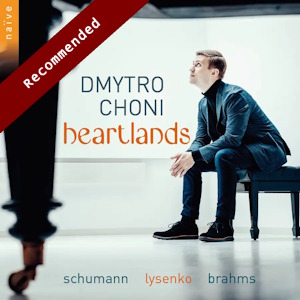
Dmytro Choni (piano)
Heartlands
Robert Schumann (1810-1856)
Piano Sonata No.2 in G minor (1833-1835)
Novelette in F sharp minor, Op.21 No.8 (1838)
Mykola Lysenko (1842-1912)
Rhapsody on Ukrainian Themes, Op.18 No.2 “Dumka-Shumka” (1877)
Rêverie: Visions of the Past, Op.13
Johannes Brahms (1833-1897)
Two Rhapsodies, Op.79 (1879)
Vier Klavierstucke, Op.119 (1893)
rec. 2025, Tonzauber, Casino Baumgarten, Vienna
Naïve V9092 [73]
Dmytro Choni won the bronze medal at the Van Cliburn International Piano Competition in 2022. If the judges decided he should win only third prize, then I suggest the standard was unusually high. He also won fourth prize at the Leeds Competition in 2021. This disc is simply magnificent, and it should win him many admirers.
Schumann’s Second Sonata receives a performance of passion and urgency in the fast movements. Schumann marks the opening “as fast as possible”, but no matter how the pianist interprets it, one should not feel that they have lost control. Choni does not allow the music to run away from him. In the Andantino slow movement, he is tender and heartfelt in a basically simple approach; more rubato, I feel, would be undesirable. The brief scherzo is ideally played, as is the Presto finale. Its turbulence is interrupted by the heart-stopping melody which Schumann would later quote towards the end of the first movement of his Cello Concerto. Altogether, Choni has Schumann’s essential passion, tenderness, impetuosity and mercurial quality well under his belt.
The term “Novelette” suggests a miniature, but the one recorded here, among a set of eight in Op.21, lasts for nearly twelve minutes. It is glorious, with as many mood changes as some of Schumann’s longer sequences. Progressive tonality is another forward-looking feature of the piece, which begins in F sharp minor and ends in D major. Choni captures the fluctuating moods with authority – no mean feat in a piece difficult to successfully bring off.
The Ukrainian composer Mykola Lysenko’s works include the opera Taras Bulba, a string quartet, cantatas and a quantity of music for piano. His Second Rhapsody on Ukrainian Themes is a most attractive, colourful work; one could not wish for a finer performance. The Rêverie which follows is, unsurprisingly, more dreamy and reflective.
Choni admirably conveys the heroic character of Brahms’s Rhapsodies Op.79. His original reading of the G minor piece reveals the reflective and mysterious qualities more than the muscular. In the B minor piece, the beautifully handled rubato genuinely enhances the character, rather than seeming “stuck on”.
In the second piece in Brahms’s Op.119, Choni observes the Andantino un poco agitato tempo marking, with perhaps more of the agitato than many pianists. The transformation into a waltz is beautifully handled. In the third piece, marked Grazioso e giocoso, he plays the rapid arpeggios with an effortless lightness. The concluding Rhapsody has passages in fine contrast with heroism.
The pianist brings it all to life splendidly – definitely a name to follow. The recorded sound is on the harsh side but this does not obscure an enthusiastic recommendation. The brief CD notes are almost exclusively concerned with Lysenko.
Philip Borg-Wheeler
Buying this recording via the link below generates revenue for MWI, which helps the site remain free













