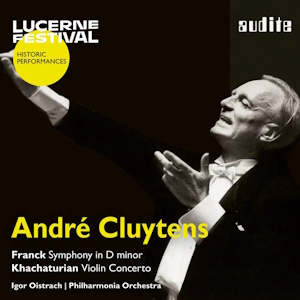
César Franck (1822-1890)
Symphony in D minor
Aram Khachaturian (1903-1978)
Violin Concerto in D minor
Igor Oistrakh (violin)
Philharmonia Orchestra/Andrè Cluytens
rec. live, Lucerne Festival
Audite 97.846 [71]
There are pieces that brood in the classical world. Many of these do so magnificently at the beginning and return intermittently to that brooding as if to remind you that it is a brooding piece in the first place. How they carry it off, however, is a different matter, and with Cesar Franck’s symphony in D minor, you need to judge the opening correctly, or you compromise the momentum of all that follows. Andrè Clytens, in this recording with the Philharmonia Orchestra from the Lucerne Festival in 1954 gets this and everything else right. Yes, I will lay my cards on the table and say that this CD was, and is a complete joy for me. The matching of two D minor works which brood in completely different ways; one, an ongoing but intermittently interrupted brood that leads to a magnificent climax, and the other a mood that shifts and slithers like the brooding opening of a film noire, before it settles down into a poignant elegiac beauty, finished off with the joyful ebullience of a village dance.
The Symphony in D minor by César Franck is his only symphony, but despite its on and off reputation, there are still over 70 recordings of it. The most famous of these recording is the 1961 one from Pierre Monteux with the Chicago Symphony Orchestra. Franck completed the symphony on August 22, 1888 and it was premiered on 17 February 1889 under the conductor Jules Garcin and dedicated to his pupil, Henri Duparc.
In contrast, the Khachaturian Violin Concerto, played here by the dedicatee David Oistrakh’s son, Igor was composed in 1940 by Aram Khachaturian during two months at his summer house as he eagerly waited for the birth of his child. It was wildly acclaimed and won him the Stalin prize, praised for its lyricism, forward motion and successful interpretation of peasant themes. The premier, conducted by Alexander Gauk with the USSR Symphony Orchestra was on November 16th of the same year in the Tchaikovsky Hall. Among the many luminaries that attended were composers Myaskovsky, Prokofiev and Shostakovich, and the young violinist in waiting Leonid Kogan.
Let’s return to the first work and explore just what makes both the symphony and this performance so magnificent. Of course, it’s the slow lento of the first movement that sets the scene for everything that follows. This piece begins, develops and re-states its themes, briefly touching on a gleam through the clouds before the magnificent central theme re-states itself in a totally uncompromising manner, leading to a similar sign-off.
Equally the initial gentle dance-like allegretto of the second movement doesn’t allow the listener long to enjoy its subtlety before the orchestra returns to something like the dark gloom of the first movement, with short wind and brass signatures heralding a more nervous shifting theme from the strings. The Cor anglais sings gently above them and the flutes occasionally mimic their slithering.
The final movement also begins in a gentle upbeat with the strings and wind beautifully hushed. The lovely themes as more instruments group in a rise and fall, sometimes seem to reach a climax, sometimes all but inaudible. It only remains for the opening theme to reassert itself in a more uncompromising manner, the gentle French folk-tune, almost bullied out by the brass. Finally, the strings take back control and sing their way out of the piece
Perhaps it takes a French conductor to understand this and tease every dynamic and last nuance from the score. All I can say is that Cluytens has this ability in spades, and continually coaxes it beautifully out of the Philharmonia, who, despite a bit of muddy live 50’s recorded sound perform splendidly.
After the full and sometimes sonorous richness of the Franck symphony, Igor Oistrakh has a lean, at times verging-on-raw sound which seems to suit the rhythms and sonorities of the other work here, Khachaturian’s Violin Concerto. To my knowledge I haven’t heard too much of him, but would certainly like to after this. Khachaturian worked extensively with native dances, rhythms and folk-songs, which Igor Oistrakh dances, and wriggles through, often hauntingly, producing a sound which would suit an east-European gypsy camp. This is immediately apparent in the second part of the first allegretto fermezza movement, where the Philharmonia back him up beautifully, complementing but never overwhelming him. In contrast to the occasional balance issue in the Franck, all seems more than well as we reach a showcase of a cadenza, before uniquely it is all but brushed aside as the piece ends in a powerful coda and a return to the D minor opening theme
Another thing I have always felt about this concerto and the first movement in particular, it that it could so easily be film music. Indeed, there are flashes of Psycho, and Bernard Hermann-like stabbing signatures. All of this falls away of course as we enter the beautiful sustained adagio, where the sense of middle European sadness is even stronger. Igor Oistrakh sustains this beautifully, his tone again lean rather than fat and full. With playing and understanding this fine he doesn’t need to over-egg the pudding. Again the orchestra’s under-stated responses are kept in the background and here again the recording comes into its own as we are held spellbound by a this glorious and gentle marriage between orchestra and soloist. As fine as both are, there is little doubt that it is Cluytens who is holding and balancing the magic.
After that hushed orchestral passage, Igor Oistrakh re-states that beautiful theme once more, and it is after he has done this that we hear the composer of Spartacus loud and clear with just a brief echo of that searingly beautiful theme.
The final movement begins with a movement like the third ‘Stalin’ movement of Shostakovich’s Tenth, only for it to be elbowed aside and for Oistrakh to emerge singing joyfully like a bird that has flown through a storm. All this time the Philharmonia wind and strings maintain that tight and lean control which complements the soloist so very well. At times you can almost sense the enjoyment of both as they seem to delight in taking turns and handing over the melody. The full joy of festive rhythms and dances is here in this allegro, as the composer must surely have intended, the opening movement’s somewhat sinister theme, shifting and nervous, eventually ending the movement far more confidently than that started.
Buy this for an occasion that was never repeated, the chance to hear the younger Oistrakh and above all for Cluytens’ legendary control of the Philharmonia.
Stephen John Wray Gladwin
Buying this recording via the link below generates revenue for MWI, which helps the site remain free