
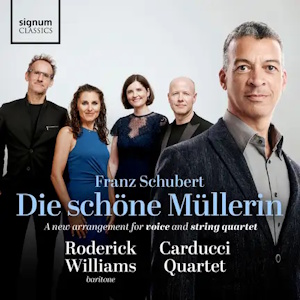
Franz Schubert (1797-1828)
Die schöne Müllerin
Roderick Williams (baritone)
Carducci Quartet
rec 2025, St John’s Upper Norwood, London, UK
Full texts and translations included.
Signum Records SIG D1003 [63]
In some ways, the collaboration between Franz Schubert and Wilhelm Müller resulting in two of Schubert’s great song cycles, Die schöne Müllerin and Winterreise,was one of unbearable tragedy. Neither the poet or the composer would live beyond 32, Müller suffering of a fatal heart-attack four years before Schubert, having held the post of Librarian of the ducal library in Dessau since 1820. By contrast, Schubert might well have composed Die schöne Müllerin while in hospital undergoing treatment for the tertiary syphilis which would ultimately kill him in 1823. It was published the following year; Winterreise, Müller’s second great cycle, which Schubert wrote in 1827, was published a year later.
One of the factors which make the early deaths of both poet and composer so tragic is that they seem to be foreshadowed in both Die schöne Müllerin and Winterreise, although their moods are very different. The first is set in spring and concerns a young man whose first love is blighted by his beloved’s love for another, and is unable to understand that getting over that is how he will grow. It is important that the singer possesses a different kind of tonal quality and approach from those needed for Winterreise, which was written with either a tenor or soprano in mind. A certain kind of baritone can carry this off too, but he needs to be able to portray the youthfulness that the two higher voices can convey so much more easily.
It is also important that this be a gentle set of poems, bitterness creeping in only in the latter section and leading directly to the young miller’s death. The wrong kind of voice can impose itself too much on the material, dominating it, rather than complementing it, sounding the wrong age already, or at worst contriving to sound the right one. If the singer is not an Ian Partridge or Ian Bostridge then, the best substitute is a light baritone, and this is where Roderick Williams fits the bill as well as anyone. In his very many recordings he has always served the text, allowing it to illuminate itself even from the distance of a foreign language, and he is not only a renowned composer in his own right with a piece performed at the coronation of King Charles III, but a bold experimenter. He has recorded Winterreise in English, with Die schöne Müllerin to come next, and before this latest recording he devoted three to a project on all of Schubert’s song cycles which introduced them to all manner of audiences outside the usual classical one. In short, if anyone is going to adapt the accompaniment of a Schubert song cycle for a string quartet in place of the piano, Roderick Williams is the man to do it. Here are a few of his own thoughts on the idea and the challenge as contained in the accompanying booklet notes:
The transcription process was fairly straightforward, in that Schubert’s piano textures contain many hints towards part writing; the cello obviously takes the bass line, and the second violin and viola often share duties in providing the harmonies. This left me with the first violin available for harmonies. It is here that I occasionally over-stepped the role of transcriber and became a fledgling composer” (by which of course he means in the context of this piece).
Die schöne Müllerin is made up of twenty songs, a few more having been shown the exit, two of them departing due to their dubious sexual politics whereby the young man indulges in the early nineteenth century version of stalking. What we are left with is the simplest of stories and because there is a clear tipping point, it’s worth repeating. The final two songs being addressed to the friendly brook, it is perhaps not surprising that in those the brook joins in, first in a ‘duet’ with the apprentice and secondly in the final and longest of the songs, Des Baches Liebeslied, a seven-minute lullaby following his death.
Until then, it has merely been a one-sided conversation with the young man playing the role of the whinging teenager who is about to have his heart broken. Everything is fine with the world. Look at that lovely green etc. However, half way through, comes the tenth song, Tränenregen, the only song in which the beloved actually appears. Like men throughout history, our hero confuses kind words with actual interest, so that “Es kommt ein Regen. Ade, ich geh nach Haus“ (It looks like rain. Goodbye; I’m going home) becomes a declaration of her love for him. Of course, the inevitable happens and he sees her looking perhaps a little too matey with the much older hunter. Having no idea how to cope, he is gradually and gently beckoned/lured into the welcoming embrace of the stream. Yes, whichever way you look at it, there is more than a hint of the sinister in his eventual fate, rather like pouring out your sorrows to an understanding counsellor, only for her to hand you the gun when you’ve finished. All of this and more has to be conveyed, but perhaps above all the sense of the his gradually becoming increasingly removed from reality.
We are used to countless performances with a singer and piano, which, after all, was what Schubert intended. The success of a new interpretation replacing that piano with a string quartet depends upon whether it achieves something both different and convincing. Added to that, is the question of whether the singer and the quartet – the excellent and at times nicely under-stated Carducci Quartet) – are individually effective and whether their marriage works at all.
Happily, here it does, but whether this is due to the ease with which Roderick Williams co-exists with his fellow musicians, it’s hard to say. It would also be interesting to hear the intended tenor or soprano singing the cycle with the same accompaniment. Roderick Williams’s diction is excellent, as ever, and he doesn’t feel the need to spit out or bite the words like Fischer Dieskau, or wail a little too much like Peter Schreier. That is no coincidence as he is a fine singing actor – as we know from his Papageno with the Royal Opera. When the words need bite or bitterness, he can more than provide that, but probably the finest factor of all in his singing is that despite the particular work, he never strays into self-pity. You keep your sympathy with the young man and his plight, which is not always the case. Of course, Schubert provides excellent guidance to the singer with his ability to change gear several times throughout the cycle, often with the plaintive following the hurtling and vice versa. At the same time, those gear changes are a positive gift for the singer and Roderick Williams takes full advantage of them.
I decided to compare Roderick Williams’s performance with two others, both by more traditional tenors: a recent release by Julian Prégardien on Harmonia Mundi B0D4H4HFNH and one from over thirty years ago with Ian Bostridge and Graham Johnson. Hyperion B000002ZFJ.The latter is part (Volume 25) of Graham Johnson’s labour of love in recording all of Schubert’s vocal music. The young Ian Bostridge is bright, clear and eager, the very epitome of the young journeyman, living in hope until those hopes are dashed. What comes over so clearly in the first two songs is all the idealistic hope. Then, halfway through, the tenth song, Tränenregen, the singer needs to gather all the vocal weaponry at his, or her disposal to convey a whole bevy of emotions. The young man’s heart is brimming over with a totally misguided happiness, while beneath him the means of his death/delivery swirls menacingly, if only he could see it. Here, and in his other two recordings with Mitsuko Uchida and live in 2019 with Saskia Giorgini on Pentatone, Ian Bostridge shows a knowledge of text and ability to deliver it which is still second to none. Julian Prégardien sounds a little bit too forceful and confident in the first two songs, although he eventually calms down and delivers what turns out to be an enlivening account.
Back to Roderick Williams, then: his problem will never be either intelligence, or his quality of singing, but rather sometimes in the daring string quartet arrangement he has saddled himself with. The playing by the Carducci Quartet – violinists Matthew Denton and Michelle Fleming, violist Eoin Schmidt-Martin and – perhaps the star of the show – cellist Emma Denton – is nearly always tight and exemplary. However, it cannot sound like a creaky old mill-wheel, as Graham Johnson can, and can only partially illustrate empathetically the downfall of a naïve young man in the way that a pianist can. For me, in this music, the partnership of singer and string quartet can never really be as satisfactory as the traditional soloist/piano combination. Again, the tenth song provides the perfect illustration. There is so much going on apart from what is in the young man’s heart and the girl’s indifference. A string quartet just rather overloads on something that an instrument like the piano, which can replicate a whole orchestra, can pitch just perfectly. Too often, the result in this recording ends up seeming sedate or even genteel. All this is rather a shame, but that shouldn’t put you off this recording’s excellent qualities – specifically, another very fine and convincing performance from Roderick Williams.
Stephen John Wray Gladwin
Other review: John Quinn
Buying this recording via the link below generates revenue for MWI, which helps the site remain free













