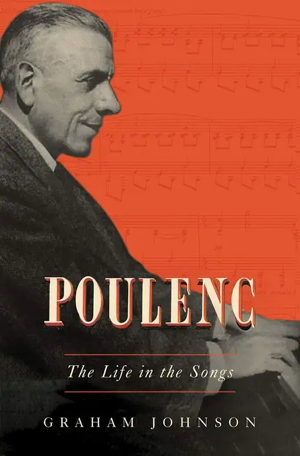
Poulenc: The Life in the Songs
by Graham Johnson
Published 2020
576 pages, hard cover
ISBN: 978-1-6314-9523-6
Liveright
Although Francis Poulenc died only in 1963, which is practically last Tuesday in the world of classical music, I have to admit that I knew about as much about his life as I do about some of those obscure Renaissance composers. Before picking up this book by pianist and scholar Graham Johnson, I would have been able to say, “Oh, Poulenc: Parisian, member of Les Six, probably gay, writer of excellent vocal music,” but that would have been the full extent of my knowledge. I’ve always loved the Dialogues des Carmélites, the Gloria, and the Figure Humaine, but I never gave much thought to the biography of their composer.
So when I happened to see Johnson’s extensive biography of Poulenc on a library shelf, my curiosity was piqued. 576 pages is a hefty size for a volume, and I am always on the lookout for ways to deepen my appreciation for a great composer. That, I suppose, is a crucial point. I read this book as a casual enjoyer of Poulenc – singers, pianists, and committed Lieder enthusiasts might find different facets of this book either valuable or problematic. I’m not sure. But for the rest of us, I can say that this book really does bring Poulenc to life in all his complexity, even if I found some aspects of the structure a bit unusual or underdeveloped.
I did not make the connection at first (but should have done) that Graham Johnson, the author, is the Lieder accompanist. In fact, he is “…the finest living accompanist,” writes Kevin Sutton (review), who goes on to heap up the commendations by calling him “certainly the most interesting and well-read commentator on the great body of song literature in the world.” Similar praise can be found in his set of the complete Poulenc songs on Hyperion (review), which I am going to describe as an essential complement to this volume. Writing about this four-CD set, Simon Thompson points out that Johnson’s booklet notes “amount to a book about Poulenc’s songs that would deserve a place on any library shelf.”
This is that book, in print seven years after the release of those recordings. I don’t have the booklet, so I cannot attest to any change or evolution in Johnson’s thinking, but I suspect the greater space afforded him here must allow for an expansion of his ideas.
Johnson’s thesis, at its most basic, is that Poulenc has been underrated and written off due to a persona cultivated in part by the composer himself. Poulenc presented himself as “frank and uncomplicated” (xiv), someone who wrote charming but trivial music in an easy, natural way. Not so, argues Johnson: “What it cost Poulenc to create his life’s work has always been underestimated” (ibid). He makes a comparison here with Robert Schumann. I believe this is a somewhat similar line to the one taken by Roger Nichols, who published a Poulenc biography almost simultaneously with Johnson (review).
Johnson has taken on a formidable challenge. It is no accident that I, and many other listeners, have found Poulenc a rather cryptic figure: he left behind no diary, for a start. In fact, he kept one, but destroyed it in 1937 due to “unkind things” he had said about Albert Roussel (91), so we must rely on his copious letters to friends, family, and others. The well-chosen quotations from Poulenc constitute one of the real delights of reading this book. As for their reliability, well, Poulenc was a true raconteur who “shaped and reshaped the contours of his life” (469) through embellished re-tellings. My impression of Poulenc, after finishing this book, is of someone who really preferred that he not be known. One example of this is his work ethic. Although he tried to give the impression of an “elegantly lazy” composer, Johnson has unearthed a punishingly intense schedule of concerts and travel (487).
The structure of Johnson’s book is unusual. After a brief introduction, we go decade by decade through Poulenc’s life, beginning with an extensive timeline (sometimes around two pages per year). Occasionally, Johnson throws in a significant event in European history that does not relate immediately to Poulenc but helps to contextualise the state of the world at the time. On the one hand, I could have done with a few more of these, but, on the other hand, Johnson compellingly argues that Poulenc was rather disinterested in politics and kept himself insulated from the world at large. After we’ve gone through a decade, we then go back through those years a second time in terms of the songs Poulenc wrote.
Texts are provided for each one, as well as translations by Jeremy Sams, and Johnson’s analysis follows. Sams’s translations are readable, smart, and take into account Poulenc’s love of French wordplay and “aural dislocations” (141–2), as Johnson calls them. The volume ends with a few short thematic essays (473–498), extensive notes (499–522), a brief bibliography (523–4), and two indices (one for song titles, one for names, 529–554).
I’d like to say I found this idea effective, but it has its drawbacks. I found that I really had to read this book in decade-sized chunks at a time; otherwise, the “double chronology” system would confuse me. I also think that there could have been a more obvious system for presenting important biographical moments. Sometimes the timelines would slip into a more narrative mode, and sometimes a song would prompt Johnson to develop a theme in Poulenc’s life instead. There is a chronological list of non-song compositions, but these are kept to the “song” sections, not the timeline sections, which I feel would have been the more obvious choice. Then there are inset biographies of some of the prominent poets set by Poulenc, but these do not necessarily appear when Poulenc first sets their verses. If I had to criticise the book, I would say all of this is enough to very slightly confuse a reader and render them hazy on strict chronology. A second consideration: Were decades necessarily the right periodisation for Poulenc? There is one point where, in the middle of the 1950s, Johnson argues that we have entered a new and distinct epoch in Poulenc’s life and oeuvre. Perhaps the chapter divisions could have reflected the organic phases of his career?
Minor quibbles aside, everything else in this book is a massive success. We move very quickly through Poulenc’s early life, through his military duty in the First World War (17), to his early works composed in the milieu of Jean Cocteau and Guillaume Apollinaire. His relationship with the latter writer is compared to the way Schumann set Heinrich Heine (25–30). In 1920, Les Six are formed, and we get several different attempts by Poulenc to establish his musical identity: the classicising Ronsard songs (50–58) and the explicitly sexual Galliards (59–67) form an interesting contrast. Towards the end of the ‘20s, Poulenc confides in the great Polish harpsichordist Wanda Landowska about his sexuality. She urges him to be happy and live his life (47–49) and we enter into a remarkably productive phase of Poulenc’s life (77): the 1930s.
In 1931, Poulenc meets Raymond Destouches, one of the men with whom he forms a long-term partnership, and he sets about producing piano music to help recover from the stock market crash of 1929 (79). Despite giving the impression of someone who had a lot of money and could spend it generously, Poulenc was constantly stressed about finances (485-6) and even wrote to his publisher, “I’m a bit of a bore about money, aren’t I?” (119).
Hier, composed in 1931, is the “first real signpost” (101) of Poulenc’s mature style for Johnson. But it is Tel Jour Telle Nuit in 1937 that is his most famous song. Johnson relates a charming story in which Poulenc throws the first draft into the fire and announces, “Don’t worry, you will have something much better by February.” (152–3). This is also the time when his interest in religion really emerges, driven in part by the choral music he wrote after his father’s death. (91, 158).
The middle part of Poulenc’s career coincides with the tumultuous rise of fascism in Germany and Italy, and indeed he spent World War II in Paris. As such, it is unsurprising that there has been a lot of interest in Poulenc’s politics. The conventional view sees him almost as a member of the French resistance (486–7). It seems likely that Poulenc would have been a leftist: gay, associated with poets like Éluard (a communist) – but no, Johnson points out that Poulenc was rather conservative. Not a fan of Hitler, but pro-Clemenceau (88, 271-2).
Johnson does not shy away from the less attractive aspects of Poulenc’s personality. He was a hypochondriac (352) with an intense drive to people-please: “cloying and precious with an undercurrent of panic,” said John H Griffin (385). Johnson connects this, not unreasonably, to Poulenc’s sense of shame over his sexuality (488–92). Here and throughout, I have to say that I admire Johnson’s compassionate tone. Some biographies are written to knock down sacred cows, but not this one. Johnson is a Poulenc defender. He does not write from a neutral academic standpoint either, he will very occasionally, tactfully, interject a personal memory or experience of his own.
I found this obvious love of Poulenc’s music entirely endearing. Johnson’s book is not a specialist monograph on the 160-odd songs of Francis Poulenc. It is an attempt to bring Poulenc to life by examining the genre in which he took the most pride. For me, the book did exactly that, and I finished with admiration for both Francis Poulenc and Graham Johnson.
Aidan Gray
Buying this book via the link below generates revenue for MWI, which helps the site remain free