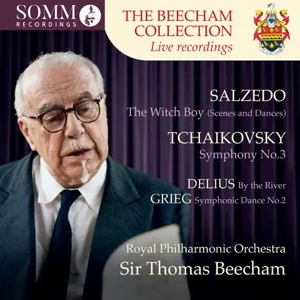
Frederick Delius (1862-1934)
Florida Suite: By the River (1887)
Edvard Grieg (1843-1907)
Symphonic Dance: Allegretto grazioso, Op.64 No.2 (1896-1897)
Leonard Salzedo (1921-2000)
The Witch Boy: scenes and dances from the ballet (1956)
Pyotr Ilyich Tchaikovsky (1840-1893)
Symphony No.3 in D major, Op.29 ‘Polish’ (1875)
Royal Philharmonic Orchestra/Sir Thomas Beecham
rec. 26 October 1954 (Grieg), 14 November 1959 (Salzedo, Tchaikovsky), 24 April 1960 (Delius), Royal Festival Hall, London, UK
The Beecham Collection, live recordings
SOMM Recordings SommBeecham 36 [76]
Over the years, Somm have been stalwart supporters of the back-catalogue of Sir Thomas Beecham. Their Beecham Collection, a genuine treasure-trove, comprises over thirty discs of live, rare, previously unreleased recordings. This disc, numbered 36, is of historical significance, since it includes some of Beecham’s last performances at London’s Royal Festival Hall. The Delius excerpt is from the very last concert – his 92nd according to Wikipedia – on April 24th 1960.
It is that Delius work, By the River –the second movement of his Florida Suite – that opens this disc. Beecham’s name is naturally synonymous with Delius. It can be reasonably argued that his editing and passionate promotion of the music ensured that Delius’s work remained well-known in the decades after his death. Beecham made a famous and enduring early stereo recording of the Florida Suite. It was recorded in 1956 but seems not to have been released until just a few months before this concert. Perhaps the inclusion of a single movement here was promotional? As just five-minute excerpts, this and the 1954 performance of Grieg’s one Symphonic Dance fall into the category of Beecham “Lollipops”.
As Delius’s first major work for full orchestra, Florida suite as a whole is remarkably successful, although I personally prefer other individual movements. The 1956 recording has hardly been out of the catalogue in the past 70 years, and it still sounds remarkably good. Perhaps that version is too imprinted on me: it is a full two minutes slower than Beecham’s at the RFH just four years later. To be fair, in isolation the quicker performance does not sound rushed, and the famous woodwind of the Royal Philharmonic are reliably fine. Yet somehow the extra languor and warmth of the studio recording surely conjure even more magically a sultry evening by a slow-flowing river. Clearly though – age has not wearied Sir Thomas!
The original recordings on this disc, taped privately with previously installed BBC microphones, were not intended for broadcast. The usual quick compliment here to Lani Spahr’s remarkable audio restoration skills, on display throughout this disc with its three different concert dates. There is an impressive uniformity to the sound. Yes, these are mono recordings and the sound – especially in the strings – is a little edgier than modern ears are used to. But the key is a very stable pitch and sound picture to which the listener’s ear very quickly adapts.
I have to say that – apart from his Delius and a handful of other “Gramophone Classics” – I am no expert on Beecham’s discography. But even a cursory first listen to this programme reveals a range of characteristics which explain the success in his lifetime, and his enduring fame up until today. Every piece on this disc exhibits Beecham’s subtly elastic control of phrase and tempo. I am sure this is a reflection of his long involvement in the opera house, so he moulds melodic lines with a lyrical singer’s sensibility. He brings the same level of detail and care to a five-minute lollipop and to a forty-minute symphony. Grieg’s Symphonic Dance here is marked “grazioso” – grace and elegance are exactly what Beecham brings to this work. On a purely personal level, I bemoan the fact that orchestras seem to have ghettoised this type of repertoire, saving it only for “Summer Pops” concerts. Hard is the heart not touched by the melodic beauty and musical elegance of such a work in such a performance.
The two short pieces serve as the prelude to the two main works here, which appeared in the same programme on Saturday November 14th 1959. First up is the work that enticed me into reviewing this disc: Leonard Salzedo’s The Witch Boy, Scenes and Dances from the Ballet. This was the premiere performance of the concert suite; the stage premiere took place some three years earlier to general acclaim. It proved to be Salzedo’s most successful work. He wrote it in the middle of sixteen years he spent as a viola player in the RPO – so presumably he is playing in this performance.
According to the Salzedo website, The Witch Boy has had over 1000 performances in thirty countries, but it would struggle to be considered well-known. The only recording of the Suite is the 1971 LP on Classics for Pleasure, with the composer conducting the LPO (coupled with a brilliant version of Ibert’s much more familiar Divertissement) – and it has never made it onto CD. Salzedo belongs to that illustrious list of fine composers never to have had a single note of their music performed at the Proms. I genuinely believe this work would be instantly popular if given that performance platform or a modern recording. The Somm liner notes quote contemporary reviews of the original ballet: “storms of applause, so many curtain calls that one lost count […] a swift exciting essay in melodrama […] a notable success […] a splendid musical score”. In Beecham’s hands, the 23-minute suite proves what that 1971 recording suggested. This is instantly attractive, entertaining and effective music, scored with the skill and knowledge that a composer who is sitting “inside” an orchestra every day can produce. Look (or listen!) no further than the spontaneous and enthusiastic applause from the Festival Hall audience that breaks out after the infectious Square Dance (track 5).
Online sources offer the following synopsis. A mysterious, supernatural Witch Boy lives isolated in the mountains, detached from human society. He encounters a human village girl named Barbara Allen. They fall deeply in love, crossing the boundary between the mortal and magical worlds. A local preacher, who is also in love with Barbara, becomes consumed by jealousy and religious zealotry when he discovers her relationship with the strange creature. He whips the superstitious townsfolk into a frenzied mob who track down the Witch Boy, capture him, and brutally lynch him to “cleanse” the town. As Barbara weeps over his body, the supernatural elements of the mountains reclaim him to be reborn, leaving the guilt-ridden villagers to face the horrifying weight of what they have done.
Musically, the work has more echoes of Copland’s cowboy ballets or even Bernard Herrmann’s The Devil and Mrs Webster or Currier and Ives Suite. The birth-death-rebirth arc is hardly original. Think Arthur Bliss’s Checkmate or Adam Zero, and a kind of shared mid-Atlantic musical vernacular. This is not to suggest that Salzedo does not have his own voice – he most certainly does.
The opening Introduction is murkily atmospheric. The souring of the Square Dance from innocent good nature to aggressive violence is brilliantly judged dramatically, and executed musically with considerable skill. Beecham and the RPO predictably revel in the illustrative and colourful character of the score. Perhaps a couple of times the syncopations and sharply defined rhythms just catch the ensemble out. Yet the whole is performed with tremendous gusto and impact. Beecham, the man of the theatre, knows how to extract maximum effect form this kind of score. For Salzedo fans such as myself, eager to grab onto any “new” music, there is extra interest: this performance includes a couple of minutes of music not present in the 1971 release. These are tantalising glimpses of what the full score might offer. Online sources suggests that the complete ballet lasts around 35 minutes – surely a gift for an enterprising recording company…
I have come to this disc for Salzedo, but I am very glad I stayed for Tchaikovsky. As I said, I am no Beecham expert, so I really did not know what quite to expect from this recording. What it does get is a sharply characterised, very exciting performance. The dynamism exhibited here would be impressive in any circumstance but it is genuinely remarkable in the hands of a conductor who had turned 80 some six months earlier. He galvanises the orchestra into really fine and committed playing. Nigel Simeone’s liner notes point out that Beecham had been conducting this work for decades. More entertainingly, they reproduces the very sniffy contemporary critical responses to the work itself. To this day Tchaikovsky’s symphonies are criticised for being “formally weak”. Within that general critique, the Symphony No.3 ‘The Polish’ is often dismissed as the worst of a bad bunch. The Daily Telegraph critic considered it “hardly more than a suite of ballet movements”. To which the reply must surely be “and what’s the problem with that?!” In fact, it is precisely because Beecham recognises characteristics of Tchaikovsky’s writing as strengths not weaknesses that this performance succeeds.
I think that Beecham’s long years in the theatre pit again help enormously. Most of Tchaikovsky’s remarkable melodies do seem to spring from song or dance. Beecham has a remarkable skill at shaping these melodies with the most natural sense of ebb and flow. The old-school Soviet conductors could make these scores completely thrilling by the sheer drama and cut-and-thrust of the playing, not that the RPO give technically much, if anything, to those kind of performances. The finale in particular absolutely bristles with attitude and character, and brings the works to a storming conclusion; I am not sure,mind, if many dancers would be performing a Polonaise at this tempo.
I have to say that this symphony is probably the one I engage with least, but I am not sure I have ever heard a performance that I have found so convincing. The cheer from the Festival Hall audience would seem to support that view. I do find it interesting that both here and in the Delius performance Beecham was clearly energised by the presence of an audience. He produced distinctly individual yet convincing interpretations that even at the end of a long and very distinguished career do not fall into any kind of routine.
As usual, Somm have produced an excellent disc. Well presented and superbly restored audio captures music-making on the wing of real stature.
Nick Barnard
Previous review: Jonathan Woolf
Buying this recording via the link below generates revenue for MWI, which helps the site remain free