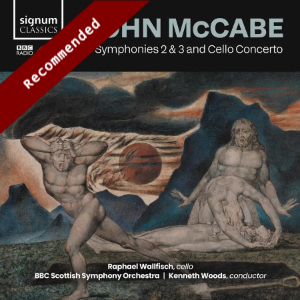
John McCabe (1939-2015)
Symphony No. 2 (1971)
Cello Concerto, ‘Songline’ (2007)
Symphony No. 3, ‘Hommages’ (1978)
Raphael Wallfisch (cello)
BBC Scottish Symphony Orchestra/Kenneth Woods
rec. 2025, City Halls, Glasgow
Signum SIGCD1007 [77]
John McCabe’s Second Symphony runs for some 25 minutes, its five movements (fast – slow – fast – slow – fast) played without a break. The musical language employed is advanced, with an extensive but controlled use of dissonance. The three fast movements are characterised by strong rhythmic drive, to which the two slow ones provide important contrast. McCabe calls on a large orchestra that includes a piano, an oboe d’amore, and a large selection of percussion instruments, but one of the many striking aspects of the work is the extreme imagination and economy with which he deploys these forces. Musical material is frequently passed from one group of instruments to another, and throughout the work the orchestration is luminous and transparent, even in the most forceful passages. The opening gesture from the three flutes returns briefly at the end of the work to provide a surprisingly abrupt close after a fearsome climax. Much of the work is played at a low dynamic level, throwing the more powerful passages into sharp relief. Guy Rickards, in a fine booklet note, reminds us of the composer’s assertion that the ‘main impulse behind the work’ was provided by Sam Peckinpah’s film The Wild Bunch. This is strange. McCabe is quoted as referring to the film’s musical shape, ‘with an exposition, lengthy development, and recapitulation’. In respect of the film’s extreme violence – unremarkable now! – he felt that this was ‘overstressed by critics at the time’. Reading between the lines I would say that Rickards is only marginally convinced by McCabe’s Peckinpah references, but Monica McCabe, the composer’s widow, in a short introductory note, takes the view that the work ‘concerns itself with mankind’s recurring cycles of unthinking and unchanging violence, as exemplified here through … The Wild Bunch.’ She acknowledges, though, that this is only her personal view, and that ‘We can all have our differing interpretations.’ For my part, not having seen the film for many years, and only now making my acquaintance with the symphony, I can perceive no parallel between the symphony and Peckinpah’s film. Nor does the symphony strike me as concerning itself with violence. What I can say is that the work adheres closely to my own notion of what a symphony should be, which is to say a coherent and formally convincing work that takes the listener on a compelling and satisfying journey.
Impressed as I am by the Second Symphony I find the Third even more striking. It is an awesome work. Writing in the score the composer gives us some explanation of the meaning of the title, ‘Hommages’. There is, firstly, overt homage to two of McCabe’s favourite composers, Nielsen and Haydn, in the form of direct quotations. You will need to know the original works very well, I think, to be able to pick them out. Then there is a second kind of homage, which he terms ‘allusion’ and ‘influence’, an example of which would be certain aspects of the orchestration having their provenance – his word – in the music of Szymanowski. This, too, clearly represents something very personal for McCabe, but which it is not immediately apparent to this particular listener. And the idea of homage doesn’t end there, as McCabe refers to ‘the continued fascination of tonality’; ‘ this symphony’, he tells us, ‘being organised on a rigorous scheme of tonalities’. Rickards points out that the work opens and closes in the key of E, but listeners will not be surprised to know that the music rarely settles for more than an instant in any readily perceived tonality. I would not like to try and trace the composer’s ‘rigorous scheme’, but his mastery of his material is surely behind the profound satisfaction and ‘rightness’ that the music communicates to the listener. Again the work’s three movements are played without a break, the opening movement beginning, as it were, in mid-sentence, with no preparatory material at all. If there are fleeting moments when the music brings Tippett to mind – I found this in the slow movement of the Second Symphony too – they may also be acts of homage. And is there another? At 2.15 in the second movement there is a tiny fragment of melody that could almost be a direct quote from the slow movement of Walton’s First Symphony. Instrumental textures are highly complex: there is always something happening, and again the composer frequently passes material from one instrumental block to another, rarely using the full orchestra, though when he does the effect is seismic. The word can easily be applied to the long crescendo that seems to be leading us to the close, the music more and more angry. But then suddenly there is a percussion-led diminuendo of rattling rhythms and textures, a stunning example of a fertile aural imagination.
As if two magnificent symphonies were not enough the programme is completed by McCabe’s superb Cello Concerto, ‘Songline’. McCabe explains the thinking behind this title in a detailed preface in the score. ‘The Songlines are the invisible pathways of the Australian aboriginals, routes that they sing into life, naming or relating to everything they see or encounter. These are both physical ways that they walk, during which process every feature of the landscape also has some tribal or mythical significance, and also psychological routes by which they trace their culture. Bruce Chatwin’s memorable book The Songlines vividly conveys the various meaning of these routes. It has for a long time seemed to me that we all do something like this anyway, when we travel anywhere, revisit old haunts, encounter old friends, and so on, and this Cello Concerto “sings” its journey through the exploration of its material – though the use of the singular “Songline” indicates that this is just one of many possible routes through the music.’ This, then, reveals the philosophical inspiration behind the work, but as in the symphonies, seeking it out in the music will probably be not be a fruitful exercise. All three works can be fully appreciated as absolute music without any such references. One again three movements are played without a break, and the orchestra frequently employed as blocks, a feature that also helps to ensure that the solo instrument is never overwhelmed. The outer movements are primarily fast, with much use of rapid repeated notes in the cello part, and an important role for the xylophone. McCabe explains that ‘the heart of the work’ is ‘the elaborate song melody played by the cello in the central slow section’, something that the listener hardly needs to be told. A further feature is a long, accompanied first-movement cadenza, though in spite of considerable technical demands, virtuosity for its own sake has no place in the work. The ending, when it comes, will take most listeners unawares.
This generously filled disc presents three works of great importance, beauty, technical prowess and integrity. All three were new to me, and they have spurred me on to seek out more music by McCabe, including returning to others that I have not heard for a long time. A huge part of the success of this programme is the truly magnificent playing of the BBC Scottish Symphony Orchestra. It is possible – though a challenge for the eyes – to follow all three scores on screen from the composer’s publishers, Wise Music Classical, and this reveals just how challenging the writing is. The Cello Concerto was written for and first performed by Truls Mørk, and I hope he continues to champion it, but it could never have a finer advocate than Raphael Wallfisch here. Kenneth Woods leads these outstanding performances, and the recorded sound, from Andrew Keener, Oscar Torres and Matthew Swan, is fine indeed.
William Hedley
Buying this recording via the link below generates revenue for MWI, which helps the site remain free