
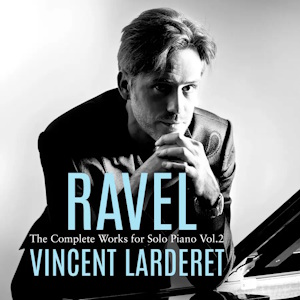
Maurice Ravel (1875-1937)
The Complete Works for Solo Piano Volume 2
Vincent Larderet (piano)
rec. 2024, Alter Sendesaal (Bremen Sendesaal), Bremen, Germany
Avie AV2766 [77]
The four volumes of Vincent Larderet’s series of the complete Ravel piano music promises to include everything he wrote for the instrument. The ethos behind this set is aided by the fact that Larderet here, as in the first volume, uses transcriptions which have been annotated by Ravel’s pupil Vlado Perlemuter. This second volume includes two major and familiar pieces; Gaspard de la Nuit and Le Tombeau de Couperin, so it makes sense to talk about them first. In so doing, I will also be comparing this with at a recent set by Konstantinos Destounis, (Piano Classics PCL10336, 2025) who has a markedly different and maybe less interventionalist approach to Larderet, especially in the first piece, but they share an equal facility of making the music speak, and catching every one of its moods. Finally, I will discuss the two additions that Larderet has made to the original canon.
First, however, we need to talk about the small but exquisite amount of piano music that Ravel wrote. The ‘complete’ Ravel piano music which is regularly performed usually contains fourteen pieces, ranging from the largest, Gaspard de la Nuit, Miroirs, Tombeau de Couperin and Valses Noble et Sentimentale, to shorter pieces such as Jeux d’eau, Menuet Antique and the most familiar of all, Pavane pour une Infante Defunte. They are the perfect set to take to a desert island – or at least, on an extended break.
Rarely has such a collection of exquisite jewels been assembled on one CD. The pieces range through many moods, sometimes within one group of pieces, such as Gaspard de la Nuit, which begins with one man’s desire for the water spirit Ondine, before taking us to the haunted base of a desert scaffold, Le Gibet, then finishing with the frenzied, gleeful dance of the vengeful gnome Scarbo. Another familiar set, Miroirs, evokes impressions that include a sad bird, a boat sailing on a calm ocean and finally La Vallé des cloches, a combination of all sorts of evocative bell sounds.
Ravel is a composer who reacts well to new and different interpretations, but only to a certain extent. For example, within the Gaspard de la Nuit suite, it is more than permissible to make the best of the frenzied crashes and glissandos in the final section of Scarbo in performing what amounts to a cadenza, as the piece more than rewards the pianist in that way.
There is only so much you can do with the second piece, Le Gibet, however, for the piece is already gloomy and eerie enough. Scabo, which depicts a sort of demonic gnome, is renowned to be one of the hardest pieces to play on the piano. Depicting as it does this gnome’s sudden and unexpected appearances and gleeful teasing, the piece also rises, and dips down deceptively until exploding with a final manic series of flourishes. Such contrasting material comes from a bizarre and gloomy collection of stories by Aloysius Bertrand which Ravel composed in 1908 and makes for a rather odd sonata.
It took me a while to get used to Larderet’s Gaspard de la Nuit and especially the first and third pieces, Ondine and Scabo, but for entirely different reasons. Initially, the pedal pulse seems to be a little bit loud in Ondine; it is an effect which continues throughout the piece. Equally the lack of frenzy he shows in contrast to the more measured playing of certain parts of Scabo, actually works in the sense of the gnome being a creature of quirks and moods. Larderet possesses none of the unrestrained frenzy of Argerich, for example, where you feel she might take off at any minute. Le Gibet remains gloomy and sinister throughout its several moods, and for me makes less of an impression. In contrast, Destounis seems to well and truly have the measure of Scabo, where at points he seems to recognise go no further than this piece of piano elastic will stretch, whereas Ondine is one of the most exquisite renditions I have heard, almost a reflection of the water creature itself, with beauty replacing the gloom, a sort of distant cousin to Debussy’s La Cathedrale engloutie, his evocation of the lost city of Ys.
Le Tombeau de Couperin finds both pianists in ebullient form. Larderet’s interpretation makes clear his intention to portray the joy as well as the courtliness of this suite, but it makes a certain contrast to Destounis’ playing of these pieces, where the obvious beauty of his playing is perhaps a little more held in and reverential. Larderet’s minuet is particularly quiet and gleaming and is followed by a fine, chattering Toccata. In Larderet’s hands, the Menuet sur le nom de Haydn, a quiet tribute to the composer written in 1909 as part of celebrations to mark the anniversary of his death, makes you wish it were longer, so subtle and reverential is the playing. The same applies to the short Prelude of 1913 which follows.
The two major inclusions come courtesy of adaptations of existing pieces by the composer. The larger one, over twelve minutes long, is the glittering and familiar Introduction and Allegro composed in 1905 for small chamber orchestra including harp, flute, clarinet and harp, and surely an assembly made in heaven. This version for solo piano by Lucien Garban, a pianist who was later to become a good friend of Ravel, was originally performed in Paris in 1907, but was eventually published only in 1919. I suspect that, like me, many people would be happy to hear it in any form, but it also makes a deal of sense as the booklet notes suggests. Essentially, the harp is the instrument that does the pyrotechnics, and it makes for an easy switch, especially when Larderet plays it this well.
An equal case for similar reasons can be made for the final ‘adaptation’ in the set, the muted and sometimes doleful Berceuse sur le nom de Gabriel Fauré, but Larderet is able to make a fine case for this as well, with playing shifting from sombre grandeur to glittering intensity.
There remains the question of whether you should invest in this collection and for me the answer is simple. Were it just a question of fifteen new minutes of adapted repertoire – even if the main body of that were a piano version of the already gorgeous Introduction and Allegro, I would possibly question the need for you to buy this. But if you either love your Ravel piano music, collect Ravel pianists, or even are new to the composer, then Larderet’s playing intelligence and technical ability make this well worth giving this a go. I admit that the Gaspard de la Nuit in particular took me a while to get used to, but now I’m eager to seek out Volume One.
Buy this for Larderet, rather than the two new adaptations, or the ‘Complete’ tag; you won’t be sorry. Having said that, if you want to have the whole piano music without additions, you are spoiled for choice. The French tradition of playing can offer you exponents like Roge, Entremont, Ciccolini and Samson Francois, to name only a few. There have also been fine recent sets by both Angela Hewitt and Steven Osborne. Sadly, the great Argentinian pianist Martha Argerich recorded only some of the Ravel pieces, but her recordings of the two concertos and Gaspard de la Nuit are a must. There’s nothing wrong with Destounis, either!
My colleague Brian Reinhart has also provided a review of Larderet’s concert from Immanuelskirche in Wuppertal, Germany which is a fine introduction to both Ravel and the pianist.
Steve Gladwin
Buying this recording via the link below generates revenue for MWI, which helps the site remain free
Contents
Menuet Antique
Menuet en ut dièse mineur
Introduction et Allegro
Gaspard de la Nuit
Menuet sur le nom de Haydn
Prelude
Le Tombeau de Couperin
Berceuse sur le nom de Gabriel Faure














This is a great review, Steve. It seems like we get a new Ravel Complete Piano Music project just about once a month, and, frankly, all of them seem to be at least pretty good. I appreciate that you delineated Larderet’s style and strengths.
As a side note, that ‘Introduction et Allegro’ transcription sounds great. It fits in perfectly with the rest of Ravel’s piano solo oeuvre, and I think it sounds clearer and cleaner than the 2 pianos / 4 hands arrangements, which always come across a bit crowded to me.