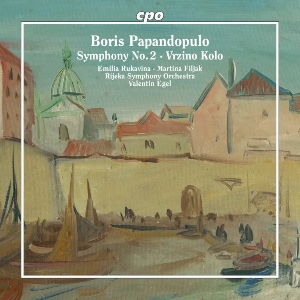
Boris Papandopulo (1906-1991)
Symphony No.2 (1946)
Vrzino Kolo (Witches’ Dance) for piano and orchestra (1958)
Emilia Rukavina (mezzo-soprano, Symphony), Martina Filjak (piano)
Rijeka Symphony Orchestra/Valentin Egel
rec. 2023, Ivan Zajc Croatian National Theatre, Rijeka, Croatia
cpo 555 618-2 [63]
I last encountered the music of Boris Papandopulo when I heard his Croatian Mass (review). Broadly speaking, I found the performance superb, but the music lacking in memorability or originality. On this disc, I first listened to the piano concerto Witches’ Dance simply because of its title and its shortness. I was thinking that it might be a modernised equivalent of Liszt’s Totentanz. Well, hardly!
The booklet briefly relates the folk legend or ancient myth. Twelve student wizards gathered in the vrzino kolo, a place where black-magic dances are performed, and built a huge bonfire, helped by fairies and dragons. They sat around reading a mysterious book. The sound of murmuring grew louder and louder until it became a thunderous roar. Sparks flew from the bonfire, the students became ablaze and one of them flew away on a dragon fashioned out of pure fire. Then the tumult died down and the remaining eleven wizards spoke quietly to each other.
I can easily see this scenario stimulate the imagination of many a composer, especially one with the full resources of a modern symphony orchestra at their disposal. Papandopulo has created a scherzo with a virtuoso piano part which plays nearly continuously, with both hands in unison almost throughout. The music, extremely dissonant, is based on the octatonic scale. Stravinsky (in the Firebird ballet) and Rimsky-Korsakov employed it when they wanted to evoke fantastic, magical events. The piece is in three parts. A fast, fiery toccata gets things going and is followed by a fugato section. At the end, things calm down with a ruminative solo cadenza and then a complete change in the harmony, which becomes consonant, that is stable and pleasant, and creates a sense of resolution.
I do not think that I have ever heard a piece that sounds like this – colourful, virtuosic, dissonant and seemingly chaotic. The booklet note asserts that “with each new hearing a hidden order and new sound worlds, especially in the orchestral palette marked by percussion instruments, are revealed”. I have listened to it a few times and have not yet discerned this hidden order, but no doubt that is my fault. The soloist, Martina Filjak, conquers the piece with virtuoso abandon, and the orchestra acquits itself as a committed ensemble.
The symphony is a very different work indeed. Papandopulo said that “his goal was to establish himself as a composer who reflected current aesthetic and ideological creative ideals, that is, those in complete harmony with the socialist-realist guidelines ratified by the Congress of Croatian Creative Artists in 1944”. Until 1948, Soviet cultural propagandists exercised enormous sway over the arts in Croatia, then part of socialist Yugoslavia.
Papandopulo re-used music from earlier works for movements 3,4 and 5, but composed the first two movements as new pieces. In the program notes for the first performance, he gave titles and assigned descriptive comments to each movement. That almost forms a manifesto in line with the current socialist-realist aesthetic. The fact that three of the five movements predate socialist-realist concerns gives some indication of how much faith one should place in his words. He was working in a one-party state that controlled artistic expression, so it was “conform or else”.
Having said that, the symphony is a hugely enjoyable work which surprised me with its thematic impact and immensely colourful scoring. It opens with a short theme on the oboe followed by fanfares of a hieratic splendour, which reminded me of Miklós Rózsa’s film music. Next comes a sweeping melody of oriental character, subsequently transformed into a dance which might remind one of Khachaturian. The second movement shows the influence of South Slavic folk song melismas and scale sequences synthesized together with orchestration of oriental colour. An unusual part of the symphony is the fourth movement Lyrical Intermezzo; it is a vocalise beautifully sung by the rich-toned Emilia Rukavina.
The orchestra plays very well, and probably enjoyed playing such impactful music. The recording is excellent and conductor Valentin Egel guides the ensemble unerringly. The booklet is well up to cpo’s usual standard, with biographical and musical notes in German and English.
Jim Westhead
Buying this recording via the link below generates revenue for MWI, which helps the site remain free