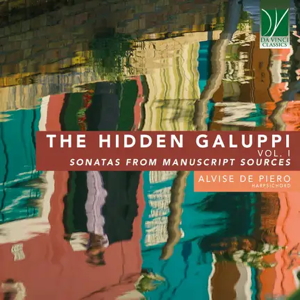
Baldassare Galuppi (1706-1785)
The Hidden Galuppi
Alvise De Piero (harpsichord)
rec. 2023(?)
Reviewed as a download
Da Vinci Classics C01176 [70]
After the death of Antonio Vivaldi, Baldassare Galuppi was Venice’s most fashionable composer. An illustration of his reputation is the fact that when in the 1750’s or 1760’s the court in Dresden was looking for new religious music from Italy, it was sent some pieces with the name of Galuppi as the composer, although in fact they were composed by Vivaldi.
Galuppi was born in Venice and probably received his first music lessons from his father, a barber who also played the violin in small orchestras. His first professional teacher was Antonio Lotti, first organist of San Marco. Soon, he started to play the harpsichord in opera houses and composed substitute arias for operas. In the following decades he wrote a large number of operatic works. In the early 1740’s he travelled to London where a number of his operas were performed, which found a mixed reception. It was mainly after his return to Italy that his star as an opera composer began to rise, reflected by the number of commissions he received. At the end of his career, he concentrated on composing religious music.
Among his instrumental works, keyboard music takes first place. Twelve sonatas for harpsichord were printed in London as Op. 1 and Op. 2 respectively. Three further sonatas were included in collections which were printed in Nuremberg. The largest part of his keyboard works has been preserved in manuscript. The disc under review is the first in a project covering the latter category. The thematic catalogue by Franco Rossi includes 172 sonatas. The number of movements varies from one to three. One of the features of his keyboard works is that they appear in various forms: often the movements are ordered differently from one source to the other, and sometimes movements appear in one source but are absent in another. Because of that Rossi, in the liner-notes to Andrea Chezzi’s recording of the sonatas Op. 1 (Brilliant Classics, 2016), concludes that “the publication of Galuppi’s complete keyboard works cannot logically claim to be a critical edition”.
The disc under review may well cover Galuppi’s entire career and reflect the stylistic development in his oeuvre. However, what all these works have in common is that the right hand has the bulk of the melodic and thematic material, and the left hand is largely confined to an accompanying role. The Sonata in F which opens the programme, may date from Galuppi’s years in London (1741-1743). It consists of three movements, the first of which has an improvisatory character, and has the traces of a French prélude non mesuré. Alvise De Piero, in his liner-notes, suggests that Handel, who also used this form, has inspired Galuppi. The second movement shows some similarity with the sonatas by Domenico Scarlatti, for instance in the passages with fast repeated notes, giving it a percussive character. The third movement has a capricious character, with sudden pauses.
Next is the Sonata in B flat, which De Piero connects to Galuppi’s music for the theatre, especially the dramma giocoso. There is something special in the second of the two movements. It includes chords on the dominant and the tonic “in which the first and third beats of the bar feature groups of four semiquavers alternating between the hands, while the second beat is occupied by a rest.” There is a connection between the Sonata in G (R.A.1.11.03) and Galuppi’s opera L’Olimpiade; the latter dates from 1747, which may be an indication of the time the sonata has been written. Here De Piero also observes similarities with a sonata by Haydn. There are undoubtedly connections between the two: some pieces thought to be of Haydn’s pen, are also attributed to Galuppi. Another case is the Sonata in G (R.A.1.11.14); this is a piece in one movement.
Two other single-movement sonatas show the strong differences within Galuppi’s oeuvre. The brilliant Sonata in G (R.A.1.11.15) is very different from the Sonata in F (R.A.1.08.12), which is a rather simple minuet. The Sonata in G (R.A.1.11.03) is a further special case: the opening movement is divided into two sections, each of which consists of two halves; the second includes written-out diminutions on the first. De Piero connects this sonata with the oeuvre of CPE Bach, in particular his Sonaten mit veränderten Reprisen. He mentions that the two composers once have met, but whether Galuppi knew Bach’s works is hard to say.
The disc closes with the three-movement Sonata in F (R.A.1.16.01), which is a piece of classical proportions. This may well be the latest piece in the programme, probably marking the latest stage of the composer’s career.
An important and often problematic issue in recordings of keyboard music from the period between, say, Bach and Mozart, is the choice of instrument. Much was going on in the field of keyboard building. The harpsichord was still very much in vogue until the end of the 18th century. At the same time the fortepiano became increasingly important, and this instrument experienced a quick development. The fortepianos of Silbermann, for instance, are very different from those of Stein and Walter. And then there were other keyboard instruments, such as the tangent piano. During the 17th and 18th centuries, the clavichord was widespread, and from the mid-18th century it became especially popular as it was particularly suited for music of an empfindsam character. De Piero mentions that it is known that Galuppi had a clavichord at home. In his case one also needs to take into account that he travelled across Europe and became acquainted with various keyboard instruments. That makes it hard to say what may be the ‘ideal’ instrument for his music. De Piero has opted for an Italian harpsichord, a copy of an instrument of 1697; it is tuned in 1/6 comma meantone and at a”’=415 Hz. I just wonder whether a later instrument, maybe even a harpsichord with pedals, would be a better choice. It will be interesting to see whether De Piero is going to use other instruments for further instalments in this project.
There are good reasons to look forward to the follow-up, because Galuppi’s sonatas are well worth being performed and recorded. The number of recordings is limited, and a thorough exploration of his keyboard music is most welcome. I very much enjoy this album, as I have previous recordings of Galuppi’s music. Alvise De Piero is a very fine interpreter, who shows here a thorough knowledge and stylistic understanding of Galuppi’s music. The result is a compelling recital, which – thanks to a clever choice and ordering of the pieces – offers maximum variety. His liner notes are informative, and very helpful in understanding the character and development of Galuppi’s keyboard music.
Johan van Veen
http://www.musica-dei-donum.org
https://twitter.com/johanvanveen
https://bsky.app/profile/musicadeidonum.bsky.social
Buying this recording via the link below generates revenue for MWI, which helps the site remain free
Contents
Sonata in F (R.A. 1.08.02)
Sonata in B flat (R.A. 1.16.04)
Sonata in G (R.A. 1.11.14)
Sonata in G (R.A. 1.11.15)
Sonata in C (R.A. 1.01.15)
Sonata in G (R.A. 1.11.03)
Sonata in G (R.A. 1.11.12)
Sonata in F (R.A. 1.08.12)
Sonata in B flat (R.A. 1.16.01)