
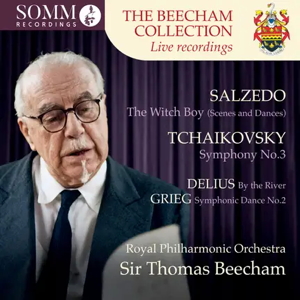
Frederick Delius (1862-1934)
Florida Suite: By the River (1887)
Edvard Grieg (1843-1907)
Symphonic Dance: Allegretto grazioso, Op.64 No.2 (1896-97)
Leonard Salzedo (1921-2000)
The Witch Boy: scenes and dances from the ballet (1956)
Pyotr Ilyich Tchaikovsky (1840-1893)
Symphony No.3 in D major, Op.29 ‘Polish’ (1875)
Royal Philharmonic Orchestra/Sir Thomas Beecham
rec. 26 October 1954 (Grieg), 14 November 1959 (Salzedo, Tchaikovsky), 24 April 1960 (Delius), Royal Festival Hall, London, UK
The Beecham Collection; Live Recordings
SOMM Recordings SommBeecham 36 [76]
The latest release in the Beecham Collection contains broadcast performances given at the Royal Festival Hall, London in 1954-1960 and of the four pieces preserved here, by far the most interesting and quietly revelatory is the sequence of ‘scenes and dances’ from Leonard Salzedo’s ballet The Witch Boy.
In the early 1950s Salzedo was a violinist in Beecham’s Royal Philharmonic and later functioned as his assistant. In 1952 Beecham had premiered Salzedo’s First Symphony and seven years later turned his attention to his 1956 ballet which has been successfully premièred in Amsterdam and then introduced to British audiences the following year by London Festival Bellet, and later in Dublin where it was described as ‘a swift, exciting essay in melodrama’. The Beecham performance preserves a little more music than can be heard in the later concert suite of the score and expands our appreciation of both composer and indeed a conductor, known for making irascible comments about popular music and jazz. This score has plenty to intrigue the curious listener and Beechamite alike.
It’s sharply characterised, features piquant instrumental conjunctions – listen to the vibraphone in the first panel – and plenty of atmospherics. Parts sound like a compound of Bernard Herrmann and Stravinsky but Salzedo proves a potent sensualist in the second part, the Dance of Love. Remarkably, Beecham responds with very unusual esprit to the overt Americana of the third panel, Square Dance, a kind of Richard Russell Bennett-meets-Aaron Copland syncopation fiesta. Yee-haw indeed. The audience greets this with avid applause, quite rightly. The final panel is called The Lynching, a terse, dramatic and theatrically purposeful scene with the vibraphone audible again, as the music revisits its earlier motifs. Though there are no overt musical similarities, I wonder if Salzedo was aware of Arthur Bliss’ 1944 ballet score for Miracle in the Gorbals. Salzedo was later something of a ballet luminary, becoming music director of Ballet Rambert and Scottish Ballet amongst others.
I’ve focused on Salzedo’s piece because it seems so incongruous in Beecham’s surviving discography but then he conducted much out-of-the-way material that was never recorded. In any case, I found it both fascinating and vividly exciting.
The other works are standard Beecham fare. Delius’ By the River comes from the conductor’s last London performance in April 1960 and is lovingly phrased but, significantly, much more fluidly so (and faster) than the commercial recording he had made three years earlier. The river’s current flows with far greater zest in 1960, coursed with an unquenchable life force, when compared with the more nostalgic 1957 recording. Grieg’s Symphonic Dance: Allegretto grazioso, Op.64 No.2 recorded in a 1954 concert is, however, very similar to the November 1959 stereo, in both cases Beecham revelling in its rustic brio.
The biggest work here is Tchaikovsky’s five-movement Symphony 3, that used always to be called the ‘Polish’. This is very similar in conception to Beecham’s commercial recording, made on 78s in April 1947 but with an added electrical charge. In the first movement he moves from the Funeral March to the Allegro brilliante with vivid dramatic impulse, points the Alla tedesca second movement with as much skill as he had in 1947 and treats the slow movement with exemplary generosity to his wind soloists. The finale is characterful and full of flair, featuring fugato fire, and a resplendent climax with adroitly graded dynamics.
As before in this long-running series, the booklet notes (Nigel Simeone) are most helpful, and Lani Spahr has done excellent work with the restorations.
Jonathan Woolf
Other review: Nick Barnard
Buying this recording via the link below generates revenue for MWI, which helps the site remain free













