
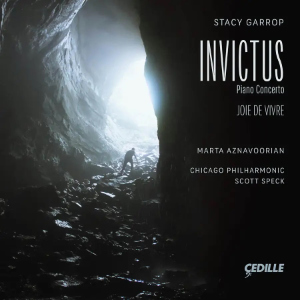
Stacy Garrop (b. 1969)
Piano Concerto Invictus (2024)
Joie de Vivre for solo piano (2024/25)
Marta Aznavoorian (piano)
Chicago Philharmonic Orchestra / Scott Speck
rec. 2025, Chicago, USA
Cedille CDR90000243 [40]
This most striking concerto may be the most impactive recent work that I have heard on CD. On her website, composer Stacy Garrop writes that each movement is inspired by the poem Invictus by English poet William Ernest Henley (1849-1903). At 12, Henley lost a leg to tubercular bone disease. When he was hospital-bound in 1873-1875 after surgery to save his other leg, he wrote Invictus (this Latin word means unconquerable or undefeated). The early years of his life were punctuated by periods of extreme pain due to the draining of his tubercular abscesses. Amongst his many friends, there was Robert Louis Stevenson. Amazingly, after the publication of Treasure Island, he wrote to Henley: “I will now make a confession: It was the sight of your maimed strength and masterfulness that begot Long John Silver”.
The first movement “Out of the night that covers me” represents the soloist at the bottom of a pit, trying to climb out. The striking opening bars could hardly be deeper. They are repeated agaists a low grumbling from the orchestra, and rise in intensity as the percussion-led orchestra seeks to overwhelm the piano. Things quieten, and the piano in a lyrical vein seeks to find inner strength. The attractive theme gradually rises in intensity to a peak, only for the orchestra to overwhelm it with multiple tam-tam-capped climaxes.
In the second movement “Black as a pit from pole to pole”, the piano is tossed from side to side by a violent orchestra. The percussion and brass sometimes sound almost aleatoric in their unbridled fury, aiming to dominate the piano. The movement ends with a single loud chord played at the extreme left-hand side of the keyboard, which I should think signifies defeat.
The third movement “I thank whatever gods may be” represents the pianist looking up and praying to the heavens. Appropriately, the movement is strong yet lyrical, and the piano is accompanied by a supportive orchestra. It occasionally becomes almost filmic, with climaxes topped by cymbals, although there are stretches where the piano plays solo, or almost so. The orchestra gradually dies to nothing, and quiet chords on the piano end matters. The movement is followed by a separate track containing a brief lyrical interlude which becomes triumphant as the piano’s theme dominates. In her own notes, the composer does not discuss this as a separate track.
In the last movement “For my unconquerable soul” the soloist placates the orchestra. The thematic material gradually rises as the upper reaches of the pit are climbed. Finally, the music reaches a quietly thankful escape.
Joie de Vivre, one more track, is inspired by Garrop’s friend, artist Joanne Bernstein. Garrop says that this warmly romantic piano piece represents her friend’s robust engagement with life. It nicely rounds off this enjoyable disc.
The recording is extremely dramatic. The piano gets a bold image, immediately striking in the opening chords. The recording producers have managed to achieve a strong forward balance. (They avoided the mistake that producer made in pianist Alexander Malofeev’s recent Sony debut recital Forgotten Melodies. There, the instrument is so closely recorded that the piano damping mechanism’s sound is intrusive.)
The gatefold cardboard sleeve contains no notes other than a track listing. A QR code takes one directly to the appropriate pages of Cedille’s website.
This is a most impressive recording of a dramatic, modern yet approachable piano concerto. It will appeal to anyone who can respond to, say, Prokofiev’s Second Piano Concerto or Bartók’s piano works.
Jim Westhead
Buying this recording via the link below generates revenue for MWI, which helps the site remain free













