
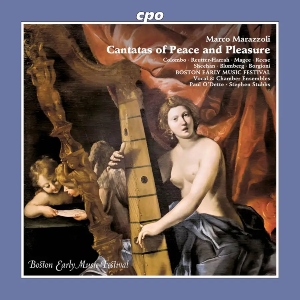
Marco Marazzoli (c1602-1662)
Cantatas of Peace and Pleasure
La Vendemmia
La Zenobia
Il Riposo
Mortali, o voi ch’in atra notte
La Guerra e la Pace
Carlotta Colombo, Danielle Reutter-Harrah & Alissa Magee (sopranos), James Reese & Aaron Sheehan (tenors), Jesse Blumberg & Mauro Borgioni (baritones)
Boston Early Music Festival Vocal and Chamber Ensembles/Paul O’Dette & Stephen Stubbs
rec. 2024, Sendesaal Bremen, Germany
Italian texts included with English translations
cpo 555 731-2 [2 CDs: 88]
The five pieces here are grouped together under the enticing soubriquet of ‘cantatas of peace and pleasure’. But only the three works at the programme’s centre actually seem to have been intended by Marazzoli to act as a set, connected with his patron, Pope Alexander VII, and his mediation between France and Spain to bring war between them to an end in 1659. These works are dramatic cantatas, somewhat like mini operas with their extended narratives, rather than domestic works for one voice and basso continuo dealing with the amorous travails of nymphs and shepherds, as do so many chamber cantatas later in the 17th and early 18th centuries by the likes of Alessandro Scarlatti, Vivaldi, or Handel. Nevertheless, there is a closed-in intimacy in the recorded sound here that suits their nature as private, edifying entertainments for the Pope.
La Zenobia deals with the same character and her husband Radamisto as feature at the centre of Handel’s opera of the latter name, nearly a century later. Danielle Reutter-Harrah takes the part of the narrator with a cool detachment, allowing Carlotta Colombo to cultivate a more emotionally engaged profile in the title role by contrast – even when calm herself she is forthright, and when she believes she is facing death, remains defiant. James Reese’s Radamisto emotes with sighs and moans.
Although not connected as a narrative, Il riposo and Mortali, o voi ch’in atra notte follow as part of Marazzoli’s supposed triptych. Whereas the strings of the Boston Early Music Festival Chamber Ensemble elsewhere tend to provide discreet support, with harpsichord and lute more to the fore, here they vividly set the scene and eponymous mood of peace for Il riposo with their lulling depiction of a boat at rest on Lake Albano, near the Papal retreat at Castel Gandolfo. Later they create some gorgeously chromatic sliding effects, for instance as the banks, shores, and ports of the lake are introduced. Bass Mauro Bargioni is a vocally rugged, forceful personification of the Lake, deploring the disturbance of its peace, which the chorus of nymphs take up in playful complaint. Jesse Blumberg expresses/exudes plangent trepidation initially, as he explains his mission as the embodiment of Repose (symbolising the Pope’s diplomatic efforts) aided by his more lyrical choral followers; only in the final movement does he attain a sense of musical restfulness. Mortali, o voi ch’in atra notte concludes the sequence with alacrity on the part of its tenor soloist, Aaron Sheehan, explicitly acclaiming the treaty which brought war to an end.
As the title suggests, La Guerra e la Pace is a dialogue, pitting the exponents of war and peace against each other. Reutter-Harrah and Colombo are finely balanced in the vocal stakes. If anything the former is the more canny, as war, in being not too officious but coaxing and alluring in ton. Colombo adopts a more haughty, even abrupt demeanour when delivering peace’s injunctions, backed up by jaunty sopranos in the chorus.
That leaves the first cantata here, La Vendemmia,as the only one which has to do with pleasure directly, and perhaps would have made more sense if it had come at the end of this pair of discs, as a celebration of the fruits of peace. In this case it extols the harvest, and wine in particular, of which the Pope is implicitly esteemed as a connoisseur. The translation of the text in the booklet helpfully notes which grapes are alluded to in the cryptic poetic references. Bargioni virtually guffaws his way through the piece as Bacchus, heralded by the sprightly Sinfonia which is imbued by the performers here with an Italianate vivacity despite the portentous dotted rhythms of a French style overture. Three soloists from the semi-chorus applaud the sweet Rugiade wines expressively in a delectable passage like an unaccompanied madrigal.
This offering constitutes a delightful smorgasbord of little-known vocal music by Marazzoli. By presenting its 88 minutes on two discs, it’s a pity that a few other kickshaws weren’t found to extend the pleasure a little further.
Curtis Rogers
Buying this recording via the link below generates revenue for MWI, which helps the site remain free













