
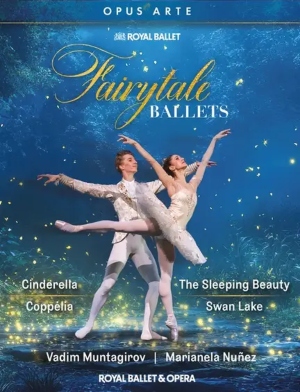
Fairytale Ballets
Léo Delibes (1836-1891)
Coppélia, ballet in three Acts (1870)
Choreography and production by Ninette de Valois, after Lev Ivanov and Enrico Cecchetti
Pyotr Il’yich Tchaikovsky (1840-1893)
Swan Lake, ballet in four Acts(1875-1876)
Choreography by Liam Scarlett, after Marius Petipa and Lev Ivanov, with additional choreography by Frederick Ashton
The Sleeping Beauty, ballet in a Prologue and three Acts (1889)
Choreography by Marius Petipa, with additional choreography by Frederick Ashton, Anthony Dowell and Christopher Wheeldon
Sergei Prokofiev (1891-1953)
Cinderella, ballet in three Acts(1940-1944)
Choreography by Frederick Ashton
rec. live, 2017-23, Royal Opera House, Covent Garden, London
Opus Arte OABD7320BD Blu-ray [4 discs: 541]
You might find yourself a little puzzled by the title of this new box set, for at first glance, the term fairytale appears to be only partially appropriate. There are, it’s true, plenty of fairies in The Sleeping Beauty. Indeed, they are introduced so quickly, one after another in the ballet’s Prologue, that it’s pretty easy to regard them as something of an entirely undifferentiated herd (which, I was rather surprised to learn, is the correct collective noun for the dainty little creatures). Meanwhile, Cinderella, just as you’d expect, features its familiar fairy godmother dea ex machina who puts the heroine’s life to rights, before, for good measure, Prokofiev throws in another four, each one representing a season of the year. So far, so good. But Swan Lake poses a bit of a problem, for it depicts literally no fairies at all. Are its story’s elements of magic and wizardry enough on their own to justify describing it as a fairytale? Similarly assessed, Coppélia appears to be a fully cut and dried case. Its animated dolls turn out, after all, to be powered not by some sort of mysterious supernatural spell but, as nosey Swanilda and her friends discover, by simple clockwork. There’s nothing supernatural, let alone fairy-like, about that.
Yet, such a dogmatically literal approach is inappropriate. The English language definition of fairytale is actually quite broad, comprehending an almost infinitely wide range of fantasy and magic and not necessarily at all requiring the involvement of winged miniature Barbie dolls. That conceptual elasticity is also well demonstrated in ballet history. In the late 19th century, some of the most popular dance productions were known as ballets-féeries. But, even though full of supernatural elements and “magical” effects delivered by elaborate on-stage visual trickery, their plots only rarely – and very much as an optional extra – featured fairies themselves. Both the fairy-full Sleeping Beauty and the literally fairy-less Swan Lake may be regarded as ballets-féeries and, although it’s a mid-20th century outlier, Cinderella fits the bill too. I still, however, have reservations about Coppélia. After all, the whole central point of its story is that the supposed magician Dr Coppélius is merely a self-delusional fraud and that there is no such thing at all as the supernatural. Nevertheless, it remains such a delightful piece of escapist entertainment that, on this occasion, I’m more than happy to give it the benefit of the doubt and accept its inclusion in this welcome Royal Ballet box set.
The four ballets included in the collection were all filmed at dates between 2017 and 2023. As you might therefore expect, they share several common characteristics. There is, for instance, little or nothing to choose between the films in technical quality (just for the record, I watched them in Blu-ray format). Very noticeably, too, lots of dancers are featured in more than one of them. The most notable example, as the box’s front cover reminds us, is that the leading roles are, in each case, danced by the star Royal Ballet partnership of Marianela Nuñez and Vadim Muntagirov.
I have previously considered theperformances of both Coppélia and Cinderella when they were released as single discs. I do not propose to repeat what I have previously written at length, so instead I refer readers to the above links to those earlier detailed reviews. That leaves us with the need to appraise this Swan Lake and Sleeping Beauty.
Quite fortuitously, this particular pairing of Tchaikovsky’s first and second ballets makes for a most interesting combination. I imagine that they have been included in the box simply because they both feature the much-admired Nuñez/Muntagirov partnership. However, to anyone with an interest in ballet history there’s just as much significance in the fact that what we have here are, chronologically speaking, the earliest and the most recent of the Royal Ballet’s home-grown Tchaikovsky ballet productions.
Putting to one side the outstanding choreographic creations of its past artistic directors, Frederick Ashton (1960-1967) and Kenneth MacMillan (1970-1977), the work with which the Royal Ballet has been most closely associated over the years has been The Sleeping Beauty. The versionthat’s been staged at Covent Garden for the past twenty years – and is now included in this box set – actually dates back far longer than that, for it was originally choreographed and designed in 1946 when Sadler’s Wells Ballet, as the Royal Ballet was then called, performed it to inaugurate their permanent residency at the Royal Opera House. An enormous success at the time, it established the company’s national and international reputations before its eventual supersedence by other productions (including, somewhere along the line, my own favourite, Anthony Dowell’s 1994 re-creation featuring Maria Bjornson’s still-controversial designs). Triumphantly brought out of retirement in 2006, it has since become a regular feature of the Royal Ballet’s repertoire. My Seen & Heard colleague Jim Pritchard reviewed its cinema relaysin February 2017 (the very performance recorded for this release on disc), January 2020 and May 2023. That same January 2020 performance was also made available online to paying viewers at home during the pandemic and Scene & Heard’s John O’Dwyer reviewed it in that formin July that same year.
Meanwhile, this Swan Lake is Covent Garden’s latest attempt to come up with a satisfactory staging of the world’s best-known classical ballet. Dating from 2018 and choreographed by the late Liam Scarlett, it has been widely acclaimed as the finest-looking production of the piece that the Royal Ballet has ever mounted. Back in June 2018 Jim Pritchard reviewed a cinema relay of the second of the two performances of Swan Lake from which this filmed version has been seamlessly put together. Four years later, after watching a screening of the same production featuring a different cast of dancers headed by Lauren Cuthbertson and William Bracewell, he provided a further update. More recently, just a year ago, I very enthusiastically reviewed a Blu-ray disc of a performance by a third cast that starred Yasmine Naghdi and Matthew Ball. As far as I can see, however, this is the first time that this composite filmed Swan Lake, incorporating the best elements from two separate June 2018 performances that were both danced by Nuñez and Muntagirov, has been considered on this website.
To begin with, let’s consider The Sleeping Beauty. The first thing to say about this filmed performanceis that it looks absolutely gorgeous, particularly in its Blu-ray incarnation. Oliver Messel’s original 1946 designs, with a few 2006 additions by Peter Farmer, are a beautiful blend of pastel pinks and blues, mauves and soft greens, with clever use of lighting to create plenty of visual interest and contrast between different areas of the stage. Barley-twist columns and elaborately embroidered canopies frame perfect settings for characters costumed in an historically eclectic mixture of styles. Thus, while the queen’s dress may look vaguely 18th century Georgian and the courtiers appear generically 16th century Elizabethan, both the king and his pompous yet incompetent major-domo Cattalabutte – all campy feathers, frills and lace – are complete sartorial salmagundis. Meanwhile, the servant girls and boys are so well dressed, squeaky clean and Colgate-bright that they look as if they’ve been created by AI, though perhaps that’s not so entirely inappropriate, given that King Florestan XXIV holds court in an entirely imaginary fairyland. In practice, the sets and costumes, no matter how mix’n’match, successfully convey the aura of fantasy, opulence and romance that we expect.
Even more florid romance is conveyed in the on-stage relationship between Princess Aurora and Prince Florimund. The Act 1 princess is a sheer delight, carefree and happy with life, though Ms Nuñez is careful to introduce a note of childish petulance and wilfulness as she defies her parents’ warnings not to play with the poisoned spindle. Once the prince has freed her from Carabosse’s curse, however, she is infused not just with gratitude but with pure transformative love for her rescuer. Throwing off her childhood immaturity, Aurora becomes a fully developed woman. I seem to recall that in an extra feature included in a previous Opus Arte release, Marianela Nuñez told us that, in terms of a dancing partner, she thought of Mr Muntagirov not as Vadim but as Va-dream and, as you watch her facial expressions – and, in particular, her eyes – as he partners her, her metamorphosis is completely convincing.
It is worth making a point here about the sheer quality of the dancing in both The Sleeping Beauty and Swan Lake. The fact that the Royal Ballet continues, uniquely among the world’s top ballet companies, to memorialise almost all its productions for home viewing, even releasing newly re-filmed performances of previously-issued productions simply to showcase exciting new performers, confirms that we are fortunate enough to be living through something of a golden age in the company’s history. As I review that regular stream of new releases, I am very conscious of the fact that its current dancers dance to such high standards that it is often virtually impossible to find any technical flaws in their performances at all. Ms Nuñez and Mr Muntagirov are (along with their colleague Natalia Osipova) among the most technically accomplished dancers of classical ballet in the world today and their dancing here is, quite simply, faultless. Thankfully, the Royal Ballet is also a company with immense strength in depth, so that the supporting solo roles are danced at an equally high level of execution. Note, indeed, how many of the dancers who were cast in smaller parts back in 2017 are now, eight or nine years later, star performers in their own right. It’s true that the members of the Covent Garden corps de ballet may not, perhaps, exhibit the exactly regimented precision and symmetry originally demanded by choreographic autocrat Marius Petipa and still so prioritised in, say, the Bolshoi and Mariinsky companies. Nevertheless, they arguably more than make up for it by delivering performances characterised by both commitment and technical skills of the highest order.
All those comments may equally be applied to the performance of Swan Lake with choreography by Liam Scarlett. Quite simply, you will not find a better-danced performance anywhere else. Swan Lake is, however, a ballet that demands more than mere dancing. Unlike Sleeping Beauty’s more simply motivated Princess Aurora, the white swan Odette is a complex character who plays on the audience’s emotions and invests them in her tragic plight, to the extent that at least a few patrons will leave the theatre with more than a slightly teary eye. That, however, is only half the issue, for, during the third Act, the same dancer is also required to portray the villainous von Rothbart’s equally wicked daughter, the black swan Odile. Ballerinas relish that particular role as it simultaneously offers both the opportunity to display virtuosic technique and the chance to create a memorable – and often quite individual – characterisation. Thus, while almost all white swan Odettes are pretty similar to each other, black swan Odiles can be portrayed in a variety of ways. The Bolshoi’s Svetlana Zakharova, for instance, invests the role with a degree of icily cold indifference that first intrigues and then captivates a prince who has been more accustomed to would-be princesses simply throwing themselves at him (review, review, review). Other dancers, meanwhile, take a quite different approach, emphasising both the black swan’s sexy seductiveness and her passionately gleeful malevolence. That’s certainly what you’ll see in filmed performances by Natalia Osipova (Opus Arte Blu-ray OA BD7174 D) and, further back in time, Maya Plisetskaya (best seen on DVD on VAI 4261, though another performance on VAI 4446 has been considered on this website [review, review]).
It goes without saying that we need have no worries with Marianela Nuñez’s acting ability, finely honed in more than twenty years as a Royal Ballet principal dancer, as she takes on the taxing dual part. Indeed, a performance she gave with her then soon-to-be husband Thiago Soares in 2009, preserved in an Opus Arte Blu-ray box set Tchaikovsky: the classic ballets (OA BD7131 D), demonstrates her complete mastery of the role years before Va-dream joined the company and became her regular on-stage partner.
In spite of his unexplained early aversion to women, a characteristic shared with both Sleeping Beauty’s Prince Florimund and Tchaikovsky himself, Prince Siegfried himself is not, on the other hand, a particularly complex psychological case. Muntagirov utilises his invariably exemplary technique to deliver a well-crafted and superbly danced account of the role. [By the way, in observing that he gives an account of the prince’s part, I certainly don’t mean to damn with faint praise. It is simply that all three of Petipa’s/Tchaikovsky’s princes, whether in Swan Lake, The Sleeping Beauty or The nutcracker,are so one-and-a-half dimensional as to be virtually impossible to interpret in an individual way. I can think of only one artist who has made a really striking personal impression on me in a filmed performance and that is Zoltán Solymosi who quite memorably portrayed Beauty’s Prince Florimund as a delightfully besotted dimwit.]
No doubt because of the sheer number of very talented dancers available to him in the Royal Ballet’s ranks, Liam Scarlett expanded some of the ballet’s supporting roles in his 2018 production. The prince’s friend and confidant Benno (Alexander Campbell) and his sisters (Akane Takada and Francesca Hayward) are given much more to do, not only offering the dancers an opportunity to demonstrate their skills but also adding some welcome extra depth to the story. Not everyone agrees that the changes are necessarily beneficial, however. My colleague Jim Westhead, for example, thought it all rather “too much”. Meanwhile, Vadim Muntagirov understandably regrets, albeit with something of a resigned chuckle, the way in which the production refocuses attention away from his own role, observing in his engaging autobiography that “Benno gets the lion’s share of… Act 1, with the prince standing around at the side of the stage. It’s no wonder Siegfried is dispirited!” (Vadim Muntagirov From small steps to big leaps [Tolworth, 2023], p. 171).
As Jim has pointed out in his Scene & Heard reviews, when it comes to John Macfarlane’s production designs there is an enormous dichotomy between Acts 1 and 3, set in the environs of the palace, and Acts 2 and 4 (Swan Lake’s “white” Acts) which take place at von Rothbart’s lakeside lair.
Act 1 sees gorgeously costumed courtiers – late 19th century in appearance – assembled in a beautiful, finely detailed and exquisitely lit woodland setting outside the palace gates. Act 3, set in the palace audience chamber, features a fabulous wall of sheer beaten gold behind the royal thrones that gives a real feel of glamour and opulence. Once again superbly lit (by David Finn), as the curtain rises the set reflects a golden glow back into the Covent Garden auditorium and, at live performances, invariably generates something of a wow of audience appreciation.
If Acts 1 and 3 are characterised by finely detailed and well-lit sets and props, Acts 2 and 4 are very different. Here we encounter a relatively simple, almost impressionistic setting of just a few rocky crags, seen in near-stygian gloom. In his 2018 Seen & heard review, Jim was pretty dismissive (“all we saw was a dingy backcloth and a bit of black jagged rock”). There is, however, another way of looking at this. Many Swan Lakes choose to depict the whole thing as an overt fairytale, so that all four Acts convey a consistent atmosphere of fantasy, albeit with the story’s events taking place at differing locations. Scarlett, on the other hand, was surely trying to create an absolutely stark Manichaean contrast between the ballet’s two worlds. Thus, while making the “real” Acts set at court as visually believable as possible, his white Acts introduce and strongly emphasise elements of darkly supernatural mystery. He thereby hammers home the point that the fantasy world inhabited by Odette and her fellow swans is not merely a slightly constricted, not-too-severe, open-prison variant of real life. It’s something far darker, utterly repellent and malevolent – so disgusting, in fact, that its very appearance is filthy, repulsive, cheap and, as Jim more forgivingly perceived it, downright dingy (the designer Nicholas Georgiadis’s backdrop of filthily foetid rags serves, you may recall, a similar mood-setting purpose in Kenneth MacMillan’s ballet Manon).
Von Rothbart’s part, taken here by Bennet Gartside, is another of those that have been considerably expanded in this production. Scarlett augments the character’s usual demonic lakeside persona with an alter ego, so that in Acts 1 and 3 he becomes a Rasputin-like power-behind-the-throne figure, with the queen (the magnificently imperious Elizabeth McGorian) acting as his Empress Alexandra. Even so, whatever his role at any particular time, von Rothbart’s demonic side operates at a level of moral and physical darkness that’s completely beyond the experience and comprehension of mere mortals like the prince.
Regardless of their conductor, I have yet to hear a performance of a classical ballet score given by the Orchestra of the Royal Opera House that is anything less than skilfully idiomatic. They do not let the side down in either the Sleeping Beauty or Swan Lake and, given how often they must have played the music, they do so with every appearance of liveliness and enthusiasm. Koen Kessels is, of course, hugely experienced in directing ballet scores. Here he delivers powerful accounts that, while appropriately acknowledging and accommodating the dancers’ physical limits, are, by turns, powerful, exciting and emotionally moving. His contribution immensely enhances the overall theatrical experience.
As I have already noted, the technical quality of all the discs in this Blu-ray package is first class, whether in terms of picture or sound. Once again, however, it is a real shame that greater opportunity was not taken to film something more substantial in the way of “extras”. A total of, on average, less than twelve minutes of supplementary material per disc simply insults the audience. Surely, if the producers have already gone to the trouble of getting some of the dancers together in front of a camera, it ought to be possible to spend a little more time eliciting their thoughts, opinions and experiences in somewhat more depth than we have here?
Even so, this proves to be a most enjoyable package that deserves an enthusiastic recommendation. It is, moreover, easily available at prices that will save you a great deal of money over the cost of buying the individual discs. One word of caution: back in 2015 Opus Arte box released another set with the near-identical title The Fairytale Ballets (OA1146BD). Still available from online sources, it actually offers the same four staged works as the box I’ve been considering here, but on this occasion the performances derive from the Dutch National Ballet (Sleeping Beauty) and the Paris Opera Ballet (Swan Lake, Coppélia and Cinderella – the latter two once again conducted by Mr Kessels). The cast lists certainly feature some very starry names. I mention this merely to help you avoid any confusion between the two boxes… though I suppose, of course, that you could always treat yourself by buying them both.
Rob Maynard
Main performers
Marianela Nuñez (Swanilda [Coppélia], Odette/Odile [Swan Lake], Princess Aurora [The Sleeping Beauty]and Cinderella [Cinderella]
Vadim Muntagirov (Franz [Coppélia], Prince Siegfried [Swan Lake], Prince Florimund [The Sleeping Beauty]and the Prince [Cinderella]
Artists of the Royal Ballet
Orchestra of the Royal Opera House/Barry Wordsworth (Coppélia), Koen Kessels (Swan Lake, The Sleeping Beauty, Cinderella)
(The Sleeping Beauty), (Swan Lake), (Coppélia) and (Cinderella);
Other cast and production staff
Coppélia
29 November and 10 December 2019
Dr Coppélius – Gary Avis
Coppélia – Ashley Dean
Burgomaster – Christopher Saunders
Innkeeper – Erico Montes
Swanilda’s friends – Mica Bradbury, Isabella Gasparini, Hannah Grennell, Meaghan Grace Hinkis, Romany Pajduk, Leticia Stock
Peasant girls and boys – Annette Buvoli, Lara Turk, Reece Clarke, Nicol Edmonds, Artists of the Royal Ballet
The duke – Lukas Bjørneboe Brændsrød
Aurora – Claire Calvert
Prayer – Annette Buvoli
Students of the Royal Ballet School
Designer – Osbert Lancaster
Lighting designer – John B. Read
Staging – Christopher Carr
Directed for the screen by Ross MacGibbon
Picture format: 1080i High Definition 16:9
Audio format: LPCM 2.0 and 5.1 DTS-HD Master Audio
All regions
Subtitles for extra features: English, French, German, Japanese, Korean
Swan Lake
1 and 12 June 2018
The queen – Elizabeth McGorian
Von Rothbart – Bennet Gartside
Benno – Alexander Campbell
Prince’s younger sisters – Akane Takada and Francesca Hayward
Waltz and polonaise – Tierney Heap, Meaghan Grace Hinkis, Fumi Kaneko, Mayara Magri, Matthew Ball, James Hay, Fernando Montaño and Marcelino Sambé
Cygnets – Isabella Gasparini, Elizabeth Harrod, Meaghan Grace Hinkis, Romany Pajdak, Claire Calvert and Mayara Magri
Two swans – Claire Calvert and Mayara Magri
Spanish princess – Itziar Mendizabal
Italian princess – Yuhui Choe
Polish princess – Beatriz Stix-Brunell
Spanish dance – Tierney Heap, Reece Clark, Nicol Edmonds, Kevin Emerton and Fernando Montaño
Czárdás – Romany Pajdak and Tristan Dyer
Neapolitan dance – Meaghan Grace Hinkis and Marcelino Sambé
Mazurka – Nathalie Harrison and William Bracewell
Students of the Royal Ballet School
Designer – John Macfarlane
Lighting designer – David Finn
Directed for the screen by Ross MacGibbon
Picture format: 1080i High Definition 16:9
Audio format: LPCM 2.0 and 5.1 DTS-HD Master Audio
All regions
The Sleeping Beauty
28 February 2017
King Florestan XXIV – Christopher Saunders
The queen – Elizabeth McGorian
Cattalabutte – Alastair Marriott
Carabosse – Kristen McNally
Lilac fairy – Claire Calvert
Her cavalier – Ryoichi Hirano
Fairy of the crystal fountain – Yuhui Choe
Her cavalier – Luca Acri
Fairy of the enchanted garden – Akane Takada
Her cavalier – Valeri Hristov
Fairy of the woodland glade – Yasmine Naghdi
Her cavalier – Nicol Edmonds
Fairy of the songbird – Meaghan Grace Hinkis
Her cavalier – Solomon Golding
Fairy of the golden vine – Anna Rose O’Sullivan
Her cavalier – Fernando Montaño
English prince – Gary Avis
French prince – Johannes Stepanek
Indian prince – Valeri Hristov
Russian prince – Thomas Whitehead
Aurora’s friends – Isabella Gasparini, Tierney Heap, Meaghan Grace Hinkis, Mayara Magri, Yasmine Naghdi, Anna Rose O’Sullivan, Demelza Parish and Leticia Stock
The countess – Christina Arestis
Gallison – Jonathan Howells
Florestan – Marcelino Sambé
His sisters – Yasmine Naghdi and Mayara Magri
Puss-in-boots – Paul Kay
The white cat – Leticia Stock
Princess Florine – Akane Takada
The bluebird – Alexander Campbell
Red Riding Hood – Gemma Pitchley-Gale
The wolf – Tomas Mock
Students of the Royal Ballet School
Original designs – Oliver Messel
Additional designs – Peter Farmer
Lighting designer – Mark Jonathan
Staging – Christopher Carr
Directed for the screen by Ross MacGibbon
Picture format: 1080i High Definition
Audio format: LPCM 2.0 and 5.1 DTS-HD Master Audio
All regions
Cinderella
5 and 12 April 2023
Cinderella’s step-sisters – Gary Avis and Luca Acri
Cinderella’s father – Bennet Gartside
Fairy godmother – Fumi Kaneko
Fairy godmother in disguise – Olga Sabadoch
Dancing master – David Donnelly
Two fiddlers – Kaoru Yamada and Ksenia Berezina
Tailor – Harris Bell
Dressmakers – Katharina Nikelski and Maddison Pritchard
Shoemaker – Giacomo Rovero
Hairdresser – Aiden O’Brien
Jeweller – Harrison Lee
Fairy spring – Anna Rose O’Sullivan
Fairy summer – Melissa Hamilton
Fairy autumn – Yuhui Choe
Fairy winter – Mayara Magri
Jester – Taisuke Nakao
Prince’s friends – Joseph Sissens, Nicol Edmonds, Benjamin Ella and Calvin Richardson
Suitors – Lukas B. Brændsrød and Philip Mosley
Artists of the Royal Ballet
Set designer: Tom Pye
Costume designer: Alexandra Byrne
Lighting designer: David Finn
Staging: Wendy Ellis Somes and Gary Avis
Directed for the screen by Ross MacGibbon
Picture format: 16:9 anamorphic
Audio format: LPCM 2.0 and DTS Digital Surround
All regions
Subtitles for extra features: English, French, German, Spanish, Japanese, Korean
Buying this recording via the link below generates revenue for MWI, which helps the site remain free














