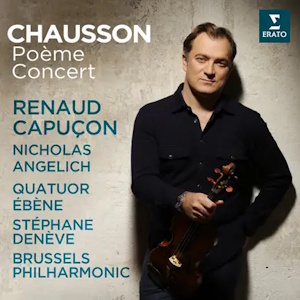
Ernest Chausson (1855-1899)
Concert for violin, piano and string quartet Op.21 (1889-1891)
Poème for violin and orchestra Op.25 (1896)
Erato 5026854565521 [62]
Ernest Chausson’s Concert (not Concerto!) for violin, piano and string quartet – a beautiful work – is not easy to programme because it is the only work for this combination. It is fairly often recorded, however. This version has an interesting history. Violinist Renaud Capuçon and his partners here had performed it publicly many times but never got round to making a studio recording. The pianist, Nicholas Angelich, died in 2022, so what we have here is a recording of a live performance from 2020.
Chausson, a pupil of César Franck, uses a similar idiom, very rich and chromatic. His personal sense of melancholy pervades many of his works. As I noted, this is not a concerto, but the solo violin, marked thus in the score, does have a role as a first among equals. The piano writing, also particularly full and elaborate, requires considerable virtuosity. Angelich was noted as a Brahms player; this piano part requires similar qualities of weight and depth, but not so much as to drown the strings.
The work is in four movements. It opens with a motto theme on three notes, expanded and variously developed in the course of the first movement. The movement concludes with two versions of the motto: one is a long lyrical line on the solo violin, the other a concise statement on the piano. There follows a Sicilienne, a charming movement in 6/8 which takes the place of a scherzo and builds to a big climax before an ethereal end. The slow movement starts as a dialogue for the solo violin and the piano, but the tempo quickens as the quartet joins in. The writing becomes more and more intricate, and there is another climax. The light-hearted finale is marked Tres animé. Some of the earlier themes return before the end, a nod to Franck’s idea of cyclic form.
This is a gripping, exciting performance. The fact that the ensemble have played it often is evident from the ease and confidence with which the players share and support their material. Nicholas Angelich had been rightly praised. Renaud Capuçon is well-known as a soloist and chamber musician. The Quatuor Ébène seem to have succeeded the Quatuor Ysaÿe to the mantle of the leading French string quartet.
I suppose that if Angelich had lived, they might have coupled the Concert with one of Chausson’s other chamber works with piano – the piano quartet or the piano trio. Presumably, neither was available, so the filler is the Poème, still probably his best-known work, in its original and most commonly heard form, for violin and orchestra. (Chausson did make a version for the same ensemble as the Concert, but we never hear that.) This kind of one-movement concertante work was popular in the more miscellaneous concert programmes of the nineteenth century; they have rather dropped out of programming nowadays. It is quite extravagantly scored; the harp, for example, has only fourteen bars of music, and the heavy brass little more. Still, it is a most beautiful work, and Capuçon delivers the solo part with great style. Stéphane Denève, perfectly at home with the idiom, supports him well with his orchestra. Even so, compared to the Concert, it counts as a makeweight.
There are many recordings of the Concert. One I am particularly fond of, with Pierre Amoyal, Pascal Rogé and the Quatuor Ysaÿe, is over thirty years old. Another fine one, with Augustin Dumay, Jean-Philippe Collard and the Quatuor Muir, is even older. If you are looking for a good modern version of this beguiling work, this will do nicely.
Stephen Barber
Buying this recording via the link below generates revenue for MWI, which helps the site remain free
Performers and dates
Concert
Renaud Capuçon (violin), Nicholas Angelich (piano), Quatuor Ébène
rec. live, 27 June 2020, Fondation Singer-Polignac, Paris, France
Poème
Renaud Capuçon, Brussels Philharmonic / Stéphane Denève
rec. November 2018, Studio 4, Flagey, Brussels, Belgium