
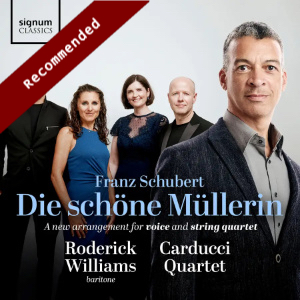
Franz Schubert (1797-1828)
Die schöne Müllerin, Op 25, D 795 (arr. Roderick Williams)
Roderick Williams (baritone)
The Carducci Quartet
rec. 2025, St John’s, Upper Norwood, London
German text & English translation included
Signum Classics SIGCD1003 [64]
Roderick Williams has previously recorded Schubert’s great song cycle in 2018 with pianist Iain Burnside (review). Seven years later he has returned to the cycle, but in a different way. Here, he offers us his own arrangement of the cycle for baritone and string quartet.
In a preface to the booklet Williams is quick to state that the arrangement “is no attempt to improve on or supersede the original. At best, it is an act of homage, an avenue for me as a musician to explore a piece that has gripped my attention for the past ten years that I have been singing it professionally.” He expresses the hope that he has remained true to the style and spirit of Schubert’s original but he admits that he has “sometimes overstepped the role of transcriber and become a fledgling composer”. In saying this, he is referring to the occasions when he has given the first violin a counter melody, creating “occasional singing lines at the top of the texture”. He then adds the fascinating observation that these occasional first violin lines made him wonder, in retrospect, “whether this might have afforded an opportunity for the cycle’s title character to have more of a voice”. That last point offers a cause for thought on the listener’s part. I say that because, as the composer Lucy Walker says in her valuable and perceptive booklet essay about the cycle, the young maid “barely registers as a character. She is principally a projection: an embodiment of the Miller’s fantasies”. Before I go on, I should say that I think Williams is being unduly modest when he refers to himself as a “fledgling composer”. In fact, he has written quite a lot of music and what I’ve heard in several recordings and live performances – mostly of his choral music – I’ve liked and admired (review). Perhaps even more relevantly to this latest project, he ‘has form’ as an orchestrator, as was demonstrated a few years ago in the collection of his arrangements of songs by British composers which he recorded with Sir Mark Elder and the Hallé on the orchestra’s own label (review).
In discussing this new recording of Die schöne Müllerin I think my main focus should be on the success or otherwise of the new arrangement since that, I suppose, is what readers will particularly want to learn about. Let me, therefore, briefly address the performance before going any further. Roderick Williams sings these Schubert songs marvellously. The singing per se is unfailingly pleasing to hear and, crucially, he brings to life the texts and the emotions behind the words. The members of the Carducci Quartet are equally fine. Throughout the songs you get the distinct impression of five musicians working as one. All this is clearly the result of significant rehearsal and thought about the music, yet at the same time they manage to sound spontaneous. So, in terms of performance standards, you can invest in this disc with complete confidence.
Inevitably, perhaps, I approached this recording with a mixture of curiosity and caution: how would I react to a work that I’ve known for decades in its piano version when hearing it in a completely different guise? I can honestly say, I was hooked within a few minutes. It may seem a silly thing to say, but the performance gave me the impression that I was listening to a Schubert string quartet with added voice part. Perhaps, in part, that’s what Williams intended. The reason I make the comment is to emphasise that his version sounds authentic.
It’s not long before there’s evidence of what Williams has done in creating at times a new countermelodic line for the first violin; an example occurs in ‘Das Wandern’. I noticed it, but I didn’t find it a distraction. The string parts are more legato than one would hear from a piano but even so the accompaniment is sprightly. The lyrical fluency of the strings in ‘Wohin?’ is very pleasing; they complement Williams’s easy delivery. The instrumental introduction to ‘Halt!’ could have been lifted straight from a Schubert quartet. A little further into this song, we hear a violin countermelody when Williams sings ‘Ei wilkommen’; it works. In my vocal score, which is the high voice version, much of the accompaniment to ‘Danksagung an den Bach’ is entirely in the bass clef. In that context, it’s so apt that Williams gives a degree of prominence to the nutty sound of the viola. ‘Der Neugierige’ is another song in which a ‘new’ line for the first violin appears. When the music moves from Langsam to Sehr langsam (at ‘Bächlein, meine Liebe’) the sustaining abilities of the strings, which are greater than those of a piano, pay dividends.
There are many strophic songs in the cycle and in Schubert’s original the piano part for each verse is identical; it’s up to the pianist to provide variety through colouring, dynamic shadings and so on. Williams does not feel so ‘constrained’ – and rightly so. In several of these strophic songs I noticed subtle but definite changes in the original accompaniment as between one verse and the next. ‘Morgengruß’ offers one such example, as does ‘Des Müllers Blumen’. In every case where Williams modifies or varies the accompaniment in such a fashion, I think it works; one notices the differences – especially if following in a piano score – but so subtle and idiomatic are the modifications that one is not distracted by them, still less irritated. In ‘Die liebe Farbe’, the string accompaniment, played legato, paints a sorrowful picture. The use of pizzicato midway through the second stanza (at ‘Das Wild, das ich jage…’) is very telling, as is the doleful viola line at the same point in the third stanza (‘Kein Kreuzlein schwarz…’)
There’s one detail in ‘Trockne Blumen’ which really caught my ear. In the original version the accompaniment has simple chords in quavers, played piano; the device recurs a little later on as well. In the Williams version, the strings play these chords pizzicato. That’s no surprise; what is a surprise is the way these chords are played, so that the sound is really dull. It’s only a small detail but, my goodness, it’s telling. I wonder if this is how Williams, as arranger, directs these chords to be played or whether the effect is an idea that the five musicians came up with in rehearsal. It matters not; it’s really imaginative. At the start of ‘Der Müller und der Bach’, the sustained string music adds to the heartrending mood established by Williams as the Miller. Then, when the Brook answers, the sound of the four stringed instruments provides gentle reassurance. In the concluding ‘Des Baches Wiegenlied’ the Carducci Quartet restrict their vibrato significantly; the sound they produce thereby adds to the sense of melancholy repose. As I listened to the performance of this song I wondered, more than previously, exactly where Roderick Williams was standing as he sang the song; he sounds to be right in the midst of the Carducci Quartet.
That last point is symbolically important, I think, because it illustrates the sense I had throughout this performance of Die schöne Müllerin that five musicians are acting in such close collaboration that they are as one. This is an ensemble performance. Williams’ role, as the singer and, therefore, the person who is delivering the text, is crucial, of course, but here he seems to be primus inter pares.
I came to this disc, as I said, with questions in my mind but I was soon and completely won over. I think Roderick Williams’s arrangement of Schubert’s great song cycle is an unqualified success; it has made me appreciate the songs in a new, exciting way and it has made me consider them afresh. If you love Die schöne Müllerin you must hear this version for yourself and make up your own mind; I hope your reaction will be as positive as mine has been. You’ll not only experience a very skilled arrangement – and one that is, I believe, true to the spirit of Schubert – but you’ll also hear a very fine performance by five excellent musicians who are on top form.
The technical side of the project has been expertly managed by producer Alexander van Ingen and engineer Tom Lewington; the recorded sound is very truthful and pleasing. As I indicated earlier, Lucy Walker’s booklet essay is very valuable.
One final thought: might Roderick Willams now turn his attention to Winterreise?
John Quinn
Other review: Stephen John Wray Gladwin
Buying this recording via the link below generates revenue for MWI, which helps the site remain free













