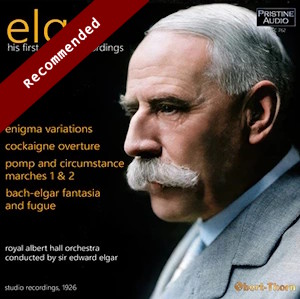
Sir Edward Elgar (1857-1934)
His first electric recordings
Royal Albert Hall Orchestra/Edward Elgar
rec. 1926, Queen’s Hall, London
Transfers and restoration by Mark Obert-Thorn
Pristine Audio PASC762 [65]
What a wonderful conductor Elgar was! Nor, apparently, was this confined to his own works; he conducted the London Symphony Orchestra’s first British tour in 1905 and was its Principal Conductor of the for two years after Richter retired in 1911, and his performances of works by other composers were highly regarded. Sadly, the only recording he made of any music that he had not composed or orchestrated was Croft’s hymn “O God our help in ages past”, which hardly tells us very much about his qualities.
This CD is ordered in chronological order of recording date, so the first item is the Cockaigne overture. This in many ways demonstrates the essential style of Elgar’s conducting: a tumultuous vitality and momentum which carries the music forward irresistibly, but also has the ability to relax in more lyrical section without ever losing that sense of momentum. The rumbustious joie de vivre of this performance has probably never been never been surpassed.
The arrangement of Bach’s Fantasia and Fugue in C minor is very much in the style of the time, and is none the worse for that. The Fantasia would perhaps have been even more effective at a slightly slower tempo, but at 4.36 it was towards the limit of the duration of a 78 side, particularly at this very early period when they would not have been sure just how close to the label they could go without affecting the recording quality. The Fugue on the second side is wonderfully big-boned and trenchant, with aspects, such as between 47 and 55 seconds into the fugue, which out-Stokowski even that great arranger of Bach. Chanson de Nuit has a lovely, unsentimental flow in marked contrast to the Bach.
The two Pomp and Circumstance marches have the same gusto as Cockaigne, and the “Land of Hope and Glory” trio of No. 1 is kept flowing rather than being heavy and portentous, and has none of the bombastic feel of most modern performances. It is also kept to a strict tempo most of the time with little rubato. The ‘Meditation’ from The Light of Life is another performance which I feel is somewhat compromised by the length of a 78 side; it would have been much more effective at a slightly slower tempo.
The main work on the CD is the Enigma Variations, and again this is an excellent performance. The theme itself has exactly the same sort of natural flow that we have heard in the other pieces – serious but without any portentousness. In the second variation, H.D.S. bustles wonderfully, and all the people whom the composer presents are etched with precision in this performance. Ysabel and Troyte are particularly fine, I think, in their utterly different characters. Nimrod would today be thought a controversial performance. Nowadays, it has been so thoroughly appropriated by the spirit of the Cenotaph that its original intention is almost completely forgotten. Like Barber’s Adagio, it has become so associated with a context of national mourning that is utterly irrelevant to anything that was in the composer’s mind when he wrote it that most people cannot think of it without the shadow of mortality. Anyone who has read the wonderful biography of August Jaeger by Kevin Allen will know how little these black-crêpe-bedecked performances have to do with the man whom Elgar portrayed.
One of the things that is particularly important about all these performances is that they were recorded at the beginning of one of the great tipping points of performance style. Up until 1926, especially in Britain, the style of orchestral string playing (and, indeed, solo playing) included the liberal use portamento. With the disdain for Romanticism which followed World War One, this style became completely out of fashion. It took a short while for the new way to establish itself, but once it had, it completely took over in an astonishingly short time. The old style was still standard in 1926, but by the early 1930s it had all but disappeared. We need only to listen to the first recordings of the two new orchestras (the BBC Symphony, founded 1930, and the London Philharmonic, founded 1932) to hear the almost complete lack of string portamento in music of all periods. The orchestra heard on all these recordings was founded in 1905 as The New Symphony Orchestra, but was renamed The Royal Albert Hall Orchestra in 1915. It reverted to its original name in 1928 until it disbanded around the start of World War Two. Its style in 1926 was entirely of the old school, which is what Elgar would have expected for all his compositions from the earliest until at least the Cello Concerto of 1919. Here is the truly “authentic” sound and style for the performance of Elgar’s music.
All the recordings here have, of course, been reissued several times before, most notably in EMI’s ground-breaking “Elgar Edition – Complete Electrical Recordings of Sir Edward Elgar”, issued in 1992. These were revelatory transfers at that time, by far the best ever achieved and the benchmark for all transfers of early orchestral recordings. But this is now 35 years ago, and transfer technology has come on enormously since that time. When making direct A/B comparisons for this review, I was surprised at how well the old transfers stood up against the new. There is definitely a greater presence in the new – it is as though we had moved to seats ten rows closer to the orchestra in the hall. The individual instruments come to the fore, the higher frequencies are more present (a good example is the series of quiet cymbal brushes between 34 and 42 seconds into the finale of the Enigma Variations – there is marked improvement on the Pristine compared to the EMI), and the middle frequencies are less “tubby” and more defined. There is a definite improvement, but it is certainly not “chalk and cheese”.
If you do not have the old EMI set, and if you have any sort of serious interest in performing styles and traditions (not to mention superlative interpretations), then this CD is a must.
Paul Steinson
Availability: Pristine Classical
Contents
Elgar – Cockaigne (In London Town) – Concert Overture, Op. 40 rec. 27 April 1926
Bach-Elgar – Fantasia and Fugue in C minor (Elgar Op. 86 after Bach BWV 537) rec. 28 April and 30 August 1926
Elgar – Chanson de nuit, Op. 15, No. 1 rec. 27 April 1926
Elgar – Pomp and Circumstance No. 1 in D and No. 2 in A minor, Op. 39 rec. 27 April 1926 7.
Elgar – Meditation from The Light of Life, Op. 29 rec. 30 August 1926
Elgar – Variations on an Original Theme (‘Enigma’), Op. 36 rec. 28 April and 30 August 1926