
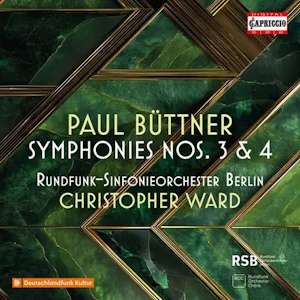
Paul Büttner (1870-1943)
Symphony No.3 in D Flat major (1910-1914)
Symphony No.4 in B minor (1917-1918)
Berlin Radio Symphony Orchestra / Christopher Ward
rec. 2024/2025, Berlin, Germany
Capriccio C5554 [81]
Yet another composer of worth emerges from the dark shadows cast by the rise the Nazis. Given the sheer number of musical discoveries already made by labels such as CPO, Capriccio and others, it is slightly surprising that the music of Paul Büttner has not featured more until now. Just over a year ago, CPO released a recording of his Symphony No.2which received a guarded welcome on MusicWeb (review). I have not heard that disc, so this release of his third and fourth symphonies is my first encounter with any of his music.
So who was Paul Büttner? The liner notes provide a very useful biographical note and a fairly detailed analysis of the music. Born into a working-class family – his father worked in a glass factory – he managed to become a composition pupil of Felix Draeseke. More crucially, by 1896 was appointed choral conductor and singing teacher at the Dresden Conservatory. Nearly a decade later he became chief conductor of the Dresden Workers’ Choral Association, and he was a music critic for a major Dresden newspaper. Because of his political leanings – as a Social Democrat he was an outspoken opponent of the National Socialists – and his Jewish wife, he was stripped of all his official posts in 1933. His compositions were added to the list of “degenerate music” before he died in poverty. The Cold War ensured that his work remained little known in the West. The revival only occurred in the last decade or so. What is not completely clear from the notes or biographies online is whether Büttner’s compositional activities were his main focus, or a parallel activity alongside his academic and critical work.
Aside from that CPO disc and a couple of older recordings re-released on CD, there is almost nothing commercially available, so this release is pretty much the place to start listening to Büttner’s music. It is fortunate, then, that it receives committed advocacy and excellent recorded sound. At 81 minutes, this is a very generous programme to boot. The bitter irony, given the Entartete Musik label applied, is that these scores could only have been written by a German composer, and one steeped in the values and traditions of 19th-century Germanic musical culture.
Büttner’s Symphonies No.3 and No.4 hark back to the musical traditions and values of that century. Franz Schmidt and Alexander Zemlinsky – just two examples – have dates similar to his. Both composers spring from an essentially tonal/neo-Romantic/Austro-German heritage, but they also sought to challenge and expand the potential of that heritage. On the evidence of this disc, Büttner was happy to emulate and celebrate that cultural legacy, not that that is a criticism as such. It is simply a practical observation, which will dictate how strongly these works engage an individual listener.
Symphony No.3, in the rich if awkward key of D flat major, has three movements; the central Adagio – Einfach und innig is the shortest. Steffen Georgi’s booklet note makes a passionate case for the quality of both works, but even he acknowledges that Büttner “seems to summon the pantheon of German Romanticism, one after another”. He goes on to name a number of famous composers, and Schumann is pre-eminent. This is undoubtedly true, although I would add a kind of Heroic Brahms as another characteristic. At the distance of over a century, the sense whether a composer is a musical modernist or conservative is less relevant than the abiding quality of the music itself. Büttner is certainly a careful craftsman and the music is engaging, especially when played as well as it is here by the excellent Runfunk-Sinfonieorchester Berlin. German orchestras still create a sound based around a sonorous and powerful lower register; that is very well caught here and serves the music ideally.
When writing reviews of unfamiliar music, I try and steer clear of the “sounds like” comparisons but in Büttner’s case this seems like a stylistic choice. Georgi points to Wagner’s Forest Murmurs as “unmistakeably related” to the close of the symphony’s first movement. He adds Mendelssohn and Franck to the list of influences for the central Adagio. To be honest, I was not too worried by these references. At the same time, it is hard to get a sense of the true voice of the composer. Having just two works on a single disc to make this assessment would never be an easy task. Yet even after repeated listening I find it quite elusive to place Büttner’s individual voice.
This issue carries forward to the Symphony No.4 in B minor. The voice of Richard Strauss is added to the stylistic melting pot. The symphony is in the standard four movements, with a scherzo second. It is significantly larger in spirit and longer than its predecessor: it takes fourteen minutes more. Given the date of its composition, I wondered if the effect and destruction of the War in part explained its fairly sombre, weighty character. The scherzo is the closest Büttner comes to the Bruckner of the later symphonies, although Georgi cites Beethoven’s 9th while the Strauss of Rosenkavalier lurks in the shadows too.
This seems increasingly like a shopping list of influences, so all credit to conductor Christopher Ward who coheres both symphonies to create a cogent whole. When the closing bars of the later work arrive, bathed in the warm glow of the end of an era, it is effective and rather moving. Indeed, I do not think a stronger case for Büttner’s work could have been made. Certainly there is enough music of interest and skilful craft here to draw the curious listener in. Even so, on the strength of one disc it is harder to judge whether an enduring revival is merited. In any event, Capriccio and all the performers must be given great credit for the quality of the presentation which these large-scale scores get.
Nick Barnard
Other review: Jim Westhead
Buying this recording via the link below generates revenue for MWI, which helps the site remain free














I really appreciate that you point out in this review how unfortunate it is, in a way, that Büttner does, in fact, sound like many of the other German romantic & late romantic composers at different times. I’m not sure if I was alone here, but to me it was a bigger problem in the second symphony (on CPO, which you cite) — in that case, I really did feel like I was hearing quite a lot of not-quite Schumann and Brahms. I thought that disc was a bit forgettable.
It might be that symphonies 3 & 4 are more confident, or maybe Ward & Rundfunk-Sinfonieorchester Berlin extract more character from Büttner, but I found this present album to be much more engaging. Okay, he still sounds like Strauss/Wagner/etc. but there’s plenty of color, variety, and emotional weight, particularly in the fourth. The ending really is very warm and rather moving, you’re spot on!
It’s very easy to pick out influences on composers – and both the MusicWeb reviews. especially Jim Westhead’s, have done this – but to me, the point is that both these symphonies present a coherence and an inspiration which together make up something really meaningful. It seems disgraceful to me that these two splendid symphonies have each had only one previous recording. Fortunately the new disc is excellent in every way.
As I mentioned in my review I try to avoid the “sounds like” comparison because I feel it can often be unfair to the composer being reviewed. However in this instance even the liner writer, who is a very passionate advocate for this music, states that Büttner “seems to summon the pantheon of German Romanticism, one after another”. Which suggests to me that this is a very conscious choice by the composer rather being a lack of originality. Quite “why” he does so is another matter and something for individual listeners to decide whether this works for them or not.