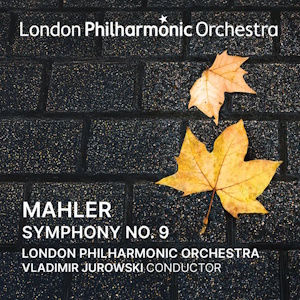
Gustav Mahler (1860-1911)
Symphony No 9 in D minor (1908-11)
London Philharmonic Orchestra / Vladimir Jurowski
rec. live 3 December 2022, Royal Festival Hall, London
London Philharmonic Orchestra LPO-0139 [79]
Vladimir Jurowski was the Principal Conductor of the London Philharmonic for fourteen very successful years (2007-21), after which he took the title Conductor Emeritus. The present recording, then, was made after he ceased to be Principal Conductor, but his rapport with the orchestra still sounds to be extremely strong.
As a somewhat sweeping generalisation, I’d say that Jurowski doesn’t approach this symphony in the acutely intense way that conductors such as Bernstein or Tennstedt have done. However, I found his way with the music very convincing; the Ninth is a work which can be very validly interpreted in more ways than one. One of the factors that disposed me very favourably towards this performance is that Jurowski divides the violins left and right; the benefits are significant
The huge first movement begins in a tender fashion, which I like very much. Gradually, both the music and the interpretation acquire intensity. The performance has great clarity; I’m sure its not simply due to microphone placing that one can hear so much inner detail in this highly complex music. The LPO is on terrific form; one of many passages that caught my attention was the little bittersweet episode (from 15:23) where the leader and the principal clarinet have significant solo contributions; both players are excellent. Soon after, though, there’s a very turbulent section and the way this is delivered is no less impressive. Throughout the movement, the climaxes are thrust home powerfully, yet time and again I appreciated especially the delicate passages where the music-making has great intimacy. Nowhere is this side of the performance better represented than in the fragile coda (from 22:56) which is beautifully delivered.
The Ländler second movement is taken steadily and sturdily; the rhythms are nicely pointed. I liked Jurowski’s way with this movement. The Rondo-Burleske, by contrast, is urgent and powerful. The lyrical central passage (from 5:43) flows very nicely – Jurowski refuses to linger excessively – and it reaches a ripe climax. When eventually the Rondo fully reasserts itself at speed (10:07) the tempo is fast and furious; it’s very exciting. In the last couple of minutes, the music hurtles to its end.
The benefits of dividing the violins left and right are most keenly felt in the concluding Adagio. Jurowski’s account of the opening paragraphs (to 9:15) is very eloquent and intense. Thereafter, the passage which leads up to the main climax (at 13:44) is taken at a tempo which is quite fleet; some listeners may be disconcerted by that, as I was at first. However, I think Jurowski makes his tempo selection work. The section after the climax (14:11 – 15:14) with the LPO horn section to the fore, positively glows. Earlier, I drew attention to the success of the LPO and Jurowski in the many delicate sections in the first movement. In the final movement, during the symphony’s long farewell (from 17:26), their way with Mahler’s delicate music is even more satisfying. The concluding Adagissimo (from 19:00) is simply wonderful. Here, the music is carried on threads of sound; the control and discipline of the LPO’s string choir is marvellous; this last section is very beautiful; you can hear a pin drop.
This is a very distinguished account of Mahler’s Ninth. Jurowski most certainly has the measure of the music and the LPO responds to his direction with superb playing from first note to last. I have literally lost count of the number of versions of this great symphony that I have in my collection; I’m very glad to have this one in addition to all the others.
The performance has been expertly recorded by engineer Deborah Spanton and producer Andrew Walton. I referenced earlier the amount of detail that’s audible. The engineers also give us a very successful ‘big picture’ and there’s a sense of the hall too; at the dramatic end of the third movement, you can hear the sound resonate in the acoustic.
I discovered that the concert was reviewed for Seen and Heard by my colleague John Rhodes, though I only read his commentary after I had finished my listening to this recording. I see that both John and also a member of the audience who posted a comment about his review, mentioned distracting coughing by some in the audience. I listened to the recording through good quality headphones and am happy to report that I heard no evidence of what another Seen and Heard colleague has memorably christened ‘the bronchial terrorists’.
Over the years Vladimir Jurowski and the LPO created a very impressive series of live recordings together. This new release is a worthy addition to that discography.
John Quinn
Buying this recording via the link below generates revenue for MWI, which helps the site remain free