
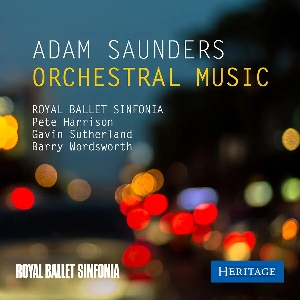
Adam Saunders (b. 1968)
Orchestral Music
Royal Ballet Sinfonia/Peter Harrison, Gavin Sutherland, Barry Wordsworth
rec. 2023-26, Henry Wood Hall & CTS Wembley, London
Heritage HTGCD117 [68]
Originally a forerunner to the fugue, capriccio – from the Latin capra (goat) – has latterly become a term for a humorous or capricious piece of music, rather fleet on its feet, a little unpredictable, and often delighting in sudden turns of mood. Philip Lane’s liner notes describe the opening track, Capriccio, as a “bright, exuberant, concert overture” exploring various themes. Some are dance-like; others, a little more wistful, offer a moment of repose. Overall, this is a good-humoured number, getting the concert off to a respectable start.
The longest work on this disc is the Three Pictures for Orchestra. The notes explain that it was designed to show off each section of the orchestra across its three movements. Each section bears a picturesque title that gently steers the listener’s imagination. Fanfare and Celebrations are more than just ceremonial flourishes: there are busy strings and deft interplay between brass and woodwind, giving a sense of festivity. Rivers of Calm, Peaks of Magnificence balance moments of serenity with passages of great grandeur; they may be a little unbalanced here and there but contain some lovely tuned‑percussion scoring. Dances of Exuberance are exactly what it says on the tin, though Saunders also finds room for quieter, more reflective episodes. It is perfectly possible for the listener to ignore the suggested titles altogether and enjoy the piece simply as a compact symphony, or even a kind of sinfonietta.
Philip Lane explains that Sketches of New York for Strings and Harp were inspired by Saunders’s visits to the Big Apple over many years. It is designed to capture moods and scenes that are “exhilarating, fascinating and melancholic”. Bustling Metropolis is full of the razzamatazz of people on the move – by road, subway, or ferry. Lonely Souls takes a dark look at those who seem to live in a parallel existence of homelessness and deprivation, removed from the city’s relentless energy. Green Oases meditates on the “wonderful parks” in the city, most especially Central Park, evoking a stroll with one’s lover. The concluding celebration of a City at Play, brings a musical depiction of a “fun‑filled night out, with all the glitz and glamour that New York offers”.
My only issue with these Sketches is the lack of muted trumpets, saxophones and percussion. These brash instruments seem to me essential for creating an impression of An Englishman in New York.
Parade of the Snowmen reflects the magical mood of Christmastime. To listeners of a certain age, it can feel as though there was snow every year; perchance we are all recalling the winter of 1962/1963 as a kind of folk memory. Children today have had fewer chances to build snowmen. Philip Lane notes that the music portrays “snowmen [waking] up all over the land, one by one they join the parade as it passes their respective gardens”. The magical scoring suggests snowflakes, fun and laughter, the march itself, a little mischief, and a touch of wistful nostalgia as the parade gradually sits down exhausted.
I do not know if there is a definite programme to the vivacious The Magical Kingdom. Children of all ages want to enter a secret place, where there are mysterious fairytale characters and scenes. We want to feel safe even in the presence of dragons, trolls and ogres. Saunders’s score provides an almost Disney-like filmic impression of these secret realms. Only towards the conclusion is there a hint of malevolence, soon swept away with a happy-ever-after coda.
It is all too easy to dismiss a sinfonietta as insignificant beside a full‑blown symphony, yet many examples of the genre have considerable artistic weight. Think of those by William Alwyn, Leoš Janáček, or E.J. Moeran: certainly not lightweight. Adam Saunders’s contribution is a shade less substantial, but it is an engaging and well‑crafted work. It opens with a brassy Allegro con spirito, setting a bold fanfare against a more languorous second subject in a straightforward sonata‑allegro design. The central Adagio tranquillo – nocturnal and atmospheric – is the emotional heart of the piece. A skittish Scherzo giocondo follows, full of wit and eccentricity, before a good old‑fashioned Allegro brillante rondo brings the Sinfonietta to a vibrant close. At around eleven minutes, it feels a touch brief, with several promising ideas curtailed, but it remains an enjoyable and satisfying miniature.
Another wintry work is the Fairytale Sleighride. The title can be taken literally or metaphorically. For some, it may summon Omar Sharif and Julie Christie gliding through the vast, frozen Russian landscapes in Doctor Zhivago; for others, the image might be Santa Claus dashing around the world each Christmas Eve. But this is not all whimsy. There is a hint of danger, too. The fairy tale is that of the Snow Queen, carrying the boy Kai away in her white sleigh across a glittering, inhospitable wilderness.
I would have appreciated a little more information about the Ballet for Strings. For one thing, is there a plot or scenario behind the well-wrought five “imaginary” dance scenes? Each movement is given a title: Giocoso, Grazioso, Animato, Delicato and Energico. This certainly suggests contrasting characters, but it remains unclear whether these are simply abstract moods or part of a more cohesive narrative. A few words on the Saunders’s intentions would have helped illuminate how these charming dances relate to one another. That said, this “suite” is on a par with Parry’s Lady Radnor’s Suite and Holst’s Brook Green Suite. It should find a place in the repertoire.
As a child, I was never entirely sure where Santa Claus lived, though I imagined it was the North Pole, somewhere amidst the icy waters of the Arctic Ocean. Nowadays, his official hometown appears to be Rovaniemi, Finland, right on the Arctic Circle, although the Finns have long regarded Korvatunturi, near the Russian border, as Santa’s magically‑protected home. Rovaniemi now hosts two major theme parks: Santa Claus Village and Santa Park.
Adam Saunders’s Journey to Lapland seems to acknowledge the commercialism of this modern destination; the liner notes detail snowmobiles, sleigh rides and husky sledding. Yet, the piece – vibrant and full of cinematic sparkle – perfectly captures the pure excitement of a festive adventure heading to points north.
This recording grew from a suggestion by Philip Lane, the well-known proponent of British Light Music, to display Adam Saunders’s concert music. A graduate and later Associate of the Royal Academy of Music, Saunders has enjoyed a varied career as performer, educator and composer. His orchestral repertoire is performed worldwide by ensembles from the Royal Philharmonic and BBC orchestras to the Hallé and Hong Kong Sinfonietta. His work spans film, television and major creative projects across the UK.
Overall, the disc offers a lively and engaging survey of Saunders’s orchestral writing. Not every idea feels fully explored, but the artisanry, colour and narrative talent are consistently appealing. Admirers of British light music (and so-called serious music as well) will find here much to enjoy.
John France
Contents
Capriccio (2025)
Three Pictures for Orchestra (2025)
Sketches of New York for Strings and Harp (2025)
Parade of the Snowmen (2025)
The Magical Kingdom (2003)
Sinfonietta (2025)
Fairytale Sleighride (2008)
Ballet for Strings (2025)
Journey to Lapland (2020)
Buying this recording via the link below generates revenue for MWI, which helps the site remain free













