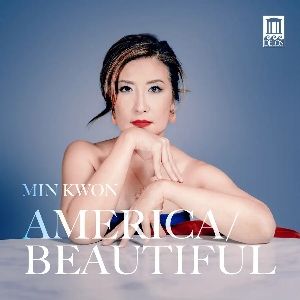
America/Beautiful
Min Kwon (piano)
rec. 2024/25, New York City
Delos DE3629 [5 CDs: 293]
Promotional material for this set states, “Delos celebrates the United States Semiquincentennial with this collection.” The release may indeed celebrate that event, but the project itself began in 2020 during the Covid pandemic lockdowns. Dr Kwon wanted to get out of her “bubble” and began contacting composers across the USA to write variations on the patriotic anthem America the Beautiful.
The 5 CDs include 76 world premiere recordings which provide an intriguing snapshot of American composers’ thoughts on piano writing in the 21st century. Not all of the works, however, are for piano solo; a handful include violin, cello and clarinet in various permutations. There is also a tenor who sings the full song on the very last track.
The liner notes begin with a rather feisty paragraph in which Dr Kwon writes, “When I first embarked on this project, one of America’s most renowned composers — who shall remain nameless — said to me: ‘Forget all these other composers. Your project will go down the trash. Just pay me $$$, and I’ll write you as many variations as you want.’” Who was this avaricious egotist? Is it a he or she or a they? Who is missing from the list of composers? The answer to that is quite a few.
I am sure Dr Kwon could author a book about the project: who said yes, who said no, what input did she have with the composers, did they have free rein to write whatever etc.? What, in fact, was their brief? The liner notes give very little information. There is a short essay by Dr Kwon and a further piece by Graeme Steele Johnson entitled E Pluribus Unum, which touches on some of the difficulties in writing variations on America the Beautiful in the present day, but for information on the composers and programme notes, you will need to find the website of the same name. The website has links to videos and much useful information. For some reason there are no links to it, nor even a mention of it in the booklet.
The website tells us that the project Mission was (is? I think works are still being commissioned):
• To celebrate the cultural melting pot that is our country
• To unite as many voices as possible for one purpose, one project, one question: What is America? Is it beautiful, was it ever, or will it ever be?
• To listen better. To understand more deeply.
These are quite lofty aims to aspire to, and I am not sure I believe music is the right medium to answer some of the questions.
The works here were, I believe, composed up to 2025, and I do not think anyone then could have foreseen the current impact of America on the world. Taking that into account in reviewing this set I could disappear down a rabbit hole of political commentary, but I shall refrain from that and just try to look at the music. There are so many works that I will be looking at four on each disc, the oldest composer on each disc and the youngest and two others. This will, I believe, give a sense of the styles heard in the collection.
The patriotic anthem America the Beautiful is more recent than I thought. The lyrics were published in 1895 by Katharine Lee Bates while the music was written, for different words, in 1882 by Samuel Ward. The two were not united until 1910, and Ward never heard them together, having died in 1903. Since that time, it has become one of the most popular of the many American patriotic works. In my humble opinion it would probably, with fewer verses, make a better national anthem than The Star-Spangled Banner, surprisingly not adopted until 1931, which with its range of a twelfth is almost impossible to sing in tune. The lyrics, to modern ears sound jingoistic, in the way that Land of Hope and Glory does to us British, but then that is the lot of patriotic songs. I have tried thinking what a British version of this project would sound like, but I doubt anyone would start one.
In the set, some composers have chosen to take issue with the lyrics while others were content to write ‘straight’ variations on the music itself. Rather than try to arrange the collection by style or theme, which could have got messy, Dr Kwon plays the works arranged alphabetically by composer A-Z. This does give rise to some unusual juxtapositions, which does, however, have the effect of keeping the ears alive.
The set opens with Samuel Adler’s grand arrangement of America the Beautiful which is followed by the same composer’s variation. Adler is a well-established figure of American Modernism and this work with its dissonant, pointillist flourishes show that this nonagenarian has lost none of his inventiveness. He provides a touching note on the work which highlights that as an immigrant to America, he arrived there from Germany in 1939: “the words have always had a very special meaning to me …and I tried to give a feeling of triumph to my variation to express the energy and creativity of our country that has inspired me from the time I came here in 1939 until this day.”
Lea Adu- Gilmore – her date of birth is not available – is a recent immigrant to the USA and holds a PhD from Princeton University. Her United Underdog “is dedicated to the unhoused, the incarcerated, the black, brown and yellow, the trans and gender non-conforming, the domestic workers, the food gatherers, delivery people, essential workers and underdogs that make these United States”. Understandably it is a pugnacious, theatrical work which contrasts spiky martial rhythms with full forearm clusters, which Dr Kwon navigates flawlessly.
Andrew Bambridge (born 1996) is not only the youngest person on Disc 1 but the youngest person in the whole set. At the time of writing the work he was a graduate student at Mason Gross School of the Arts, part of Rutgers University, where Dr Kwon teaches. He is a percussionist and in the tremolo effects of the opening of his work Oh Beautiful, we can hear the sound of the marimba. It is one of the few delicately lyrical works in the set, its rippling textures evoking the sea.
The disc ends with Stewart Copeland (born 1952), formerly of The Police, who provides no note for his work, but who seems to take a cue from Virgil Thomson and gives us a work that begins naively and then moves into a bluegrass tribute. Min Kwon is joined effectively by Yoon Kwon Costello on violin.
Vietnamese-American composer Viet Cuong (born 1990), who is currently on the faculty of my alma mater, the University of Nevada Las Vegas, opens Disc 2 with Americathe Beautiful: Echo Chamber. It sounds a fearsomely difficult work to play. In between rapid filigree patterns that traverse and swirl about the whole keyboard the melody is dropped into and picked out. Reverberation is a key feature of the work and Kwon pedals to perfection.
Pulitzer Prize winner and MacArthur Fellow John Harbison (born 1938) in Getting the Upper Hand on America gives us a humorous take on the brief. As the composer writes, “I thought while playing a set of variations one hand might like a rest. The hand that continues plays two fast variations; if there were a third It would travel right off the piano.” So what he has written is a rare work for right hand alone, that is a scherzo-like, whose light-hearted delicacy provides a welcome break to the many weighty utterances. On the same disc, Fred Hersch (born 1955) writes his Four Windows into America for left hand alone.
Justin dello Joio (born 1955) comes from a long line of composers; his father was the distinguished, though scandalously neglected, Norman dello Joio. Like him, he has had quite a connection with dance and this work Playing with Fire, has a very dance-like quality to it. As the composer says it is “fractured virtuosic toccatina” and I can easily see it finding its way into Yuja Wang’s repertory of encores.
Reena Esmail (born 1983) is an Indian-American composer and a graduate of The Juilliard School and the Yale School of Music. Her music is a syncretic blend of her heritage. Accordingly, America/Desh blends America the Beautiful with a melody in Raag Desh from the Hindustani classical tradition. The collision of the two worlds gives rise to some wonderful harmonies. The composer writes, “I hope this arrangement evokes a sense of multi-national pride, especially among the ever-growing population of South Asians living in America.” It is quite magical.
Disc 3 has two works by Koren-American Texu Kim (born 1980). The first America the Dream begins as if it is going to vary Beethoven’s Für Elise, then becomes a brilliant concert fantasy in the style of Gotschalk via David del Tredici and is deftly engaging. It is followed straight away by America the Polarized in which Dr Kwon is joined by Siwoo Kim on violin and Andy Lin, Nan-Cheng Chen on cello, and the material becomes a violent dystopian vision; the beauties of America the Dream become a nightmare.
The elder statesperson on Disc 3 is Libby Larsen (born 1950) who was born in Delaware but developed her reputation through many years in Minnesota. She tells us that Amber (Variation), was inspired by “the image of a ripened field of grain, rolling and swaying in late -summer wind”, though on first listening I heard streams or rivers. The music is cleverly based on two parts of the melody America the Beautiful – “Oh beautiful, for spacious skies” and “for amber waves of grain”. These two fragments form the basis of the work in which the composer instructs the performer to play “delicately oscillating, lightly, legato throughout” and with dynamics never above pianissimo. Its shimmering textures are a balm to the soul.
It is in complete contrast to the work by her contemporary George E. Lewis (born 1952), who is Professor of American Music at Columbia University, and one of the most distinguished of African-American composers. America the Changing Scene comes with a dense academic programme note, which I struggled to grasp. It is based around thick chords in the lower end of the keyboard and ghostly fragments of the tune in the upper register. At about 2’44”, a fragment of We Shall Overcome is sounded timorously but perhaps hopefully. I found this the toughest work to get into, but it has born repeated listening.
The youngest composer on Disc 3, Patricio Molina (born 1993), provides one of the most aurally interesting works. Dr Molina is like Andrew Bamridge a former student at Rutgers University. His work Amrika, he tells us “embodies my personal journey as an Arab. Born in Chile to a Syrian mother, I am now settled in New Jersey, close to my Arabic family who sought refuge from Syria’s unrest.” It utilises aspects of Arabic musical scales and at the beginning seems to ask the pianist to place paper on the keys to produce a buzzing sound. It is very atmospheric. In its gestures though it did remind me of Saint Saens Africa Fantasy and parts of the Piano Concerto No. 5.
On Disc 4 I was very surprised by Terry Riley’s contribution until I realised there is a typo on the slip case. The work is listed as Crown of Brotherhood but on the website, it is called Crown of Brotherhood Rag, which makes sense. This founder of American Minimalism has here taken his cue from William Bolcom and William Albright’s works and writes a ragtime/bluesy number. It is very surprising but very entertaining.
The only deceased composer in the collection is Paul Schoenfeld (1947-2024). His works were always inspired by the whole range of his musical experiences, and in his borrowings from the popular and highbrow he delighted his public and upset critics. His most famous work is probably Dog Heaven the last movement of his piano concerto Four Parables, a madcap homage to ragtime and cartoons, guaranteed to have the audience on its feet cheering.
In true fashion, his wonderfully titled Aramaic Fuel Tube, which the composer said came to him as an improvisation, and which maintains the free spirit of that form, takes on a stylistic journey. I think I heard snatches of Johan Strauss II, Brahms and Schubert, and I am sure there are others. Quixotic and brilliant it is guaranteed to raise a smile.
Newman-Lessler (born 1990) calls his Kintsugi (for singing pianist or piano and two Ebows) “broken music”. It was written during the June 2020 George Floyd protests, and uses an idea taken from the Japanese culture where a broken ceramic is mended not with the same material but with gold so that the join is always visible. Here that means that he fractures the melody of America the Beautiful and reassembles it. His programme note for this very short – two minute – piece promises much but the music is much more prosaic. The process of fragmentation is clearly heard but the sentiments he describes are outside the scope of the work. Dr Kwon chooses not to sing in the work and uses two electronic Ebows on the piano strings to sustain what I think was a D.
Pulitzer Prize winning composer Shulamit Ran (born 1949) contributes America Summer 2020 [the Beautiful] is one of the works that questions “the Beautiful” in the song’s lyrics and hints at, for the 21st century a darker side the work. Poetic and enigmatic, it expertly poses, in musical terms a question.
On Disc 5Derek Skye’s (born 1982) toccata like Woven, Gesture, Flow, is one of the most surprising of the works in the collection. A few seconds in and the unsettled tuning made me think that it was in just intonation not equal temperament or maybe some strings are prepared in advance; his notes give no clue. In any event, it is a rhythmically and harmonically diverting work that is over far too quickly.
The elder composer on the final disc is Judith Lang Zaimont (born 1945) who studied piano with Rosina Lhévinne at Juilliard and composition with Hugo Weisgall and Jack Beeson at Queens College and later with Otto Luening while at Columbia. Her variation is In darkness veiled, a nocturnal work in a Romantic/Impressionist idiom in which gossamer hints of the melody appear only to quickly disappear.
Liliya Ugay born in 1990 in Uzbekistan is a graduate of Yale University and is Assistant Professor of Composition at the Florida State University. In her note to the work, she outlines, as did Samuel Adler, the very positive time she has had in America. The Beautiful if anything reminded me of one of the less dense early works of Sorabji. Impressionistic harmonies, filigree patterns and an overall feeling of contentment suffuse the work with a warm glow.
Patrick Zimmerli (born 1968) is a composer whose work seemingly covers jazz, classical and everything in between. The notes tell us he is working on a commission from Opera Arizona to write a serial opera to be viewed on mobile phones and tablets! His work Melting takes its cue from the phrase “America the Great Melting Pot”, and is a virtuoso jazz influenced fantasy on the tune. Brilliant and uplifting, it gives Gershwin a run for his money.
The collection ends with Dr Kwon’s own arrangement of America the Beautiful for piano and tenor, here Stephen Costello. After what has gone before it is a maudlin affair, sounding more like a lament than an affirmation – a decidedly curious end to almost five hours of music.
Min Kwon cannot have liked all of the works she requested, and yet she shows what a tremendous artist she is in that she approaches all with such a tremendous sense of dedication and unerring musicality. From ragtime to virtuoso cascades of notes, she proves herself more than a match for every demand.
In 1978 C. F. Peters Corporation published the collection of Waltzes by 25 Contemporary Composers edited by Robert Helps and Robert Moran. That grew, as does this set, out of communications, then telephone and letter, rather than Zoom or email, between the editors and those composers they thought would be interested. That set included, and is the type of music missing here, John Cage’s 49 Waltzes for the Five Boroughs, a set of instructions for creating the work. There are no representatives here of that experimental approach to composition and the experimental is something I have always associated with American piano music. The C.F. Peters set did include some of the then developing American minimalism namely Philip Glass’s Modern Love Waltz. Now a major ’school’ in composition it is odd that the only minimalist work in this collection is by Glass protégé, Nico Muhly.
In the early/mid1980s, the late Yvar Mikhashoff curated, for the Almeida Festival in North London, a series of concerts looking at the development of American piano music. A later iteration was collected in the four-CD set on Mode Records “Yvar Mikhashoff’s Panorama of American Piano Music” and is well worth searching out. Mikhashoff’s survey included almost no women composers. Out of almost sixty composers in the recorded version only three are women. Thankfully, times change, and here out of seventy-six composers almost one third are women. Mikhashoff’s composers were all of Western European descent, but what is so striking here is the number of composers whose families originated from all corners of the world. In that sense America truly is a melting pot of musical cultures. It is the interaction of other music with the Western tradition that have made for the most striking works in this collection.
In an essay on the website Julia Cho writes that “part of Kwon’s hope for the project is for future generations to have a record of this time.” In that she is undoubtedly correct; this is an invaluable collection of contemporary piano works. For the reasons stated it is not stylistically exhaustive, but it is fascinating.
Paul RW Jackson
Contents
Disc 1
Samuel A Ward (1848-1903)
America the Beautiful (arr. by Samuel Adler)
Samuel Adler (born 1928)
A Celebration of Our Beautiful Nation
Bruce Adolphe (born 1955)
A Contemplation
Leila Adu-Gilmore
United Underdog
Timo Andres ( born 1985)
American Coda
Anonymous
TBD
Andrew Bambridge (born1996)
Oh Beautiful
Jonathan Berger (born 1954)
But, Wait a Minute…
Victoria Bond (born 1945)
Sea to Shining Sea
Peter Boyer (born 1973)
Still Beautiful
Kenji Bunch (born 1973)
Beauty for All (Or for None at All)
Theo Chandler (born 1992) Undimmed by Tears
Anthony Cheung (born 1982)
no longer stain
Charles Coleman (born 1968)
To Be Beautiful
Stewart Copeland (born 1952)
America Quite Beautiful
Disc2
Viet Cuong (born 1990)
America the Beautiful: Echo Chamber
Sebastian Currier (born 1959)
23 Variations on America
Richard Danielpour (born 1956)
Fantasy Variation (The Visible Enemy)
Tyson Gholston Davis (born 2000)
American Tableau (Tableau XI for Piano)
Justin Dello Joio (born 1955)
Playing with Fire
Donnacha Dennehy (born 1970)
New Jersey
Jed Distler (born 1956)
Ameritango
Anver Dorman (born 1975)
American Toccata
Reena Esmail (born 1983)
America / Desh
Alan Fletcher (born 1956)
Liberty in Law
Michael Gandolfi (born 1956)
Of Liberating Strife
Michael Gilbertson (born 1987)
Grace
John Harbison(born 1938)
Getting the Upper Hand on America
Stephen Hartke (born 1952)
O Genus Infelix humanum
Jake Heggie (born 1961)
Undiscovered
Fred Hersch (born 1955)
Four Windows into America
Jonathan Bailey Holland ((born 1974)
No Man’s Land
Huang Ruo (born 1976)
Meditation
Disc 3
Vijay Iyer (born 1971)
Crown thy Good
Pierre Jalbert (born 1967)
Endeavor
Kristjan Järvi (born 1972)
Look Up America
Gabriel Jenks (born 1981)
Passage
Juan Pablo Joffre (born 1983):
Air of America
Aaron Jay Kernis (born 1960)
Epilogue: End of the Dream
Texu Kim (born 1980)
America the Dream
America the Polarized
Jiyoung Ko (born 1982)
My America
Libby Larsen (born 1950)
Amber (Variation)
George Lewis (born 1952)
America, the Changing Same
Lei Liang (born 1972)
America the Beautiful… Devastatingly Quiet…
David Serkin Ludwig (born 1974)
Qaddis
Maya Masaoka (born 1958)
Praying for a Sign
Jessica Meyer (born 1974)
Halcyon Skies
Patricio Molina (born 1993)
Amrika
Paul Moravec (born 1957)
America, the Work in Progress
Disc 4
Nico Muhly (born 1981)
Refine
John Musto (born 1954)
Habanera
Qasim Naqvi (born 1977)
America The
Daniel Newman-Lessler (born 1990)
Kintsugi
Scott Ordway (born 1984)
You Are Welcome Here
Paola Prestini (born 1975)
through eyes that see quite clearly…
Dave Ragland (born 1978)
A Most Glorious Grace
Sulamit Ran (born 1949)
America Summer 2020 (The Beautiful)
Gity Razaz (born 1986)
Beauty of America
Gyan Riley (born 1977)
Endure
Terry Riley (born 1935)
Crown of Brotherhood
Daniel Bernard Roumain (born 1971)
America, Never Beautiful
Greg Sandow (born 1943)
America Slow Dance12-Tone America
David Sanford (born 1963)
Three Places in America (Less than a Mile From Each Other)
Paul Schoenfeld (1947-2004)
Aramaic: Fuel Tube
Disc 5
Jeff Scott (born 1967)
Purple Mountains
Juri Seo (born 1981)
America the Beautiful – “Sotto voce”
Robert Sirota (born 1949)
Two Variations: …Alabaster Cities… –…God Mend Thine Every Flaw…
Derrick Skye (born 1982)
Woven, Gesture, Flow
Augusta Read Thomas ( born 1964)
FUSION
ChristopherTrapani (born 1980)
Thine Every Flaw
Liliya Ugay (born 1990)
The Beautiful
Melinda Wagner (born 1957)
Swinging in My Yard (An American Reverie)
Wang Jie (born 1980)
Under the Same Flag
Trevor Weston (born 1967)
A Fantasy on AmericaPamela Z (born 1956)
America Guay America Guay America
Judith Laing Zaimont (born 1945)
In Darkness Veiled
Patrick Zimmerli (born 1968)
Melting!
Samuel Zyman (born 1956)
Latin, America Beautiful
Samuel A Ward (1848-1903) (arr. by Min Kwon)
America the Beautiful
Other performers
Graeme Steele Johnson (clarinet), Brian Hong (violin), Yoon Kwon Costello (violin), Siwoo Kim (violin), Andy Lin (viola), Nan-Cheng Chen (cello), Stephen Costello (tenor), Ari Evan (cello).
Buying this recording via the link below generates revenue for MWI, which helps the site remain free