
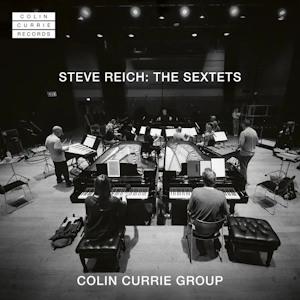
Steve Reich (b. 1936)
Sextet (1984, rev. 1985)
Double Sextet (2007)
Six Marimbas (1973, rev. 1986)
Dance Patterns (2002)
Colin Currie Group
rec. 2025, Kings Place, London, UK
Colin Currie Records CCR0009 [79]
I consider that Steve Reich peaked early. He began with phase works, more in the nature of experiments than satisfying compositions. In the 1970s and 1980s, he produced the works for which he is still best known: Drumming, Music for Eighteen Musicians, some orchestral music and the choral works The Desert Music and Tehillim. These have a glow and radiance, impossible to describe though easy to recognize – and, to my mind, largely absent from most of those of his later pieces which I happen to have heard.
This conviction was strengthened when I listened to the present programme: two works from what I am calling Reich’s peak period and two from later. They are all sextets, but the instrumental makeup is different in each one, and none conforms to any traditional idea of a sextet.
The piece called simply Sextet is for three marimbas, two vibraphones, various percussion instruments, two pianos and two synthesizers, so the six players have to be versatile. Its five movements form a kind of arch used by Bartók, a very different composer. The fast outermost movements enclose two slower movements, and the central movement is the slowest and the shortest. The first movement is very beguiling, Reich at his finest with the rhythmic patterns constantly varying according to a scheme explained in the booklet (one is not expected to follow that scheme). I found the middle movements less attractive, partly because of the frequent use of the bass drum, whose thumps were too frequent to be pleasant. Bowed vibraphones provide a change in timbre. The last movement is like the first but not as attractive.
Next, we have Double Sextet for two ensembles, each consisting of flute, clarinet, vibraphone, piano, violin and cello. There are three movements, fast, slow and fast. The musical language is similar to that of Sextet, but somehow the magic is gone. The rhythmic patterns unfold themselves and it is all skilfully done, yet some intangible quality is missing.
With Six Marimbas, we are back to the earlier period. This is in fact a reworking of Six Pianos, done at the suggestion of one of Reich’s percussionists. There is one extended movement. The marimba is a lovely instrument, so the sound is immediately very attractive. The rhythmic patterns change frequently enough for the listener to be charmed, not irritated. The work does not outstay its welcome.
Dance Patterns is a short piece, part of a composite score by several composers for a ballet on film. It is for two pianos, two vibraphones and two xylophones, and falls into three short sections played without a break. It is pleasant enough but in no way special.
Colin Currie is, in effect, the authorized successor to Reich himself as a performer, and Reich has praised his performances. His group has already recorded Reich’s Drumming and Music for Eighteen Musicians (review), and a disc of short works they made together. The performances have all the required precision and commitment, and the recording is excellent. This is not going to convert the sceptical, but those committed to Reich or only just curious about him will find it of interest.
Stephen Barber
Buying this recording via the link below generates revenue for MWI, which helps the site remain free













