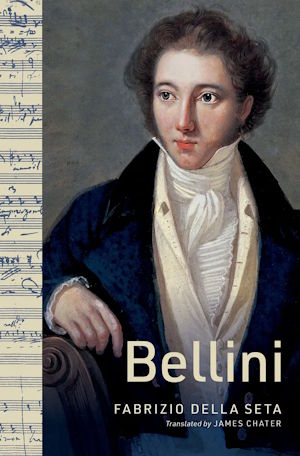
Bellini
by Fabrizio Della Seta (translated by James Chater)
Published 2026
448 Pages, 32 b/w illustrations, 33 musical examples, hardback
ISBN: 9780197787236
Oxford University Press
In 2024 Oxford University Press announced the next stage of the evolution of the venerable Master Musicians series. Now re-envisioned as ‘Composers Across Cultures’, its new name heralds an expanded remit, designed to include figures beyond the traditional Western art-music canon, including jazz, popular, and non-Western musical traditions. It will be fascinating to see how the titles develop and diversify, but the first new volume to find its way to me is of an individual firmly within that canon: Vincenzo Bellini. Indeed, Leslie Orrey’s Master Musicians book on Bellini, first published in 1969, has been a valued reference point for me over the years in my encounters with the composer.
Fabrizio Della Seta’s new volume provides an instructive comparison in a number of ways. Structurally, it’s much more in keeping with modern trends in critical biography. Instead of a relatively concise account of the life followed by an analysis of the works, which we find in Orrey and many of the older Master Musicians books, here the operas are presented in biographical context, which feels not only natural but immediately illuminating. In terms of content, Della Seta rightly sees Bellini as a dramatist first and foremost. There’s excellent analysis of the music of course, but it’s balanced with much interesting writing on the wider theatrical and cultural context in which Bellini was working. Finally, there is a wealth of new scholarship. At just about the same time as Orrey’s book was published, Bellini studies took off. Della Seta pays tribute to musicologists such as Friedrich Lippmann and William Rothstein whose analytical rigour yielded insights that shed new light not just on Bellini but his contemporaries too. Della Seta himself has also been an important contributor to the seminal, ongoing Edizione Critica of Bellini’s works which has not only been revelatory in terms of the more famous operas but has permitted the staging of some for which no settled version of the score had previously existed.
What does all this mean for the reader? The highest compliment I can pay is that the book presents an engrossing narrative which one can read from start to finish and come away enlightened and entertained. My affection for Orrey and many of the other Master Musicians volumes is genuine, but I used them chiefly as reference companions and rarely felt compelled to read them cover to cover. For anyone at all interested in 19th century opera, Della Seta’s book is a genuinely good read.
One of its great strengths is the focus on creative partnerships. Della Seta is fascinating on Bellini’s relationship with his librettists. He starts, for example, with a defence of Andrea Leone Tottola, who wrote the words for Bellini’s first opera, Adelsone Salvini. In a brilliant textual analysis of an aria of Bonifacio’s from the second act of the opera — an astonishing self-dialogue — Della Seta quickly makes it evident what the perceptive young composer saw in Tottola. Then there is the chronicling of the relationship with Felice Romani, who was the librettist of many of the works which followed Adelson. From the promising beginnings that were Il pirata, they went on to the extraordinary act of creation which was I Capuleti e i Montecchi. This opera, not based on Shakespeare but drawing on some of the same sources as Romeo and Juliet, was written in the space of a month! Romani intelligently reworked an earlier libretto he had written for Nicola Vaccai, Bellini equally skilfully revisited the musical material he had written for the dramatically inert Zaira. La sonnambula and Norma followed, only for the relationship to founder with the writing of Beatrice di Tenda. Romani was not happy with Bellini’s decision to abandon a planned opera based on Dumas’s drama about Queen Christina of Sweden for one based on Carlo Tedaldi Fores’s play centred on Beatrice. A judicial injunction was required to force Romani to get on with the work. His revenge was an inscription on the libretto declaring that the story ‘needs all the indulgence of the readers’. Unsurprisingly one of the great creative partnerships in opera was not renewed after this episode, which helps to explain why I Puritani was set to an arguably less than accomplished libretto by Count Carlo Pepoli.
Then there are the singers: Giovanni Battista Rubini, the romantic tenor for whom the role of Gualtiero in Il pirata was conceived. Rubini was to go on to feature as Elvino in La sonnambula and as Arturo in I Puritani. Della Seta writes that his creative relationship with Bellini was comparable to that of Britten and Pears, and the book helps us to understand why. There’s also a notable constellation of female singers, very vividly evoked: Giuditta Grisi who created the role of Romeo (and whose skill was responsible for Bellini deciding to make it a trouser role), her sister Giulia who sang Juliet and went on to be the first Elvira in I Puritani and of course, Giuditta Pasta, who created both Amina inLa sonnambula and the title role in Norma. Her voice was famously more dramatic and expressive than purely virtuosic, or as Della Seta puts it more precisely, ‘not so much technical-vocal but interpretative’.
I’ve left what Della Seta has to say on the music until last, partly to convey something of the richness of the book’s evocation of the context and creative milieu in which Bellini was composing, but as you might expect from one of the General Editors of the Bellini Edizione Critica, his musical analysis is superb. Genuinely enlightening on Bellini’s compositional development in the early works and how his approach evolved, I found Della Seta’s observations on the mature works utterly absorbing. Take his demonstration of the innovative ostinato rhythms in Beatrice di Tenda, for example, which were a huge influence on Verdi, or his magisterial structural dissection of the Introduzione and Finale dell’atto primo in I Puritani. Intelligent and informative, this is music writing at its best.
Talking of I Puritani, it’s interesting that Orrey’s list of Bellini ‘masterpieces’ doesn’t include the opera. Admiring though he is of the work, it’s clearly not in the same league for him as I Capuleti e i Montecchi, La sonnambula and Norma. With new productions this year at both the Met and Covent Garden, I think most opera lovers’ view of the work is very different in 2026. Della Seta’s book, informed by his critical edition of the opera, gives intellectual substance to the sheer thrill one experiences when hearing it sung well, as in the recent Met broadcast. His story of the work’s creation also includes a tantalising sub-plot concerning Bellini’s developing relationship with the all-powerful Rossini in Paris. Rossini’s admiration for the younger composer was clearly on the rise, and it seems likely that he offered Bellini advice on the score, but we’ll never know exactly what, only that, as Bellini wrote to a friend at the time, ‘Rossini loves me very very very much’.
Master Musicians aficionados will be pleased to hear that not only does Bellini maintain the standards of previous volumes, in some ways it improves on them. Its presentation — examples, tables, layout, typography — is exceptionally clear and its hardback incarnation is tastefully produced, recognisably part of the legacy of the series as well as its future. You can absolutely dip into this book for reference before a visit to the opera, but you’ll want to read the whole thing too. However well you think you might know the composer, I guarantee there will be something new on almost every page.
Dominic Hartley
Buying this recording via the link below generates revenue for MWI, which helps the site remain free