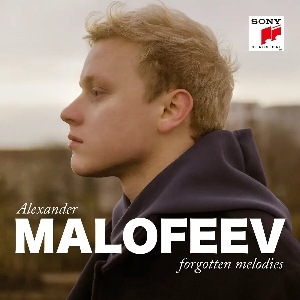
Forgotten Melodies
Alexander Malofeev (piano)
rec. 2025, Jesus-Christus-Kirche, Berlin, Germany
Sony Classical 19802936922 [2 CDs: 121]
Allow your social media algorithms the merest hint of interest in virtuoso piano playing and your feed is flooded with any number of transcendental studies and blazing sets of etudes. Just how does a young pianist cut through this blizzard of technique and talent to register as something truly exceptional in a time when ‘just’ exceptional seems to have become the new normal? Winning a raft of major international competitions in your early teens probably helps. This is what Alexander Malofeev did, gaining the gold medal and first prize at the 8th International Tchaikovsky Competition for Young Musicians held in Moscow in June and July 2014, at just thirteen years old. Two years later, he was awarded the Grand Prix at the 1st Grand Piano Competition – International Competition for Young Pianists in Moscow. In 2019, he won second prize and silver medal at the 1st China International Music Competition. Given that kind of exposure alongside an active concertising career ever since, credit to him and his management that he has waited until the grand old age of twenty-five to release this, his debut recording/recital.
I must admit I had not encountered his playing before so what first impression is gained? The simple answer is that this is remarkable and compelling playing. A slightly unusual feature of this debut is that Sony have lavished a generous 2-disc/two-hour format resulting in a very well planned, cleverly conceived programme that Malofeev then dispatches with breath-taking technique allied to searching musicality. The recital is given the collective title of “Forgotten Melodies”. The album features works by four composers who were all born in Russia but died far from their homeland: Alexander Glazunov (Paris, 1936), Mikhail Glinka (Berlin, 1857), Sergei Rachmaninoff (Beverly Hills, 1943), and Nikolai Medtner (London, 1951). Malofeev contributes to the liner and explains the conceptual thread connecting these composers: “They all share a similar feeling of nostalgia. But you cannot really figure out which moment in time they are actually nostalgic for. It’s almost as if they are nostalgic for a very similar setting which never really existed in history. It’s like it is totally made up, almost a dream world—and you can find it everywhere on this album”. Perhaps part of this empathy springs from the fact that Malofeev himself left Russia in 2022 – in part as protest for the ongoing war in Ukraine – so he shares a sense of a lost ideal.
The programme across the pair of discs is cunningly structured. Relatively slight – but attractive – ‘salon’ works by Glinka and Glazunov bookend the more substantial contributions from Medtner and Rachmaninoff with a mighty performance of the (revised) Piano Sonata No.2 Op.36 by the latter the high point of the entire collection on the second disc. The first disc opens with a group of five Glinka works with only the opening The Lark in Balakirev’s transcription lasting longer than two minutes. Within moments of that opening, most of the characteristics of this recital both musical and technical as well as in production terms are clear. The poise and expressive control of Malofeev’s playing is genuinely exceptional. The nostalgic dream-world referenced above is instantly evoked with a gentle turn of a phrase that somehow embodies Slavic melancholy unmistakeably. But as soon as Glinka/Balakirev decorate the melodic line the crystalline clarity and precision of Malofeev’s keyboard technique is equally apparent. However, I was surprised to see that the famous Jesus-Christus-Kirche Berlin is the recording venue as producer/engineer Maximilien Ciup has created a quite bright, rather dry acoustic which prioritises clarity over warmth. In part this is due to a very close microphone set-up indeed which allows breathing and piano damper movement to be heard – the latter in particular creating an odd disembodied thud every time the pedal is used. This boarders on the distracting but seems to be a distinct production choice. I see Ciup has amongst his discography several of Teodor Currentzis’ orchestral recordings as well as Khatia Buniatishvilli’s Rachmaninoff concerti for Sony and Lukas Geniušas’ powerful Rachmaninoff 1st Sonata on Alpha. The instrument used by Malofeev is not named either – although a studio video performance of the same worked that can be found on YouTube released to promote this set shows him playing a Steinway. My own personal preference is for a warmer basic piano tone. I did not realise that Glinka had written quite such a substantial body of keyboard music. IMSLP lists just shy of fifty works with numerous Waltzes, Mazurkas, Dances and Variations on popular themes suggesting salons of the rich and influential as the target performance space. These brief works can be viewed on the IMSLP site and they are simple in the extreme – and often very plainly presented on the page with few tempo or expressive indications. No surprise then that Malofeev adds a lot of rhythmic and expressive freedom to his interpretations although all of his choices feel apt and eloquent. The appeal of these works is their very simplicity and Malofeev’s great skill is to add just the right amount of emotional weight to make the result affecting without affectation.
The bulk of the first disc is given over the complete Forgotten Melodies Op.38 of Nikolai Medtner which mine a far greater emotional range and scale than Glinka. Medtner is often considered something of a “connoisseur’s Rachmaninoff” in the sense that his music charts a similar late-Romantic Russian musical path without the instant gratification of his contemporary. Interestingly, in the liner note, Malofeev essentially supports this view. To quote; “I consider Medtner as a composer for musicians [and] the most interesting composer to learn. Rachmaninoff[‘s music is] so well crafted …. you don’t need to intervene. It’s just perfect by itself… it plays itself. … Medtner is kind of the opposite… the time you spend with Medtner is an exploration… every bar is a research.” Of course, to play any music as well and as insightfully as Malofeev does on this recital goes far beyond music “playing itself” but the sense that Medtner needs more ‘work’ from both player and audience is probably valid. Clearly other great players share Malofeev’s view with the likes of Marc-André Hamelin, Nikolai Demidenko, Geoffrey Tozer, Hamish Milne and Earl Wild to name just a few who have recorded substantial amounts of his piano music. But clearly that select group is dwarfed by the number playing and recording Rachmaninoff. By including Medtner here, and by the excellence of the playing, this might well serve as an introduction for some listeners who come for the Rachmaninoff but stay for the Medtner.
The choice of the complete eight pieces that form the Forgotten Melodies Op.38 is a wise one. Not just because No.1 of the set – the 14-minute Sonata Reminiscenza – is “the most famous thing he wrote” to quote Malofeev, but also because across the forty or so minutes of the work the listener gets a perfect window into Medtner’s musical and expressive world. Malofeev is an ideal guide – strikingly different from Hamelin who recorded the work complete for Hyperion as part of a 4-disc survey of the complete piano sonatas. Hamelin is of course a remarkable player and he is well served by the Hyperion team (Andrew Keener and Tony Faulkner) to produce a lighter and generally more flowing accounts. Except in the opening Sonata Reminiscenza and the closing Alla Reminiscenza Hamelin is fleeter (not just “quicker”) and this difference somehow embodies the essential brooding and intense quality of Malofeev’s playing. Demidenko who recorded the sonata alone also for Hyperion plumbs even deeper broody depths taking a full 18:39 compared to Hamelin’s 16:05 and Malofeev’s 14:14. I have to say I genuinely enjoy all three versions by these fine players which is probably a mark of the quality of the music itself.
A striking feature of this group of pieces is the range of style, scale and musical expression within the set. This makes it well-suited to performance as a set and Malofeev is again excellent at exploring the diverse expressive and technical demands Medtner makes. At the same time the thematic links between the works are clearly delineated with the final Alla reminiscenza bringing a satisfying sense of closure to the whole work. A little stroke of programming genius is not to end the disc there but add the relatively slight Fairy Tale Op.48 No.2 as a brief afterword. As I say, I am no Medtner expert but I do know I have never enjoyed a recital of his music more than here.
Rachmaninoff is much more familiar territory but here too Malofeev proves to be a compelling, occasionally surprising but always convincing guide. He opens this half of his recital with the most famous solo piano piece the composer wrote; the Prelude in C sharp minor Op.2 No.3. From the very first notes Malofeev challenges convention. Rachmaninoff wrote the opening imposing motif ff (fortissimo) with added accents underlining the powerful gesture. The answering phrase is the sharply contrasted pp (pianissimo) but later the composer directs sffff dying away to ppp – so a massive dynamic range the pianist needs to allow for from the very start. In that context Malofeev’s very measured mf (at best) makes logical sense if only because when he does reach the mighty ffff it is huge and very exciting. Another area of wide contrast Malofeev deploys is basic pulse. Quite often the slower tempi will be chosen at the slower end of the usual range whereas faster tempi are a display of remarkable clarity and precision – as well as expressive power – at lightening tempi. The result is a very familiar piece presented with unusual but convincing impulsive individuality.
Another neat piece of programme planning places a genuine Rachmaninoff rarity next: the brief Fragments Op. posth. This touchingly brief and simple work forms an ideal interlude between the prelude and Piano Sonata No.2 that follows. Malofeev chooses the revised version which he says in the liner is “closer to Medtner in the way he develops material”. He also says he loves both versions but this performance is quite excellent. Again, the extremes of dynamic and tempo fluctuation are present with visionary musings alongside titanic convulsions. Occasionally I wonder if Malofeev risks becoming becalmed in the beauty of the moment but there is something in his playing that manages to hold the narrative thread together (the central non allegro – lento is especially rapturous) – perhaps the sheer poise and beauty of his playing is so bewitching. Overall, it is genuinely riveting performance – generally I like the extra sprawl of the original version but I cannot think of a performance of the 1931 revision that has enthralled me more. More good planning places the composer’s own transcription of his song Lilacs Op.21 No.5 and the achingly nostalgic Élégie Op.3 No.1 followed by three of the more reflective Études-Tableaux Op.33 as striking contrasts after the exultantly dynamic closing pages of the sonata.
For all his importance and significance in the musical life of Russia in his lifetime, Glazunov’s music now sits on the periphery of the repertoire with just a couple of works occasionally appearing in the concert hall. Certainly his piano music remains all but unknown. Just about the only complete survey came from Stephen Coombs in a series of four discs for Hyperion – quite a shock to realise these first appeared over thirty years ago as did the competing set on Marco Polo by Tatjana Franová. Perhaps part of the reason for their neglect is that Glazunov wrote mainly salon and genre pieces for the piano whereas tastes today lean towards large-scale ‘serious’ musical statements. Malofeev offers four relatively slight works although the later Idylle Op.103 dating from 1926 – the last solo piano work Glazunov wrote – contains an aching nostalgia reminiscent of his pupil Rachmaninoff and quite out of time and place. Malofeev’s ability to float a phrase is beautifully deployed although in the quieter passages the thudding damper pedal is always more apparent – annoyingly so, given the calibre of the actual playing. After all the drama contained across these two discs, I rather like the gentle simple envoi of the closing Valse in D major Op.42 No.3 that closes the disc.
Malofeev is most certainly an interventionist player but from my point of view this more often served the composer’s purpose than the performer’s ego. The programme is genuinely excellent and the music-making highly skilled. The only real question must be the engineering/production. I found that the more I listened to these discs the more irritating this became – I do find it quite surprising that Malofeev would be happy with the audio artefacts being so present to distract from his compelling playing.
Nick Barnard
Contents
Mikhail Glinka (1804-1857)
A Farewell to Saint Petersburg: No.10, The Lark (transcr. Balakirev for Solo Piano)
Mazurka in C major
Mazurka in C minor
Polka in D minor
Farewell Waltz
Nikolai Medtner (1880 1951)
Forgotten Melodies Op.38
Fairy Tale Op.48 No.2
Sergei Rachmaninoff (1873-1943)
Prélude in C-Sharp Minor Op.3 No.2
Fragments, Op. posth
Piano Sonata No. 2 in B flat minor, Op.36
Lilacs Op.21 No.5 (transcr. Rachmaninoff for Solo Piano)
Élégie in E-Flat Minor Op.3 No.1
Études-Tableaux Op.33 Nos. 3,7&8
Alexander Glazunov (1865-1936)
La nuit Op.31 No.3
Song of the Volga Boatmen Op.97
Idylle Op.103
Valse – Allegretto Op.42 No.3
Buying this recording via the link below generates revenue for MWI, which helps the site remain free