
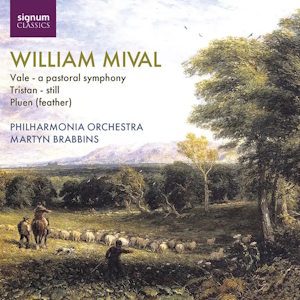
William Mival (b. 1959)
Vale – a pastoral symphony (2022-23)
Tristan – still (2003)
Pluen (feather) (2018)
Philharmonia Orchestra/Martyn Brabbins
rec. 2024, St Jude on the Hill, Hampstead, London
Signum Classics SIGCD977 [57]
Born in Rhyl, North Wales, William Mival was a pupil of Anthony Milner, Robert Saxton and York Höller. He was Head of Composition at London’s Royal College of Music between 2004 and 2022. From his biography in the booklet, it’s clear that he has a significant portfolio of compositions to his credit. I’m afraid, though, that up to now his music has eluded me; rather, I know him best – as I suspect many others do – as a regular contributor to BBC Radio 3 broadcasts, especially Record Review. I was intrigued, therefore, by the prospect of investigating this CD of three of his orchestral works which all appear here, I’m sure, in premiere recordings.
Before going further, I think it’s right to salute the generosity of a benefactor, Laurence Modiano. William Mival first met Modiano in his capacity as a fundraiser for the RCM. He commissioned Vale and also, through the Laurence Modiano Charitable Trust, he commissioned Pluen. The Trust also gave financial backing for this recording project. Particularly in these straightened times for the Arts in the UK, it’s important to acknowledge the generosity of such patrons. Similarly, though the BBC as an institution comes in for its fair share of criticism, the Corporation does a huge amount to sponsor classical music in this country; it was they who commissioned Tristan – still.
Tristan – still is the earliest of the three works on this programme. It was commissioned to complete the programme for a BBC Symphony Orchestra concert in 2003; I learned from Richard Bratby’s notes that it was intended as a counterpoint to a performance of Act III of Tristan und Isolde. The brief to Mival was to use the same orchestral forces, though I understand he added a bass drum to the scoring. Tristan – still is a remarkable composition; it is, in effect, a substantial slow movement for orchestra which plays in this performance for 18:58. In a programme note written for the premiere of the work by the BBC Symphony Orchestra and Donald Runnicles, the composer writes that it is “built out of a few tiny splinters of ‘echt’ Wagner tweezered out of the love duet from the second act of Tristan und Isolde”. One thing I think should be clearly stated: Mival’s piece is in no way a Wagner pastiche. To be sure, the music is often richly harmonised; both the harmonies and melodic language convey either warmth or longing – or both. He refers to “tiny splinters” from the opera. To be honest – and I mean this as a sincere compliment – I think you will need to have a pretty detailed knowledge of Tristan und Isolde (which, in all honesty, I don’t possess) to identify those splinters, so skilfully and seamlessly is the music woven together. Interestingly, though, I identified – or at least I think I identified – a fragment from a piece by a different composer. The piece has been divided up into four separate tracks – which is very helpful; these are tracks 7 – 10 on the disc. Starting at 1:01 in track 8 I heard what sounds very like the first four notes from the vocal line of Mahler’s song Ich bin der Welt abhanden gekommen. I wouldn’t mention this were it not for the fact that this material is used quite extensively thereafter in the work. My “suspicion” was heightened subsequently when I read in the booklet Mival’s comment that he has always had a “huge interest” in Mahler. To be honest, it doesn’t matter whether I’m right or not about this possible Mahler quotation; what really matters is the excellent use that Mival makes of such a simple four-note motif. Tristan – still is a piece which moves slowly but purposefully along its course. Climaxes, when they arrive, seem to grow very organically out of the music and the piece as a whole has great intensity. I found that my attention was gripped throughout. One detail is worth mentioning. I said earlier that Mival had added a bass drum to Wagner’s Tristan orchestral forces; having done so, whenever he uses the instrument, its effect is telling. Right at the end, after a final and quite extended climax, the piece winds down fairly quickly to a tranquil conclusion. The last sound we hear is a chord played by two clarinets; is this a subtle reference to the two oboes which are heard right at the end of Tristan und Isolde? Tristan – still is a most impressive piece and here it’s marvellously unfolded by Brabbins and the Philharmonia. We learn from the booklet essay that the piece’s first audience loved it – I’m not surprised – but unfortunately, it was not as well received in all quarters. In the composer’s words “it was either too much, or too little for some I think – the words ‘time travel’ were used on several occasions. I was taken aback…So, I concentrated on my teaching, taking virtually a ten-year break from composition”. What a shame! I hope that this splendid recording will win new friends for this highly expressive piece.
Eventually, Mival returned to composition with a 2015 ensemble piece entitled Correntandmente. Then, in his words. “Pluen came along”.
Pluen was commissioned to mark the 70th birthday, in 2018, of King Charles III; at that time, he had not succeeded to the throne and was still Prince of Wales. The title is the Welsh word for feathers. A trio of feathers is included in the heraldic crest of the Prince of Wales; two larger feathers flank a shorter one in the centre; that device is relevant to the structure of Mival’s score. He explained in a programme note for the premiere (conducted by Martyn Brabbins) that he devised the piece, which here plays for 10:56, as “three extended variations followed by a conclusion”; in a reference to the heraldic device, the first and third variations are of roughly equivalent length while the second variation is the shortest. The theme is never stated in full. Mival took a Welsh folk-tune, Y Glomen (The Dove), which had previously been arranged as a choral work by Holst; the composer explains that “barely recognisable fragments of the original melody are woven [into the score]”. I have to admit, I couldn’t readily discern the fragments of the tune – which I don’t know sufficiently well in any case – but what I could discern is that there’s a beautiful melodic foundation to the piece. Again, Signum helpfully divide the work into salient tracks, in this case four; one for each variation and one for the short, tranquil conclusion. Pluen is strongly melodic and the harmonic language is appealing and accessible. It also seems to me to be very well imagined for the orchestra; though I’m unsure of the exact forces, I have the impression that in this work Mival uses a slightly smaller orchestra than is the case in the other two works on the disc. Pluen is a very approachable composition; I liked it very much.
I may be wrong but I suspect that Vale – a pastoral symphony is William Mival’s largest orchestral work to date; the present performance plays for 27:16. It’s a continuous score, though it’s divided into a number of sections; Signum divide it into six separate tracks, which is really helpful. Mival was inspired by the landscape of his youth – specifically the Vale of Clwyd – and in two ways: one is an extract from geological survey of the Vale; the other is some lines from the poem In Praise of Limestone by W H Auden. Both of these short texts are quoted in the booklet. What readers may initially find just as helpful is this quotation from Richard Bratby’s notes: “The Vale of Clwyd is an area of outstanding natural beauty entirely within the Welsh county of Denbighshire. It is fertile land, drained by the river Clwyd which reaches the sea at Rhyl.” The town of Rhyl, it will be remembered, is where Mival grew up. One word from that quotation is of key importance, I think: fertile. If you listen to Vale, as I hope you will, you may conclude, as I did, that Mival’s music is extraordinarily fertile.
The opening section (marked Senza ironia) is distinguished by long melodic lines and impressively sonorous textures. At 2:38 we hear what I can best – but, I’m sure, not entirely accurately – describe as an imposing, upward scalic figure played mainly by the brass; this is important at the time it first appears and will return later in the work. The following section (Fluido, bucolico e espressivo) covers two tracks. The first part (tr 2) is characterised by lyrical serenity. This is carried over into tr 3 but with growing intensity. The music is very effectively scored for the orchestra – as is the case throughout the symphony – and all the instrumental lines sing. There follows an extended Lento episode (tr 4). This begins with gentle writing for the strings. As it unfolds, the music has genuine melodic and harmonic beauty. The impression is one of serenity and thoughtfulness, even on the rare occasions when the music raises its voice. This is a lovely section. The work moves to Piú mosso, fluido (tr 5). Again, the music is broad, albeit the pulse is a little quicker. From around 2:00 there is greater urgency and much is made of that upwards scalic figure that we encountered much earlier in the score. Over time, Mival brings the work to a convincing climax before everything winds down to the concluding section (Meno mosso – rubato e molto espressivo). This brief coda, lasting 1:37, brings Vale to a quiet, warm conclusion.
In this symphony William Mival has written music of great confidence and breadth. Vale is a fine achievement which I admire very much indeed. The work’s cause is helped greatly by the splendid and convincing performance. It sounds as if Martyn Brabbins and the Phlharmonia are very sympathetic towards the music they are playing. I don’t know if Vale has yet achieved a public performance but I hope this fine recording will bring it to a wide audience.
The performances have been expertly recorded by producer Stephen Jones and engineer Mike Hatch. I like the sound very much; it shows off the music to excellent advantage. Richard Bratby’s essay, judiciously sprinkled with comments by the composer, introduces the music in an ideal fashion.
These three fine pieces are notable additions to the catalogue of British orchestral works.
Buying this recording via the link below generates revenue for MWI, which helps the site remain free













