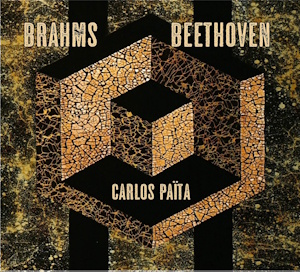
#Ludwig van Beethoven (1770-1827)
Symphony no. 5 in C minor, op. 67 (1808)
Symphony no. 7 in A major, op. 92 (1813)
Johannes Brahms (1833-1897)
Symphony no. 1 in C minor, op. 68 (1854-1876)
Violin concerto in D major, op. 77 (1878)
Ayla Erduran (violin)
Philharmonic Symphony Orchestra/Carlos Païta (Beethoven symphonies)
National Philharmonic Orchestra of London/Carlos Païta (Brahms symphony)
London Philharmonic Orchestra/Carlos Païta (Brahms violin concerto)
rec. 1981 (Beethoven 5 and Brahms 1), 1983 (Beethoven 7) and 1985 (Brahms violin concerto); Walthamstow Town Hall, London (Brahms violin concerto) and Kingsway Hall, London
Le Palais des Dégustateurs PDD040 [2 CDs: 153]
Until very recently, it would be fair to say that the Argentinian conductor Carlos Païta (1932-2015) hadn’t enjoyed a particularly good press on MusicWeb International’s pages. Thus, if you search for his name among our archive reviews published before 2023, you will find only three entries, the first of which will direct you to one of Michael Herman’s invaluable discographical lists in which Païta’s 1980s recordings of Dvorák’s final three symphonies are simply catalogued rather than reviewed.
Each of other two results links to an individual entry in Lee Denham’s series of comprehensive repertoire surveys. In the first, focusing on Mahler’s first symphony, Lee considered Païta’s reading “very wilful… [and] a real mixed bag of curate’s eggs… [with] occasional flashes of brilliance… undone by… conducting eccentricities elsewhere”. He ultimately rated the performance as 5/10, leaving it only marginally above a verdict of “poor and to be avoided”. The second survey compared recordings of Bruckner’s eighth symphony, and there Lee was even more critical. Indeed, one might even describe him as brutal in his assessment. “When the 1982 effort by Carlos Païta… with the Philharmonic Symphony Orchestra finally tumbled through my letterbox”, he recalled, “it was duly auditioned and then sent straight off to the charity shop – the less said about that one, the better”. As it turned out, however, in the end Lee did have a little more to say after all. Concerned, no doubt, for his more fragile readers’ sensibilities, he observed, in the very last sentence of his whole survey, that “if I have insulted any fans of Carlos Païta or others on my journey with my views and recommendations, forgive me; it was not intentional!”
In fact, however, the current, post 2022 incarnation of our website has begun to expand Païta’s representation. In January 2025 he was mentioned in passing – and relatively favourably – when my colleague Jonathan Woolf reviewed an eight-disc collection of performances by cellist Christine Walevska. A few months later, Steven Francis Vasta seemed somewhat surprised when, in criticising a somewhat poorly delivered passage in the finale of Bruno Walter’s 1954 recording of Mahler’s first symphony, he opined that “Horenstein and, of all people, Carlos Païta, show how much better it works in tempo” [my own emphasis]. Now, in 2026, the re-release of several of the conductor’s recordings on the Le Palais de Dégustateurs label means that something of a wider reassessment is under way. Jonathan Woolf has, for instance, already offered his thoughts on the three Dvořák recordings listed in Michael’s previously-mentioned discography, concluding, with the occasional caveat, that they memorialised “dramatic, largely unidiomatic performances of huge personality and drama”. Perhaps not a library choice, then, but certainly worth a listen.
This two-disc set of much-recorded repertoire by Beethoven and Brahms dropped through my own letterbox emblazoned with an array of seven (thankfully removable) promotional stickers citing all sorts of international recommendations, nominations and awards. In fact, when I did a little research on just one of those accolades, picked out at random, it transpired that it had posthumously been accorded not, as one might have reasonably inferred, for this specific release but instead for Païta’s overall lifetime achievement. Moreover, even the award’s citation carefully points out that some of the conductor’s interpretations have generated responses ranging from enthusiastic praise to total disapproval. It is, consequently, worth emphasising to prospective buyers that promotional stickers can’t necessarily be taken as recommendations for the particular performances to which they’ve been affixed.
Even so, I can quite see why many listeners will enjoy these accounts of Beethoven’s and Brahms’s musical warhorses. They are, in general terms, boldly delivered, beefy and big-boned versions that are put across with great energy and conviction. Albeit exhibiting occasional and well conveyed moments of delicacy, they are more often characterised by a forthright, muscular style that chooses to prioritise the application of striking primary colours over subtly applied tints. Moreover, some listeners may respond positively to the conductor’s occasional and already-noted tendency towards interpretational individuality. While Païta may not be as prolific with his alterations as, say, Leopold Stokowski, he is clearly willing to adopt an interventionist position whenever he considers it appropriate. It is only fair to point out that such modifications can sometimes add intriguing interest to – or sometimes even enrich – the performances.
Païta’s Beethoven symphonies are played here by the Philharmonic Symphony Orchestra. Although the conductor made quite a few recordings with the PSO, its status seems somewhat shrouded in mystery. It may simply have been one of the big-name professional London orchestras playing, for contractual restrictions, under a pseudonym (thus, two decades earlier and for that very reason, the Westminster label had occasionally attached the near-identical name Philharmonic Symphony Orchestra of London to recordings that had actually been made by the Royal Philharmonic Orchestra). Alternatively, it may have been a specially recruited pick-up ensemble – a conjecture that seems to be supported by Jonathan Woolf’s observation that the orchestra played for Païta not only in the recording studio but in concert halls in front of paying audiences. Conjuring up his own personal orchestra in that manner would not have come cheap. Neither would setting up a new record company, but the Swiss Lodia label would appear to have been founded in 1980 primarily to market Païta’s recordings. While speculation as to whether it was financed by the conductor himself or by some wealthy admirers seems unresolved, Païta was certainly Lodia’s default conductor of choice. Thus, if you refer to the Presto Music website you will find that, of the 25 Lodia recordings listed there, his name is attached to no less than 20 of them.
Whatever the case, the playing on these two discs is usually pretty good. Païta, it quickly becomes clear, is a dab hand at balancing the orchestra’s various sections to good effect, while simultaneously exercising very effective dynamic control to add drama and mood to the music.
Those positive qualities are immediately apparent in his account of Beethoven’s fifth. In general, the opening movement is energetically driven and rarely stops to take breath. Thus, when it actually does relax for a few moments, the interpretation runs the risk of appearing a little exaggerated. The conductor’s skill, here and elsewhere, lies, however, in giving such episodes a special significance. The brief passage from 4:45 to 4:59, for instance, where a rather wistful reminiscence by the solo oboe can often pass by relatively unnoticed in other performances, here draws disproportionate – but, it’s worth stressing, not necessarily unwelcome – attention to itself. This, it seems to me, is not mere wilful self-indulgence but a genuine attempt to add interpretative insight.
In similar fashion, the overall approach to the andante con moto second movement is relatively conventional, though that’s by no means to deny its positive features, including the carefully deliberate pacing, the precisely detailed playing that Païta coaxes from the orchestra and his carefully constructed balances that allow us to appreciate the performance to the full. Once again, though, a moment of interpretational indulgence adds a little individuality as, from 8:44 onwards, some unexpected tweaks to tempi take effect. An initial acceleration introduces a brief episode, almost bringing to mind an episode of bucolic, peasant merrymaking, that is not only effective in itself but also serves to emphasise the subsequent elegiac mood as restored by judicious application of the musical brakes.
Though marked allegro by the composer, Païta’s approach to the third movement is somewhat grand and stately. His deliberate pacing proves, however, a particularly effective means of showcasing the orchestra’s impressive strings, with the double bass players sawing away with particular energy. In the quieter passage leading up to the transition to the finale (3:52 onwards), the conductor skilfully conjures up a real degree of tension that will, I suspect, have you listening much more intently than is usually the case. The final movement itself is well played and delivered and is, in general, free of idiosyncratic touches. Its exciting climax brings this enjoyable and rather impressive performance to an end.
Païta’s account of Beethoven’s seventh symphony is less remarkable, though it too displays obvious skill and conviction. After a somewhat carefully phrased, even ruminative start, the first movement fairly conventionally – and quite rightly – majors on the strongly delivered rhythms that caused Wagner to describe the whole symphony as “the apotheosis of the dance”. While Beethoven had marked the second movement allegretto, Païta distinctively if lightly puts his foot on the brake at the opening so that it becomes a virtual funeral march. Well-balanced strings and woodwinds characterise the movement’s more delicately crafted final section, from 7:10 onwards, thereby generating an air of tension that compels careful listening.
Such refinement is replicated in the more relaxed passages of the third movement presto. Elsewhere, however, the predominant impression is again one of strong rhythmic propulsion driving the music forward – and that actually becomes an even more pointed feature of the finale, a real sonic whirlwind that makes many other accounts sound, in comparison, a little tame. In his review of Païta’s Dvořák, referenced above, my colleague Jonathan Woolf refers to “impressive… consistent vitality… kinetic, rhythmic intensity and… cumulative drive”. Such qualities certainly characterise this Beethoven seventh, yet ultimately, I think, they are not enough on their own to mark it out as a particularly memorable account.
As usual in my reviewing, it was only after listening repeatedly to the disc that I read the booklet notes and, on this occasion, they proved to be particularly enlightening. Their author, Max Trébosc, draws particular attention to the fact that, for this recording of the seventh, Païta decided to make some significant augmentations to the strings. He had, it appears, been struck by the fact that Beethoven had particularly appreciated an 1814 performance in which the numbers of violins/violas/cellos/double basses had been increased for the first time to, respectively, 36/14/12/7. In the performance under review, Païta went further, deploying 40/16/14/10 strings. Mathematically-inclined readers will immediately appreciate that while that equates to an increase of only 11% in the strength of the violins, it causes an overly disproportionate near-50% increase in representation for the double basses. While that certainly produces an impressively weighty body of string sound overall, it brings with it a few negative side effects.
In the first place, that orchestral tuttis become slightly muddy, especially when, as here, the Kingsway Hall’s acoustics sound rather more reverberant than usual (the discs’ documentation fails to include the names of the recording engineers). Secondly, the string-heavy balance sometimes overwhelms the rest of the orchestra and obscures important detail below the surface. For comparison, I listened to a 1953 performance in which the Berlin Philharmonic is conducted by the often-overlooked Paul van Kempen and was immediately struck by just how much more transparent and light-footed that is. The Dutch-German conductor digs somewhat deeper into the score, emphasising that there is rather more to it than can be conveyed by forceful over-reliance on sheer rhythmic vitality.
In spite of being recorded in the same Kingsway Hall, Païta’s 1981 recording of Brahms’s first symphony comes across rather better in its sonics, though it is worth pointing out that it becomes even more impressive in that respect with just a little upwards tweak in the volume control. The pick-up National Philharmonic Orchestra, no doubt basking in the acclaim it had received over the previous decade for its series of more than a dozen RCA Classic film scores LPs, is also in tip-top form. This is a very engaging account of Brahms’s first, characterised primarily by fire and passion. Its only interpretative quirk is the extra emphasis put, right from the symphony’s opening, on the tympani. In most accounts the timpanist’s contribution might be thought of as something akin to a beating heart, constantly propelling life onwards without drawing undue attention to itself. Païta and his (one again unnamed) engineering team, on the other hand, very effectively add to the overall drama and excitement by according the tymps greater prominence in the orchestral mix on virtually every occasion that they appear. The rest of the orchestral balance is, nevertheless, finely maintained. While the strings deliver a plush, rich and idiomatic Brahmsian texture, the woodwinds’ often rather beautiful contributions are always clearly heard. The conductor’s already-noted firm grip on dynamics also adds regular point and emphasis that makes a substantial contribution to the overall drama and tension of the performance.
Both middle movements are characterised by a sense of the music flowing inexorably – and sometimes quite briskly – along. My one possible criticism is that the Un poco allegretto e grazioso third movement, which comes across as perhaps a tad relentless, might have benefitted from putting a little more emphasis on the grazia – though I freely concede that doing so might have compromised the conductor’s overall conception of the piece. The finale is, however, an unquestioned success, from the early phrases for pizzicato violins, delivered in a distinctively in-your-face fashion, to the ultimate and cathartic emotional resolution (14:41 onwards) that brings this expertly delivered, musically satisfying and, for me at least, eye-opening performance of the symphony to its conclusion.
As you will have gathered, I found this to be an impressive and enjoyable account of Brahms’s first. Others, it seems, are even more enthusiastic. Only repeated exclamation marks can, it seems, convey booklet essayist Mr Trébosc’s somewhat hyperbolic enthusiasm: “With Brahms’ first symphony, Carlos Païta… made a strong impression! This sonic earthquake felt like a revolution in the symphonic world of the composer! No one played Brahms like that. Even the most daring conductors, such as Solti or Chailly, could not measure up. This first symphony… was furiously dissected by Païta. Not only did it withstand the shock, but it demanded more! A new Brahms appears: passionate, moving, even rebellious… Can one ever listen to another version afterward?”
A third orchestra and a different recording venue both come into play in a 1985 performance of the Brahms violin concerto. It features the Turkish soloist Ayla Erduran who died last year at the age of 90. While she has not left a large legacy of recordings, I was interested to note that one of the relatively few reviewed on this website was of the Brahms concerto, recorded for Radio Suisse Romande in 1970 when she was accompanied by the Orchestre de la Suisse Romande under Richard Beck. Back in 2019, my colleague Stephen Greenbank particularly admired Ms Erduran’s “silken tone” and thought that her “contouring of the lyrical line is captivating, enhanced by her sweetness of tone in the upper registers”. The whole performance, he thought, exhibited “wonderful poise and elegance”.
When it comes to her contribution to this Carlos Païta release, I can only echo Stephen’s sentiments. Unfortunately, however, the (once again unidentified) engineers have not managed to capture Ms Erduran’s “silken tone” particularly well in Walthamstow Town Hall. Not only has she been recorded a little too far back from the microphone, but the recording as a whole is actually rather boxy and unflattering to both soloist and orchestra. Consequently, London Philharmonic’s contribution emerges as less characterful than either the PSO’s or the NPO’s and, in spite of being the most recent of the four recordings presented here, you’d probably guess that this performance of the concerto is the oldest.
At the first movement’s opening, a combination of Païta’s robust, almost fiery mood, Ms Erduran’s physical positioning and her apparently naturally rather small tone means that, at particularly tempestuous moments, the solo violin line is insufficiently projected and is hard put to ride over the orchestra. As the movement goes on, however, I suspect that other ears, like my own, will attune themselves to the recording’s sound balance so that it becomes somewhat less of an issue. Ms Erduran’s sweet tone and her very lyrical approach are, indeed, very winning and prove particularly effective in a dreamily delivered account of the movement’s cadenza.
The Adagio second movement is the most remarkable of the three. Païta’s introduction is so slow that it holds one’s attention if only to discover whether it will grind to a complete stop. Ms Erduran adopts, at least initially, the same approach, eschewing the lyrical flow that might have been expected. Instead, closely supported by Païta, she ratchets up the tension by refusing to hurry and ultimately conveys a mood that comes across almost as one of pain. I have never previously heard the movement played in that way and I found it both powerful and affecting. In the finale, Païta seems a little more restrained than usual, and we get to hear the soloist’s fireworks quite clearly, even if they’re closer to modest sparklers than giant rockets – quite clearly. Mr Trébosc, by the way, is uncharacteristically restrained – or perhaps simply quite exhausted – by this point, describing the performance of the concerto as “something special… [and] [a]n astonishing success that surprised us when we rediscovered this unexpected and exquisite recording”.
Here, then, we have something of a mixed bag. The standout performance is undoubtedly that of the Brahms symphony. Beethoven’s fifth is also well done and the striking account of the slow movement makes the concerto well worth a listen. I have one more Païta disc in my reviewing pile and my colleagues have, I believe, a number of others. It will be fascinating to discover, in due course, whether MusicWeb’s overall assessment of Carlos Païta requires serious revision. Certainly, in my own case and on the basis of what I’ve heard so far, I’m not necessarily going to be making a trip to the charity shop anytime soon.
Rob Maynard
Availability: Le Palais des Dégustateurs