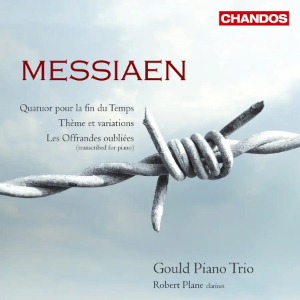
Olivier Messiaen (1908-1992)
Les Offrandes oubliées, Méditation symphonique (1930, composer’s version for solo piano)
Thème et variations for violin and piano (1932)
Quatuor pour la fin du Temps for violin, clarinet, cello and piano (1940-1941)
Gould Piano Trio
Robert Plane (clarinet)
rec. 2007, Champs Hill, UK
Presto CD
Chandos CHAN10480 [68]
And I saw a mighty angel come down from heaven…and his face was as it were the sun, and his feet as pillars of fire. He set his right foot upon the sea and his left foot on the earth…and lifted up his hand to heaven, and swore by Him that liveth for ever and ever, saying “There shall be time no longer, but on the day of the trumpet of the seventh angel, the mystery of God shall be finished.”
This apocalyptic message from the Book of Revelation was the preface to the score of Olivier Messiaen’s Quartet for the End of Time, and supplies the title. The work has long held emblematic status: he wrote it during the war in which time ended prematurely for as many as 70 million people, while he was imprisoned in a concentration camp. Players therefore perhaps approach it with a special devotion. There have been many recordings, and often they are distinguished by a sense of commitment and by atmosphere. Such is the case with this issue. It is not new, nor is it a reissue: it has the same cover, catalogue number and fill-up music as before. If it ever left the catalogue, it is good to have it back.
The work’s opening movement, Liturgie de cristal (Crystal liturgy), evokes the “stillness before dawn” with polyphonic complexity. Stylised birdsong on clarinet and violin is set against independent rhythmic patterns on piano and cello. Robert Plane’s clarinet makes this merry dance of chattering birdsong most engaging. His playing is also haunting in the Lent, expressif sections of the third movement, Abîme des oiseaux (Abyss of the birds), which is a clarinet solo of over eight minutes. The contrasting livelier vif sections are rhythmically precise. So too is the fourth movement, the scherzo-like Intermède.
The Gould Piano Trio’s cellist is sensitivity itself in the first of the string adagios, Louange à l’Éternité de Jésus (Praise to the eternity of Jesus). The Danse de la fureur, pour les sept trompettes (Dance of wrath, for the seven trumpets) is scored for all four instruments in unison, which Messiaen’s preface says denotes “purple rage, or icy fury”. The Gould players cope very persuasively with its tricky rhythms. But then they are persuasive throughout the Quatuor.
The earlier Thème et variations for violin and piano is an attractive and appropriate makeweight, and the composer’s own piano version of Les Offrandes oubliées (Forgotten offerings) makes a meditative opening to this accomplished programme. Many good versions of the Quatuor are available, so this one resides in a very competitive field. One of its attractive features is a very good booklet note by the Messiaen scholar Peter Hill, so it would make a good entry point for those new to this repertoire.
Roy Westbrook
Other review: Jens F. Laurson
Buying this recording via the link below generates revenue for MWI, which helps the site remain free