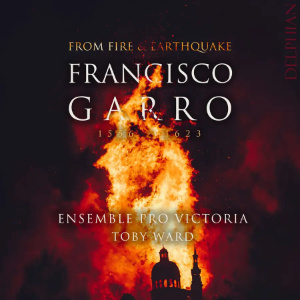
From Fire & Earthquake
Francisco Garro (c1556-1623)
Asperges me
Missa Saeculorum (primi toni)
In principio erat verbum
Parce mihi Domine a 6
Vidi aquam
Francisco Guerrero (c1528-1599)
Maria Magdalena
Francisco Garro
Missa Maria Magdalena
Ensemble Pro Victoria / Toby Ward
rec. 2023, All Hallows, Gospel Oak, London
Latin texts and English translations included
Delphian DCD34305 [72]
Prior to receiving this disc for review, I had not encountered the music of Francisco Garro. If his music is also new to you, you’ll find the booklet essay by Gareth Thomas very useful indeed. Thomas relates that Garro was born in Alfaro, a town in the Spanish region of La Rioja. He held a number of musical posts in his native Spain until, in 1592, he was appointed as mestre of the Royal Chapel in Lisbon, which post he held until his death. Thomas helpfully sets Garro’s career against the political background of the time. In 1580 King Philip II of Spain invaded Portugal and claimed the vacant Portuguese throne; he was crowned Philip I of Portugal in April 1581.Thus he brought together the entire Iberian Peninsula. Interestingly, though, it appears that the Portuguese were allowed to retain a good deal of national identity under the terms of the Iberian Union, a state of affairs which prevailed until 1640; Portugal and its overseas territories did not become provinces of Spain and the country retained its own laws, currency and government. That seems to have been a pretty enlightened way for the Spaniards to deal with the newly-acquired territories. Thomas adds that Lisbon, where Garro came to work, was “a thriving metropolis”,
I also gained from Gareth Thomas a good deal of background information which is directly relevant to the music here recorded by Toby Ward and his colleagues. It appears that most of Garro’s activity as a composer dates from his Lisbon days. That’s important to note because, apparently, the Royal Chapel in Lisbon was, at this time, “a well-resourced musical establishment, complete with instrumentalists as well as singers”. Garro was not as prolific a composer as some, Thomas says; just nineteen works survive. (It occurred to me to wonder if more music might have been lost, say, in the Lisbon earthquake of 1755.) There are, apparently, two printed sources for Garro’s music, both of which date from 1609. Just one of these sources is in the form of a choirbook; that’s the source on which Toby Ward has drawn for this programme.
It’s worth just saying a prefatory word about the forces that Toby Ward has assembled to perform this music. There are eleven singers (3 sopranos and two each of altos (female), tenors, baritones and basses). The singers are joined by an instrumental ensemble consisting of cornett, sackbut, baroque harp, lute, bass viol/violone and chamber organ; as we shall see, the full instrumental group does not participate in every piece, though they are all present, so far as I can tell, in both of the Masses.
It’s probably best to consider the pieces in the order in which they appear on the programme. Toby Ward opens with a setting of the Antiphon Asperges me. This was sung (or said) during the sprinkling of water onto the congregation immediately prior to Sunday Mass. I well remember this from my childhood, though I had forgotten that the text is not used during Eastertide. The words are from Psalm 50 (Vulgate) and are essentially penitential. So, I was surprised at how lively and buoyant the music is – although that might be an interpretative decision, I suppose. As I listened, I recalled a comment by Gareth Thomas. Referring to the Spanish takeover of Portugal, he says that Portuguese composers of the period exhibited “a notable trend for texts of lamentation…as they grieved their kingdom’s fate and waited with longing for a native ruler to return”. Thinking of that in the context of Garro’s Asperges me occasioned a wry smile: there’s no real sense of lamentation in this piece but, of course, as a Spaniard, Garro was on the “winning side”.
We then hear the first of the two Mass settings. Gareth Thomas explains that Missa Saeculorum is a paraphrase Mass, the source of which is unusual: Garro turned to the first psalm tone and took from it the notes to which the concluding words ‘saeculorum. Amen’ are set. Such a melodic fragment might seem restrictive, but not to Garro. His Mass is for five voices and the vocal writing within it is endlessly inventive; moreover, in this performance, it’s delivered with great clarity by the singers. That clear singing was evident right from the start, during the Kyrie. So was another factor: among the accompanying instruments, the sackbut and, especially, the cornett were prominent features within the overall ensemble. The Gloria is spirited from start to finish; Ward and his forces give an exciting performance. The Credo is similarly energetic, though the ‘Crucifixus’ offers some reflection, even though the pace of the music remains brisk. Perhaps a little surprisingly, it’s at ‘Et ascendit’ where the pace slackens a little. The energy levels are high once again at ‘Et in Spiritu Sancto’. By now, I’d come to admire Garro’s musical invention; however, I was starting to feel that the music – or perhaps the performance – was just a bit unrelenting, with the cornett rather too prominent for my liking. The music of both the Sanctus and Benedictus is more thoughtful and the performers respond accordingly. That means that the exuberant ‘Hosanna in excelsis’ at the end of each movement makes a strong impression. I liked very much the dignified and flowing performance of the Agnus Dei; this is a fine conclusion to Missa Saeculorum.
A selection of shorter pieces follows. In principio erat verbum is a setting of the first three verses of St John’s Gospel, which is the Gospel reading for Christmas Day. This piece is much more lightly accompanied; this enables a greater focus on the vocal parts. The vocal polyphony seems simpler than the writing we experienced in the Mass; it’s very effective. Parce mihi Domine takes verses from the Book of Job, which form part of the lesson at Matins of the Office of the Dead. Garro sets this penitential text to exquisite, slow-moving polyphony. The last three words of the text are ‘subito probas illum’ (suddenly test him). Taking his cue from the word ‘subito’, Garro quickens the pulse; it’s a most imaginative bit of word-painting. Parce mihi Domine is a fine piece; here, it’s very well performed.
The rest of the programme focuses on Easter. Gareth Thomas observes that Garro’s music for the Easter season is all scored for six voices “and is some of his most lavish polyphony”. During Eastertide, the antiphon Vidi aquam takes the place in the liturgy which is occupied for the rest of the year by Asperges me. The text of Vidi aquam is suitably joyful so I don’t find it surprising that Garro’s music should be lively and positive. The cornett and sackbut, absent from the two previous pieces, make a return but this time the cornett is not as dominant as was the case at times in Missa Saeculorum. Vidi aquam is a marvellous short piece, full of Paschal joy and promise; nowhere is that more apparent than in the extended ‘Alleluias’ with which the piece concludes.
Garro’s Missa Maria Magdalena is a parody Mass, modelled on Francisco Guerrero’s motet. Guerrero somewhat unusually set a narrative text from the Easter Day reading from the Gospel of St Mark in which we hear of Mary Magdalena “and the other Mary” who came to the tomb to anoint the body of Christ and found instead “a young man sitting on their right, covered in a white robe”. Guerrero’s piece is sumptuous – the instrumental accompaniment is very rich and the choral part-writing conveys jubilation. Toby Ward directs a performance that brings the music – and thereby the story – vividly to life. It’s very good to hear this motet immediately prior to the Mass which it inspired.
Garro’s Mass is a fine one. The words of the Kyrie may be a prayer for mercy but here there’s a festive feel. I love the way the sackbut adds sonority underneath the vocal lines. The Gloria is fast-paced and exultant, I feel there’s rather more textural variety than was the case in Missa Saeculorum; the use of only high voices at ‘Domine Deus’ is a case in point. The cornett is in evidence but it’s less obvious than in the other Mass; I feel it’s better integrated into the overall texture and its contribution adds welcome colour. After the jubilant Gloria, Garro continues the celebratory mood in the Credo; in the opening pages you almost have the sense of the music tumbling over itself. Without dropping the pace, Garro makes ‘Et incarnatus est’ more reflective than was the case in Missa Saeculorum. ‘Crucifixus’ is similarly thoughtful; here, I love the fact that the scoring is reduced to sopranos and altos accompanied by cornett and (I think) the lute above the instrumental bass line; it’s most effective. The full ensemble resumes at ‘Et iterum’. The conclusion of the Credo is really exciting in this performance. The Sanctus is celebratory but in the Benedictus the scoring is reduced at first to the female voices and sackbut; again, that’s very effective. The Agnus Dei is spacious and sonorous. Overall, I preferred Missa Maria Magdalena to its companion setting.
I’ve enjoyed making the acquaintance of Francisco Garro’s music. His cause has been extremely well served by Toby Ward and the highly accomplished singers and players of Ensemble Pro Victoria. Though I have expressed one or two mild reservations about aspects of Missa Saeculorum – reservations which others may not share – those reservations do not extend to Missa Maria Magdalena. The short pieces are all expertly crafted and well worth hearing. Ward and his colleagues bring all this music colourfully to life. The disc is particularly valuable because none of the music has been previously recorded, with the exception of Asperges me, In principio erat verbum and the Guerrero motet. I hope that these recordings will bring Garro’s compositions to a wider audience.
Delphian’s production values are up to their usual high standards. Paul Baxter has recorded the performances expertly; it’s surely thanks to his skills as well as those of the musicians, that we can hear so much detail, even when the polyphony is at its most complex. As you’ll have gathered from the extent to which I’ve drawn upon it, Gareth Thomas’s essay is invaluable.
John Quinn
Other review: Dominy Clements
Buying this recording via the link below generates revenue for MWI, which helps the site remain free