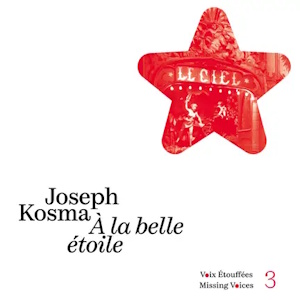
Joseph Kosma (1905-1969)
À la belle étoile
rec. 2024 and 2025, Alfortville, France
Texts and notes in French
Hortus 835 [61]
Fans of classic French films will undoubtedly have heard of Joseph Kosma. From 1935 on, he was an active composer for films. In the 1930s and 1940s, he created the scores for such classics as The Crime of Monsieur Lange, Grand Illusion, Children of Paradise and The Gates of Night, among many others. He is equally well-known in vocal circles as the composer of numerous chansons, many to texts by his friend Jacques Prévert, with whom he was also involved in many film projects. This disc, part of Hortus Editions’ Missing Voices Project, contains a couple of chansons, but is mostly dedicated to Kosma’s works in forms less popularly associated with his output. (The Missing Voices Project now numbers five discs, all devoted to composers who had been forced to flee the Nazis. Kosma himself had originally fled Hungary because of the political situation there, and had to hide from the Nazis during the Occupation.)
Perhaps most unexpected here are several choral works. Kosma seems to have had an equal facility with multiple voices as with a single one. The two choruses by the Resistance poet Madeline Riffaud are both most affecting, though in different ways. They demonstrate the composer’s sense of French identity, even though France was his adopted country. Lou Bouyé is Kosma’s poignant setting of an old song associated with the Albigensian movement. It was also adapted to Resistance use by Radio Toulouse during the Occupation. Kosma’s left-wing affiliations are in evidence in the final two choruses, one from a cantata in memory of the Courrières mine disaster of 1906, the other a setting of part of Ethel Rosenberg’s final letter to her children before her execution. Both are deeply moving, and further demonstrate the composer’s facility with choral writing.
We return to the war years with the Esquisses béarnaises from 1940. Kosma and his wife had escaped from occupied Paris to the small town of Navarrenx in the Béarn area near the Spanish border. They were well looked after by the inhabitants. In gratitude, the composer wrote a suite of short piano pieces. Seldom more than a minute long, they are serious and gentle – a worthy remerciement. Somewhat similar are Cinq chansons populaires du Languedoc, a violin/piano version of a 1947 Suite Langdocienne for piano solo. Unlike other works of that time, the music shows much Hungarian feeling clear in the earlier chamber works such as the Sonatine for two violins. Interestingly, Kosma gained French citizenship the year after the composition of Cinq chansons.
There is no film music on this disc, but we do have excerpts from incidental music for Le Cercle de craie, an adaptation of Brecht’s play The Caucasian Chalk Circle. These four short vocal numbers which might almost be chansons, except they provide a descriptive element more than one would expect from a chanson, in keeping with incidental music. Either way, they are quite beautiful, among the best works on the disc. There also are two actual chansons, Les Oiseaux (The Birds) and Rue Saint-Julien le Pauvre,both are very sad. They are perfect examples of Kosma’s unique talents in this form.
All performers are excellent. I was especially impressed with soprano Catherine Trottman and mezzo-soprano Anne-Lise Polchlopek. In addition to the music from Le Cercle de craie,Ms. Trottman does a wonderful job with Les Oiseaux. Ms. Polchlopek is even better with Rue Saint-Julien le Pauvre; she has the right voice for this song and near-perfect diction. In addition to his pianist duties, Thomas Tacquet elicits a fine sound from the Fiat Cantus Chorus. They are just the right size for this music, and demonstrate great sincerity in their five numbers, especially Un jour viendra and Si nous mourrons. From the notes, unfortunately only in French, I gather that the disc is Mr. Tacquet’s overall conception. He is to be congratulated for producing such an intriguing recording.
William Kreindler
Buying this recording via the link below generates revenue for MWI, which helps the site remain free
Contents
a) Zourika
b) Lamentoso
c) Sonatine for 2 violins
d) Sonatine pour violon et piano
e) Esquisses béarnaises
f) Cinq chansons populaires du Languedoc
g) Les oiseaux du souci
h) Rue Saint-Julien le Pauvre
i) Lou Bouyé
j) Les femmes
k) Traquenard
l) Le Cercle de craie
m) Un jour viendra
n) Si nous mourrons
Performers
Luka Ispir (violin, a)
David Moreau (violin, d, f)
Anne-Lise Polchlopek (mezzo-soprano, h, l)
Catherine Trottmann (soprano, g, l)
Michael Riedler (violin, a)
Pierre Schaaf (cello, a)
Stanislas Kuchinski (double bass, a)
Fiat Cantus Chorus (i-k, m-n)
Thomas Tacquet (piano and conductor)