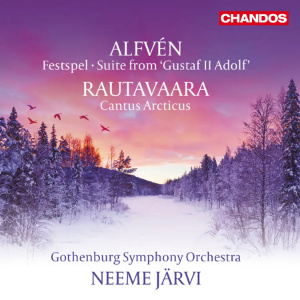
Hugo Alfvén (1872-1960)
Festspel Op.25 (1907)
Gustav II Adolf Suite Op.49 (1932)
Einojuhani Rautavaara (1928-2016)
Cantus arcticus, Concerto for Birds and Orchestra Op.61 (1972)
Gothenburg Symphony Orchestra/Neeme Järvi
rec. live, 11 October 2024, Concert Hall, Gothenburg, Sweden
Chandos CHSA5386 SACD [61]
Neeme Järvi may be of the most recorded of conductors, with over 500 recordings, some which date back decades. In 1982, he became the principal conductor of the Gothenburg Symphony Orchestra and held the post for 22 years. He now is their Principal Conductor Emeritus, and continues to conduct in Gothenburg regularly, as evidenced by this live 2024 recording. Here we have him performing works by two composers he has championed, Hugo Alfvén (review) and Einojuhani Rautavaara.
Rautavaara’s Cantus articus (Arctic Song) is one of his best-known works. The University of Oulu in Northern Finland commissioned it for an academic ceremony. Instead of a counterpart to Brahms’s Academic Festival Overture or a celebratory cantata, Rautavaara decided to portray the native environment of that part of Finland: he wrote a Concerto for Birds and Orchestra, with bird sounds supplied by tape recordings. The work is in three movements, each featuring the sound of a different local bird. Every movement has a similar ABA design where the B section is in the form of a chorale.
The first movement, The Bog, is subtitled “Think of Autumn and of Tchaikovsky”. This is most appropriate – the music distinctly reminds one of both – but what is important is the taped sound of wild cranes, beautifully blended with the orchestra. The middle, slow section is very moving and sensitively scored. Equally beautiful is the cello solo that ends the movement. Wild cranes are followed by larks in the middle movement, subtitled “Melancholy”. Here the composer is more straightforward in his naturalism. The movement features beautiful writing for the strings. The last movement, Swans Migrating, starts with a reminiscence of the opening movement. That leads into the most beautiful chorale section of the three, with excellent blending of birds and orchestra, before the birds have the last word.
Alfvén’s Festspel (Festival Play) is one of his most popular shorter works, whereas the Gustav II Adolf Suite has not fared well on disc, except the Elegi movement. Festspel comes from a dry spell in the composer’s output. Alfvén happened to be visiting Verner von Heidenstam, a Swedish Nobel Prize winner, who was writing a play about a group of soldiers called King Karl’s Men in Poland during the Great Northern War. Heidenstam’s description of the play inspired Alfvén to start on a polonaise, which became Festspel. The excitement Alfvén must have felt at resuming composition can be felt in every note. Järvi emphasizes this with his combination of verve and subtlety, especially in the contrast between the various sections of the piece. The Gothenburg brass do a great job in supporting him.
Unlike his contemporaries Nielsen and Sibelius, Alfvén wrote only one significant theatrical work, unless one counts his two ballets. The Gustav II Adolf Suite, a work of Alfven’s sixties, is one of his largest orchestral works at over half an hour. King Gustav II Adolf, known as Gustavus Adolphus, was Sweden’s greatest mlitary commander during the Thirty Years’ War. The music was commissioned for Ludvig Nordström’s play that celebrated the 300th anniversary of the King’s death.
The first movement, Vision, mystically conjures up the time of the Thirty Years’ War and the importance of Gustavus Adolphus to Sweden. It is based on the old hymn Ein Feste Burg is unser Gott. The scurrying strings of the Intermezzo which follows, as the Swedish forces assemble, show Alfvén at his most vigorous. In contrast, there is In Emperor Ferdinand’s Castle Chapel, where the King’s foremost enemy, the Holy Roman Emperor Ferdinand II, attends a service before battle. This slow movement has a sense of reverence rather surprising from the non-religious Alfvén, but there is an underlying atmosphere of menace throughout. The following three movements are successful essays in 17th-century dance forms, especially the Sarabanda, whose grave undertones foreshadow future events. The well-known Elegi, whichdepicts the night before the Battle of Breitenfeld in 1631, is very moving. Finally we have the Battle of Breitenfeld itself. Alfvén’s music is not quite up to the level of William Walton’s score for the Battle of Agincourt, but is very enjoyable and benefits from the composers skill with orchestral color. There is also a return of very moving music from the Elegi before the final victory.
The SACD recording is superb. Not only would one never know that it is a live recording, but the clarity of the orchestral lines is outstanding. The various solos are perfectly life-like, and the sound of the full Gothenburg Orchestra is very full and colorful. As noted above, Järvi’s unique blend of verve and subtlety is well-suited to all the music here, especially Alfvén’s suite. Many listeners will want to purchase the disc for the Gustav II Adolf music alone, but one should not overlook the quality of Järvi’s performances of the other two works.
William Kreindler
Buying this recording via the link below generates revenue for MWI, which helps the site remain free