
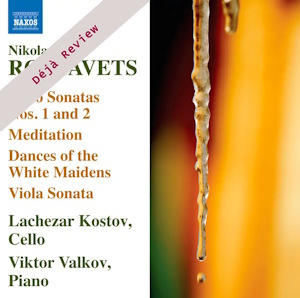
Déjà Review: this review was first published in April 2011 and the recording is still available.
Nikolay Andreyevich Roslavets (1880-1944)
Cello Sonata No.1 (1921)
Razdum’ye (Meditation) (1921)
Cello Sonata No.2 (1922)
Tantsï belïkh dev (Dances of the White Maidens) (1912)
Viola Sonata (transcribed for cello and piano) (1926)
Lachezar Kostov (cello)
Viktor Valkov (piano)
rec. 2008, Academy of Arts and Letters, New York City
Naxos 8.570996 [53]
With this disc Naxos continues its path-finding role in unearthing little known – and sometimes even unknown – repertoire which does sterling service to composer and listener alike. In the case of Roslavets at least, his works are becoming better known and more than 3 dozen CDs from various labels exist to shed some light on yet another composer from Soviet times whose career was bruised by the interference of the State. Apart from Dances of the White Maidens, a work which dates from 1912, the works on this disc were all written in those heady days shortly after the revolution of 1917 when artists in all creative spheres truly believed that an era was beginning that would allow for the highest degree of experimentation. These exciting times, in which many superb artistic creations came about in art, architecture, literature, the theatre and music, came to an abrupt end following Lenin’s death in 1924. Stalin’s naive and rudimentary understanding of art coincided with his inability to appreciate anything but the most banal. Even though Roslavets was an early champion of the new regime and quickly joined the Communist Party he was later condemned as “an enemy of the people” whose music was not designed “to speak directly to the proletariat” but instead was self-indulgent, confused and confusing.
The compositions on this disc will be further assistance in putting Roslavets’ music in the spotlight. It will undoubtedly be recognised for the brilliance of its writing and the new direction that was being ploughed in that brief but exciting period of the early twentieth century in Russia.
The Cello Sonata No.1 from 1921 launches itself straight into spiky rhythms without any preamble. Those listeners who might be put off in advance by the comparison with Schoenberg often, and I think incorrectly, made, should take heart as this is by no means full blown atonality. It is full of inventiveness characterised by beautifully lyrical lines tinged with the anguish so redolent in ‘the Russian soul’. The Sonata’s tortured cello line continues until half way when there is something of a more calming aspect that comes to the fore. The over-arching sadness returns to conclude the work. Overall it puts the players to the test as this is technically difficult music. It is to the credit of the two young players here that there is little hint of that. ‘Meditation’ opens with another very serious and reflective theme and its mood is maintained throughout.
The Sonata No.2 at twice the length of the first is once again a meditative, introspective piece that pulls no punches in the emotion it conjures but contains some beautiful melodies, particularly in the piano parts that provide a counter to the cello’s more sombre mood. Dances of the White Maidens is the earliest work on the disc, dating as it does from 1912, and shows Roslavets as the innovator that other composers recognised him to be. The opening notes from the cello are more lyrical and less tortured though still soulful and the theme is worked on throughout the piece. As the liner-notes put it the work, takes one into “a mystical and ethereal universe” which is underlined when, at the end the instruments simply dissolve into silence. The final work, the Viola Sonata, transcribed for cello and piano is a lovely one with gorgeously rich harmonies that the two instruments weave between them. It repays frequent hearings, as do all the works here. The main theme is so full of passion that one regrets it when the end comes making you want more. It is the least difficult music on the disc and is immediately rewarding.
The two instruments in all the works here presented are equal partners, the piano having as much to say as the cello. The two young Bulgarian musicians are completely committed to communicating the essence of the music to their listeners. If you find this music as interesting and exciting as I do then I can wholeheartedly recommend that you also try the other Naxos disc of his Violin Sonatas 1, 4 and 6 and 3 Dances, on Naxos 8.557903.
Steve Arloff
Buying this recording via the link below generates revenue for MWI, which helps the site remain free













