
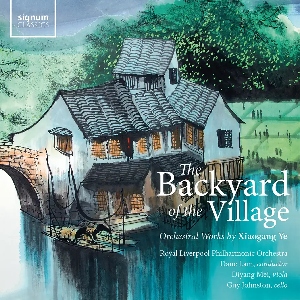
Xiaogang Ye (b. 1955)
The Backyard of the Village, Op. 89 (2019)
The Memories of Mount Jing Gang, Op. 87 (2019)
My Faraway Nánjīng, Op. 49 (2005)
The Loquat in Five Colours, Overture for Orchestra, Op. 108 (2024)
Diyang Mei (viola), Guy Johnston (cello)
Royal Liverpool Philharmonic Orchestra/Dane Lam
rec. 2024, Philharmonic Hall, Liverpool, UK
Signum Classics SIGCD972 [52]
Xiaogang Ye was born in Shànghǎi in September 1955. He studied initially with his father Yè Chūnzhī before training in ballet from the age of six. In his twenties his mother, singer Hé Shuǐyīng, encouraged him to take up composing. His teen years were scarred by the horrors of Máo Zédōng’s Cultural Revolution (1966-76), which sought to purge capitalist influence from China. His father was sent to a labour farm, and Ye to work in a factory. He survived these hardships and when the Central Conservatory of Music in Běijīng reopened, he studied there between 1978 and 1983. His primary composition teacher was Dù Míngxīn, who had studied in Moscow in the 50s, and was well known as one of the contributors to music for the 1964 ballet The Red Detachment of Women.
In 1980 his horizons were broadened when he studied briefly with Alexander Goehr, the first Western composer to teach in Beijing following the Revolution. In 1987 he received a scholarship to the Eastman School of Music at the University of Rochester, studying with Samuel Adler and Joseph Schwantner. Later still, he studied with Louis Andriessen. He returned to China in 1994 and since then has built up a stellar career as composer, teacher and administrator.
He is not as well-known as his contemporaries Tán Dùn and Chén Qígāng, who with their Chinese-rooted though Western modernist music, have developed major presences in the West. I was surprised listening to the disc and then reading about the composer how none of it sounded as though it would have been by a composer with his pedigree.
What I mean, is that the music is by a composer who has an impeccable and impressive classical technique, but it is certainly not coloured by any of the modernist or minimalist styles of his teachers. Having done some research via YouTube, I can see that the music here is Xiaogang Ye ‘lite’, music to entertain, which it does very well. His ‘other’ music such as the Pippa Concerto, The Scent of Green Mango, or Symphony No.3, which is much more adventurous in concept, easily puts him up with Tán Dùn and Chén Qígāng as a major figure in contemporary music. So, rather like Peter Maxwell Davies, it seems that Ye has two styles: the populist and the more challenging. The music on this disc is inspired by Chinese culture but coloured by the music of early twentieth century composers such as Stravinsky, Debussy, Ravel, Respighi and even Copland. It is uncluttered and direct and its main aim is to communicate to a wide audience.
The Backyard of the Village, commissioned by the Qiántáng River Culture Festival, was written in a week – an impressive feat for a twelve-minute work. The commission asked for a ‘representation’ of the scenery around Hángzhōu, Zhèjiāng Province; in addition, they wanted the work to illustrate ‘the new spirit of today’s Chinese farmers in the area’. The score incorporates folk songs, with which the composer had been familiar since childhood. These give a Chinese foundation to the work as does the instrumentation and pentatonic harmony. The florid arpeggios on piano reminded me of Respighi’s Pines of Rome.
The Memories of Mount Jing Gang for viola and orchestra was commissioned by the China National Orchestra. It is inspired by the ridges and ravines of the Jǐnggāng massif in eastern China, where, during the first days of the Chinese Civil War, Máo Zédōng led his Red Army against the forces of the ruling Guómíndǎng party. The liner notes quote a poem about armies and guns, but I did not get any militaristic feel from the work; rather, it is a rhapsodic lyrical work with a very Copland-like feeling. Maybe it is the struggle against right over wrong, or the one against the many? Diyang Mei is an excellent soloist, coping brilliantly with the often very high tessitura.
I think I expected more horror in My Faraway Nánjīng for cello and orchestra, as it was written in memory of the 300,000 Chinese people massacred by the invading Japanese army in Nánjīng in 1937. The liner notes quote from a horrific account of the time, but the music, while impassioned and elegiac, does not convey any overt sense of horror or outrage, except perhaps near the very end where the cello plucks five four note chords and the timpani and bass drums sound ff. It is a beautiful work, beautifully played by Guy Johnston, but the narrative that goes with it is lost on me.
The disc ends with the most recent work The Loquat in Five Colours an overture for large orchestra commissioned by the Central Conservatory of Music. It is based on an earlier work, the folk inspired Héběi Rhapsody, Op 84 (2018) – Héběi being a province of the North China Plain. It is a lively, cinematic work full of Chinese sounding melodies and illustrations of an open landscape, and is all great, undemanding fun.
The recording engineers have done a sterling job in capturing the sound world of the four works quite vividly. The liner notes include a detailed and informative essay by the distinguished writer Ates Orga.
I do not know how I have gone so long without hearing any music by Ye, but I am glad that I now have. Hearing these populist works, in these excellent performances, has led me to discover more of his concert music which I look forward to exploring in the future.
Paul RW Jackson
Other review: David Barker
Buying this recording via the link below generates revenue for MWI, which helps the site remain free













