
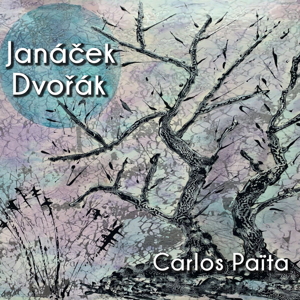
Antonín Dvořák (1841-1904)
Symphony No. 7 in D minor, Op.70 (1885)
Symphony No. 8 in G major, Op.88 (1889-1890)
Symphony No. 9 in E minor, Op.95 From the New World (1893)
Leoš Janáček (1854-1928)
Taras Bulba – Rhapsody for Orchestra (1915-1918)
Royal Philharmonic Orchestra, Philharmonic Symphony Orchestra (Janáček) / Carlos Païta
rec. 1982, Kingsway Hall, London, UK (No.7), 1989 Walthamstow Town Hall, London, UK (No.8-9); live, 1980 (Janáček)
Le Palais des Dégustateurs PDD045 [2 CDs: 136]
Here is another release from Le Palais des Dégustateurs in their retrospective survey of the discography of the Argentine conductor Carlos Païta. The bulk of Païta’s recordings were released either on Decca and latterly on an “own” label funded by a wealthy group of the conductor’s admirers – Lodia. Critical reception of these releases at the time was mixed ranging from laudatory to dismissive so it has been interesting to revisit these performances some forty years since they were released. Lodia LPs were presented as a ‘premium’ product and several of the earlier recordings – which includes the Symphony No.7 here – had the additional kudos of being early digital recordings with all the novelty that implied.
Carlos Païta either engaged regular orchestras – as in the Royal Philharmonic that appears in Symphonies 8 & 9 – or used an ensemble called the “Philharmonic Symphony Orchestra”. Whether this was a pick-up freelance orchestra or a ‘rebadged’ contract band I do not know and the internet fails to elaborate but I assume the former. Both Symphony No.7 and Leoš Janáček’s Taras Bulba are performed by this orchestra in this set and to be fair they play decently well in the symphony if rather roughly in the Janáček. Indeed, the playing throughout is perfectly respectable – often better than that so the interest and value for the collector rests wholly with the interpretative strength of the performances and their technical/recording presentation.
Disc one pairs Antonín Dvořák’s Symphony No.7 in D minor Op.70 with the Symphony No.8 in G major Op.88. The former is a 1982 digital recording made in the famous Kingsway Hall London. Païta is not a subtle or nuanced conductor and he is certainly not one interested in exploring any of the Bohemian or rustic elements in any of these famous symphonies. These are explicitly dramatic – often driven – versions that cumulatively can feel unrelenting and rather one dimensional when heard back-to-back. That said, Symphony No.7 is Dvořák’s ‘darkest’ symphony and the one most likely to respond to this performing style. The 1982 digital recording is actually pretty good – the Kingsway Hall is not caught with the supportive warmth that typified the great analogue recordings made there but the sound is truthful and clear.
Of course, the catalogue groans under the weight of numerous recordings of the “Big Three” Dvořák symphonies both historical and modern, and Païta offers few interpretative insights to displace previous favourites. The stopwatch confirms what the ear suggests: except for a pretty brisk and bracing finale Païta is pretty ‘standard’ tempo-wise across the whole work. My personal preference is for performances that hark back to the influence, sonically and expressively, of Czech performances which, even in this weightier symphony, allows phrasing to be pliant and the music to occasionally relax. Païta’s approach is almost never flexible and he rarely permits the music to dance – so key in all three scherzi especially – in these symphonies. But that said, as a broad-brush dynamic version this is perfectly good and certainly a performance that would be enjoyed in the concert hall.
By the time Païta came to record Symphony No.8 in G major Op.88 in 1989 the compact disc was the dominant format which allowed the original release to place it alongside the New World Symphony too as a generous, if not unique, coupling. The Royal Philharmonic was booked and Walthamstow Assembly Hall the familiar recording location. A decade into digital recording techniques means that the engineering is now good and of course the orchestra play this with considerable skill and technical prowess. As such, the Walthamstow venue sounds a good deal warmer and generally more acoustically sympathetic than that achieved at the Kingsway Hall some years earlier. Usually, this symphony is regarded as one of the most good-natured and benevolent of the Dvořák canon – elements that Païta is happy to marginalise. Again, this is not just a question of timings but the feel for a phrase or the elegant turning of a melodic line.
For comparison, I randomly chose Charles Mackerras’s two-disc set of the three late symphonies recorded with the LPO for EMI Eminence in the early 1990s – so fairly contemporaneous. Mackerras does not labour the rustic or bohemian elements but his are such wonderfully natural, unaffected and affectionate performances. For sure, Païta is dynamic and exciting and the RPO backs him to the hilt but this is a one-dimensional approach that brings limited rewards. Worth noting however that the laudatory liner note quotes musicologist (and French music specialist) Harry Halbreich that this performance is the “most beautiful ever heard”. A comment as sweeping as it is questionable. The issue for me is not that Païta makes choices I happen not to like – that really would not matter since that is simply a question of taste and preference. Rather, he makes very few choices of note at all except to apply a muscular and frequently unbending approach throughout.
Moving onto the coupling of the New World Symphony recorded at the same time as No.8, Païta does make a couple of unexpected choices that at least challenge convention and as such are interesting to hear. The very opening of the work is marked semiquaver/sixteenth note = 126 – Païta plays this at nearly half speed – equalling 66 but pressing forward significantly from bar 9. Dynamic and theatrical for sure if not at all what the composer wrote. In the main allegro section of the first movement the quieter dynamics are only partially observed but he does do the traditional pull-back in tempo for the second subject – although the basic phrasing is unimaginative. He is far from alone in missing out the exposition repeat but I personally prefer to hear it – Dvořák wrote it and knew what he wanted. The most extreme deviation from any kind of norm is a very slow tempo for the second movement Largo. The marking is crochet/quarter note 56 with Païta closer to a glacial 20 (quaver 40) but this is not steady in itself with the second half of the third bar pushing forward and the timpani roll coming in ‘early’. Discogs credits the cor anglais solo to an iron-lunged Geoffrey Browne who plays this slow solo really beautifully. I have to say that I did actually find this rather powerful although the gear change back to a more normally executed (tempo-wise) poco piu mosso does not feel organic or completely convincing.
The remaining two movements fall back more to the standard Païta preference for brusque tempi and unleashed dynamics especially from the brass and timpani. One final quirk is the final a niente wind and brass chord held far longer than normal – actually rather effective. Overall, I do prefer a dynamic approach to the symphony which too often can be presented as some kind of symphonic cosy fireside chat. Vaclav Neumann’s first (analogue) Czech PO Supraphon recording I find utterly compelling in its balance of drama and warm lyricism – the authentic sound of that orchestra in this repertoire helps greatly too. Dvořák’s handling of form and the way the work is thematically bound together displays the genius at work under the surface of this supremely appealing and attractive work. I am not convinced that Païta is particularly interested in the formal unity of the piece preferring instead to focus on exciting moments and gestures. Given that the RPO plays well and is decently recorded those passages are exciting but whether the interpretation as a whole coheres, I am far less certain. So again, this is a performance that might well excite as a one-off in the concert hall but is too inconsistent for repeated listening.
The coupling on the second disc is a nominally ‘live’ performance of Janáček’s Taras Bulba played by the Philharmonic Symphony Orchestra. The liner – frustratingly lacking any technical or recording – simply marks this as “Live 1980” – no date or venue offered. As such it appears to be the first time this has been commercially released. The acoustic is certainly different – rather too large and blurring with some odd internal instrumental balances – but there is little obvious audience noise and no applause. If not at the level of popularity of the Dvořák symphonies, this orchestral work is available in multiple recordings which technically, orchestrally and interpretively far outstrip this version. Janáček’s writing is always kaleidoscopic and patchwork in the way the orchestration is assembled. This version – which is competently but not brilliantly played – has various issues of intonation, splits and ensemble along with an organ tuned fractionally differently to the rest of the orchestra. Again, the result lacks coherence even though Païta does not indulge in any tempo extremes. However, the liner notes gush: “Taras Bulba tears through the air and sound under this incandescent and inspired baton. The finale is apoplectic.” I am not sure that quite made it out of Google translate unscathed… This performance is borderline poor and at this price point – €25 for the 2 CD set or €13 for the download – there is no justification for this in preference to any number of alternatives. Once more, for direct comparison the famous Mackerras/VPO/Decca recording is almost exactly contemporaneous and in a different league by any measure.
This is just one of several releases from Le Palais des Dégustateurs which return a significant part of Carlos Païta’s discography to the current catalogue. This is a clear investment of time, money and belief. My sense is that this will be of limited niche interest given the available competition.
Nick Barnard
Previous review: Jonathan Woolf
Availability: Le Palais des Dégustateurs













I, too, like hearing the exposition repeat in the first movement of Dvorak’s ninth symphony. It gives the first movement welcome added weight, since otherwise it would go by very quickly. The vast majority of Czech conductors, however, do not play the repeat. Czech musicians and musicologists point out that while Dvorak’s initially asked for the repeat and the score was published that way, he later regretted it (in writing) and crossed out the repeat and lead-back bars in his copies of the score. Dvorak was more equivocal on what he wanted regarding this point then, than what this review assumes.
Let’s be clear. The famous score held in Prague where Dvorak crossed out the first movement repeat adding “Away with these repeats forever” was Symphony 6, not the “New World”, or do you have knowledge that he put a similar comment on the score of that too? I must say, this latter repeat is a puzzler. Dvorak put first movement repeats in symphonies 1 and 2, in no. 3 he not only did not put one but wrote “NO REPEAT” in the score as if in fear that someone might play it anyway. Repeats were back in place for 4, 5 and 6, the latter deleted as above. That sounds final and 7 and 8 do not have them (which did not stop a critic in Hi-Fi News long ago from comically criticising Colin Davis for omitting them, a review worthy of Pseuds’ Corner). So why did he write a repeat again in no. 9? Did it occur to him that, as Gary says, that “otherwise it would go by very quickly”? Maybe this is the one Dvorak first movement repeat we should play? I can’t help feeling, though, that Nick Barnard is over-confident in saying that “Dvorak wrote it and he knew what he wanted”. Unless there exists a statement from Dvorak regarding the repeat in Symphony 9 specifically that I am not aware of (which is perfectly possible) it seems that Dvorak was really not always sure what he wanted on this matter. Maybe by extending this survey to the first movement repeats or lack of them in Dvorak’s many chamber works a further pattern might emerge.
By the way, does anybody know which conductor was the first to make the repeat in no. 9 on record? Rudolf Schwarz’s 1954 recording with the “New Symphony orchestra” has it. Does anyone know of an earlier one? The Schwarz, incidentally, is about as forgotten as a record can be, but in its quiet understatement I find it utterly refreshing, far from dull (which Schwarz admittedly could be on occasion).
Thankyou for that information Gary which I did not know. Curious that the critical edition of the score clearly still includes the exposition repeat – I don’t have my copy to hand to know what the editors say about this in their introductory notes. By the simplest of measures – my own personal preference! – I agree completely with your observation about the movement going by very quickly without it.
I have always been intrigued by the fact that this ‘late’ example of a Romantic Symphony chooses such a traditional concept as the opening repeat. Of the major/famous works Rachmaninov 2 does the same – and again I personally prefer hearing it although in that instance it needs a conductor of real insight not to allow that to sound too long! Other late repeaters(!) are Rach again in No.3 and then more unlikely offenders in Nielsen 1 and DSCH 9 and of course Mahler 1&6. In each instance these composers are such masters of form and content that their use of this old practice suggests to me a concious choice rather than simply following out-moded convention? As such I like to keep them in……
Chris – you are probably right in asuming my over confidence! Which simply proves that what appears to be a certainty is so often clouded by doubt. Does anyone know why Czech conductors (often – not always – see I’m learning!) opt to omit it?
Nick, for some reason I see your second comment (April 17 at 10:55) on my mobile (but only after refreshing the browser twice over) while I can’t access it through my desktop at all – a daily problem for me and I wonder how many people coming to MusicWeb see only old reviews and comments because they don’t realize that if they refresh their browser they will see new ones. If this is only my problem, I’ll have to put up with it. If it’s a general problem, perhaps those running the server would care to investigate. Anyway, having got that off my chest …
I understand that those who study conducting at Prague Conservatoire have their attention drawn to the crossed out repeat with comment on the score of Symphony 6 and are told firmly that Dvorak didn’t want his repeats played. And of course the great Czechs of the past – Talich, Sejna, Ancerl – didn’t play the repeats, but that was a generation that didn’t usually play repeats in symphonic first movements anyway. I don’t know if younger students still accept this unquestioningly – those who conduct regularly in the UK might have discovered that they are more likely to get a good review if they play the repeats. I continue to feel that if Dvorak, having cancelled the repeat in no. 6 and not put repeats in nos. 7 and 8, wrote one in again in no. 9, perhaps he really did want that one, realizing, maybe, that the movement was a bit short without. I think that, if I were a conductor, I would probably play the repeat in no. 9 but not the others, but I’m not a conductor and Dvorak didn’t write piano sonatas over which I might have to agonize ….