Antonín Dvořák (1841-1904)
Symphony No. 7 in D minor, Op.70 (1885)
Symphony No. 8 in G major, Op.88 (1889-90)
Symphony No. 9 in E minor, Op.95 From the New World (1893)
Leoš Janáček (1854-1928)
Taras Bulba – Rhapsody for Orchestra (1915-1918)
Royal Philharmonic Orchestra, Philharmonic Symphony Orchestra (Janáček)/Carlos Païta
rec. 1982, Kingsway Hall, London, UK (No.7), 1989 Walthamstow Town Hall, London, UK (No.8-9); live, 1980 (Janáček)
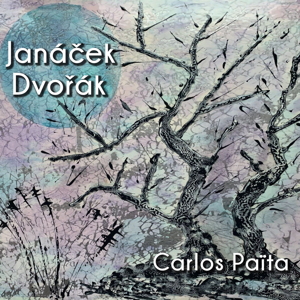
Le Palais des Dégustateurs PDD045 [70 + 66]
Many of Carlos Païta’s recordings were reissued on Lodia, a label that was largely set up, I believe, by the conductor himself to preserve his legacy. The Argentinian Païta (1932-2015) had a reputation as a fiery interpreter with dramatic instincts, not least in Berlioz and Wagner chunks and his Dvořák Seventh Symphony has always been admired by a coterie of admirers. His legacy seems now to be in the hands of Le Palais des Dégustateurs as the company has recently reissued a swathe of it.
I came fresh to Païta’s Seventh, having never heard it before and was impressed. It was recorded in Kingsway Hall in London with the Philharmonic Symphony Orchestra (PSO), a session outfit like the National Philharmonic, a group familiar to Stokowski admirers. The PSO toured across Britain and Europe with Païta and made a number of recordings with him, such as this one. It was recorded digitally in 1982 and is reminiscent of the proportions Rowicki found with the LSO a decade earlier but with greater tension in the finale. In fact, Païta is faster than almost everyone in this movement but what is so impressive about his reading is its consistent vitality, its kinetic, rhythmic intensity and its cumulative drive. Païta even finds vistas of melancholy in the Scherzo and the performance is, if anything, even more exhilarating than Monteux’s classic recording.
After the Seventh I found the Eighth, with the Royal Philharmonic, a let-down. What works in the most ‘Austro-German’ of the Dvořák symphonies is more resistant to the conductor’s rigorous drive in the more romantic, folkloric stretches of the G major. Païta steams through it with remorseless intensity and only approaches a conventional tempo in – ironically – the finale, an Allegro con fuoco where Païta is less fuoco than many – Talich, Kubelík and Rowicki amongst them. The in-your-face 1989 sonics in Walthamstow Town Hall add to the glare of a performance which is never, for a second, dull but is rarely convincing.
The Ninth was recorded at the same time with the same orchestra in the same location. This time the conductor’s impulse to tensile drive has deserted him and his tempi are, with one massive exception, comparable to Karel Ančerl’s Vienna Symphony recording. The exception is the Largo, stretched to an almost Celibidache-like 15:51, and which I found unlistenable – except to note the admirable breath control of the cor anglais principal and the ability of the strings to change bow without causing major disruption to the line. Païta ensures maximum contrast by letting rip in the finale, a technicolour picture that blazes in italics. Once again, it’s tremendously lively, the opposite of dull, but hardly recommendable as such.
There’s a pendant of Janáček’s Taras Bulba performed live on tour with the PSO in 1980 at an unknown location – or to be precise, at a location that’s not noted in the track listing. There’s less opportunity for tempo excess here and Païta duly cleaves quite close to conventional tempos. It’s a work that responds well to his talent for dramatic portraiture and is played with valiant, expressive commitment.
If you’ve come across Païta but not his recordings there are now many to select from this label. This double disc comes as a gatefold with notes in French and English and presents dramatic, largely unidiomatic performances of huge personality and drama.
Jonathan Woolf
Other review: Nick Barnard
Availability: Le Palais des Dégustateurs