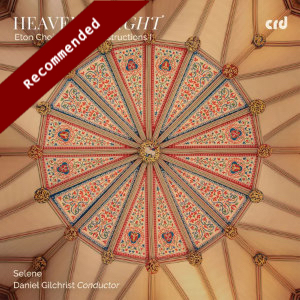
Heavenly Light • Eton Choirbook Reconstructions I
Selene/Daniel Gilchrist
rec. 2024, St. Martin’s East Woodhay, UK
Texts and translations included
CRD 3555 [65]
The choirbook of the kind to which the Eton book belongs, is a large format score of liturgical music with all the vocal parts shown, though not aligned as in a modern score, but ranged one above the another and on facing pages. The choir would all sing from the one copy, unless singers had individual parts written out for them. The Eton choirbook is one of the few surviving English choirbooks from the pre-Reformation period. The Reformation affected every aspect of doctrine and worship, and the authorities then insisted on a much simpler musical style, and with the texts in the vernacular instead of Latin. Devotions to the Virgin Mary, which had formed a large part of pre-Reformation worship and therefore of music, were banned. Much of the written music was lost or destroyed. The English musical tradition, which had been one of the strongest in Europe, was permanently weakened.
The Eton book originally contained ninety-three works by twenty-five composers. It was compiled between 1496 and 1515 by Robert Wylkynson, who was master of the choristers at Eton College Chapel. However, about a third of the works are missing, lost some time before the remainder was rebound in the mid sixteenth century. Of these missing works, fragments of twenty-one works survive, of which about twelve have at least half of their material. These have been reconstructed by Russell Blacker, and the present disc, the first of two planned, contains nine of them. I should add here that the reconstruction of scores of Renaissance church music, usually from incomplete sets of part books, has been carried on by scholars for some time now, and considerable expertise has developed. Some listeners will know the five disc set The Lost Music of Canterbury by Blue Heron which contains music from the Peterhouse part books with the missing parts reconstructed by Nick Sandon, and there are others. The problem with the Eton fragments is that a missing page means not one missing part but half of them, posing a greater challenge for the reconstructor.
In his handbook, Latin Church Music in England 1460-1575, on which I have drawn, Hugh Benham says ‘The most outstanding traits of the Eton music are a richness and brilliance of sonority not found in earlier music or as a rule in contemporary Continental work . . . and outstanding rhythmic vitality and melodic variety.’ The price of this, as he immediately concedes, is ‘the usually rather distant relationship between words and music.’ Indeed, such is the richness of the polyphony that it is often impossible to distinguish the words, even with the texts in front of you. This was one of the things the Reformers objected to. But if you are prepared to accept this feature you will find this music absolutely ravishing. The music is written in four, five and sometimes six parts; these are listed work by work below.
Four of the nine pieces here are by Robert Wylkynson, who also compiled the book. The longest of these is his setting of the Magnificat, an elaborate piece running to nearly thirteen minutes, Blacker explains the technicalities in his booklet note; all I need say is that the piece is glorious to hear. Of Wylkinson’s other pieces here, O Virgo Prudentissima sets not a liturgical piece but, possibly on commission for a court occasion, a poem by the Florentine humanist poet Angelo Poliziano (Politian). In contrast Gaude Virgo Mater Christi is quiet and reflective. Salve Decus Castitatis makes considerable use of imitation between the parts and ends with a long and beautiful Amen.
The opening piece here, Nicholas Huchyn’s Ascendit Christus is a good introduction as it is rather simpler and easier to follow than many of the others and of serene beauty. This is one of only two surviving works by this composer.
William Horwood is the earliest composer represented here. His Gaude Virgo Mater Christi is both lyrical and exuberant, with a soaring top line. Robert Fayrfax and Richard Davy are tolerably well known, the former’s Ave Lumen Gratiae, which survives only in part, having been frequently recorded, Davy’s Gaude Flore Virginali is written on a grand scale, beginning with a section in two parts, then in three, then back to two before opening out to six with a rich and complex texture.
Finally, we have Robert Holynborne’s one surviving work, Gaude Virgo Salutata, setting a long text with the most elaborate polyphony and rising to a splendid climax on the Amen.
Daniel Gilchrist formed and conducts the choir here. There are two each of sopranos, altos, baritone and basses but four tenors. You will notice that he uses women sopranos rather than boy trebles on the top line; this is not one of the college choirs though I understand that its members do also sing in some of them. Personally, I am perfectly happy with this, and, given the extremely florid nature and high tessitura of the top lines, I feel secure with them being handled by women. They give wonderfully confident and eloquent performances of this ravishing music. The recording, made in an appropriate church acoustic, is excellent and the notes informative. This is a most valuable enterprise and I look forward to volume 2.
Stephen Barber
Previous review: Gary Higginson (April 2025)
Buying this recording via a link below generates revenue for MWI, which helps the site remain free



Contents
Nicholas Huchyn (c.1465-1504?)
Ascendit Christus a 5 (secunda pars)
Robert Wylkynson (c.1450-1515)
O Virgo Prudentissima a 6 (prima pars)
Robert Fayrfax (1464-1521)
Ave, Lumen Gratiae a 4 (prima pars)
Robert Wylkynson
Magnificat a 6
Robert Wylkynson
Gaude Virgo Mater Christi a 4
Richard Davy (1465-1507)
Gaude, Flore Virginali a 6 (secunda pars)
William Horwood (c.1430-1484)
Gaude Virgo Mater Christi
Robert Wylkynson
Salve Decus Castitatis
Robert Holynbourne (d.1508)
Gaude Virgo Salutate