by Charles A Hooey
Consider this … an American tenor who joined the Metropolitan Opera for the 1949-1950 season was denied an opportunity to sing an Opening Night performance throughout his tenure of seven years, while far away in Milan, the Opera Company at Teatro alla Scala were not so chary; they invited him to participate in the opening of their season on 7th December 1951 as Arrigo in Verdi’s I Vespri Siciliani with none other than Maria Callas as Elena. Thus he became the first American tenor to open at La Scala.
As a collector of opera recordings, I happened to contact Eugene Conley in 1972 to see if perchance he had a tape of that famous occasion and/or any of his I Puritanis in hopes of obtaining copies. I half expected he would not reply, but he did. Alas, he knew of no recordings but we stayed in contact. Later it turned out he had arranged for acetate and tape recordings to be made of his performances but not of any I was keen to acquire.
One day in the mid-seventies I noticed in a Winnipeg newspaper that the acclaimed artist, Eugene Conley, was to give a concert at the University. “Aha!” I thought, “It will be great to meet finally!” With a friend I attended, but I was startled to see a person quite unlike photos I had seen of the tenor. Then he began to sing in a pleasant-enough voice, but as a baritone! “Well,” I thought, “many years have elapsed and changes do occur.” Afterwards we hustled back-stage where I thrust out my hand, saying. “Hi, Gene, we meet at last!” Without a word he abruptly turned away and began talking to other people. Puzzled, I came home, sat down and wrote to Eugene Conley in Denton, Texas. He responded by saying my man was likely someone active in academic circles with whom he had had instances of confusion during their careers.
Tenor-to-be Eugene Thomas Conley was born on 12 March 1908 in Lynn, Massachusetts, about 20 kilometres northeast of Boston, to Reuben A. and Josephine Conley née Farnsworth, who were both transplanted Canadians, from Annapolis, Nova Scotia. (Could this explain his desire to correspond with me, as I, too, am a Canadian?) Gene, the eldest, along with two siblings, grew up to the old-fashioned fiddling of their father, so naturally he gravitated towards music. Initially he gave solos with the High School Glee Club and as first tenor with a Male Quartet. To finance his studies with George Dane, he took a job at General Electric. After only six months of study, he was able to make his first professional appearance at a concert sponsored by the local Women’s Club.
There followed progress up the career ladder by means of radio, specifically a series of commercial programs in Boston, climaxing with an appearance on the Jenney Concert Hour. Unusual in the case of so young a singer, he made his first recordings of classic oratorio favourites courtesy of the Federal Music Project. This led to an engagement in Detroit where he sang on the air for a year until, discovered by an NBC scout, he was invited to New York and provided with a forty-five piece orchestra and a radio series of his own, called “NBC Presents Eugene Conley.”
Opera must have lurked in his psyche though for he ventured an appearance at the Metropolitan Auditions of the Air in 1936 when that program gave its first season. However it was not until he met famed teacher Ettore Verna at a party in the home of a member of the Opera Guild that he began to think seriously of a career in opera. By May 1940, Verna had him in a serious training routine where he quickly acquired tradition, mise en scène, a couple of rôles and a decided ‘Italian flavour’ all at the same time.
With Salmaggi, Gallo et al.
Once Verna had decided his protégé was ready to take the plunge, he arranged for him to link up with Alfredo Salmaggi, the head of a popular-priced touring company, based in the Hippodrome, a giant theatre on the east side of Manhattan. In 1933 ticket prices ranged from 25 to 50 cents as Salmaggi competed with his friend Gatti-Casazza at the Metropolitan. In 1940, while performing at the Brooklyn Academy of Music, Conley made his début as the Duke in Rigoletto. Without benefit of a rehearsal, it was almost a two-man show with Verna prompting from the wings, coaching in the dressing room, and somehow pulling the young singer through the evening. Press and public blissfully unaware of the difficulties they had witnessed gave the youngster a rousing reception.
After this baptism of fire, Salmaggi provided a host of opportunities to learn as the tenor toiled with Faust, Butterfly, Bohème, Traviata and Cavalleria, growing familiar with stage routine, spurred on by the confidence and guidance of his teacher. As the story goes, near the end of ‘La donna è mobile,’ he would toss a pack of cards into the air to signal to the conductor he was about to release his high note. So when he closed his aria with a high B, it was like a shower of stars and the house went wild. Under easygoing Salmaggi, an encore was not only permissible but also usually inevitable. Nodding to the conductor, Conley reached into his pocket and out came a second deck of cards.
Soon, other companies were clamouring to feature him, and as a result engagements materialized on several fronts. Thus, he was part of the New Opera Company during its launch at the Forty-fourth Street Theatre in New York City. On 15 October 1941, he sang Ferrando when a series of Cosi Fan Tutte performances began with Ina Souez (Fiordiligi), Pauline Pierce (Dorabella), Andzia Kuzak (Despina) and other aspirants. More followed. Then in 1942, Fortune Gallo’s San Carlo Opera became interested. Like Salmaggi, Gallo’s operation acted as a marvellous proving ground for young singers such as Dorothy Kirsten and Carlos Ramirez. They and Conley learned much from experienced artists active with the company. Gene started to make cross-country tours of single night stands as a member of the San Carlo troupe.
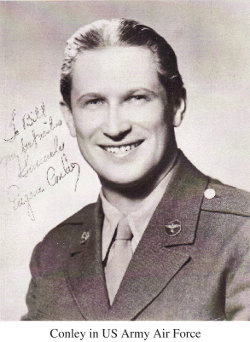
But, after Pearl Harbour he decided to put his budding career on hold and join the services, a pursuit that would occupy him for two and one-half years. However, one evening, as he left a New York theatre after a show, a friend who owned a downtown restaurant collared him and said, “Hurry, Your C.O. is almost half way through his supper. Come to The Music Box and you’ll be able to sing for him. The plot worked, for in civilian life the Colonel was an organist in San Antonio, and a half hour later, he was sitting at the piano accompanying the young airman. Official red tape was quickly snipped giving Conley freedom to sing in special opera performances with companies that fattened the coffers of the Army Aid Society. He was also chosen to sing in the Army Air Force Show “Winged Victory” and was scheduled to appear in the film version although this apparently did not come to pass.
Thus, he was able to join San Carlo in New Orleans on 15 October 1942 for a matinée La Traviata with Lucille Meusel and Ivan Petroff as Germont. Going on to Los Angeles on the 27th, he repeated this opera with Meusel and Carlo Morelli and “next demonstrated his superior accomplishments in the leading rôle in The Tales of Hoffmann where his work was as notable for clarity of English diction as for voice quality.”
When the company reached Center Theatre in New York on 7 May, they found they were following an ice spectacle, but the show had to go on. On the second evening Gene appeared in Rigoletto, his Duke being “vocally smooth and acceptable (while) Grace Panvini used her light voice prettily as Gilda”… Ivan Petroff provided vital, dramatic singing in the title rôle with Charlotte Bruno a capable Maddalena. Next, as Lionel in Martha, he sang with Meusel as Lady Harriet, Bruno as Nancy and Stefan Kozakevich as Plunkett. He also sang in La Traviata with Meusel and Petroff. On 15 May, during a matinée Tales of Hoffmann, he sang Hoffmann while that evening he was the lead in Faust with Leola Turner as Marguérite and Harold Kravitt as Méphistophélès.
In April 1943 at Center Theatre, he sang Rodolfo in La Bohème with Dorothy Kirsten as Mimi, Shiela Vogelle, making her début as Musetta, Mario Valle as Marcello, Kravitt as Colline and Kozakevich as Schaunard. In the evening of 30 May, he returned as the Duke in Rigoletto with Morelli as the Jester, Amelita Galli-Campi as Gilda, Kravitt as Sparafucile and Margery Mayer as Maddalena. On 4 June, he sang Faust with Kirsten, Valle, Kravitt and Mayer as Siébel. Then on the 6th, to conclude, he sang Almaviva in the Barber of Seville with Meusel as Rosina, Morelli as Figaro, Kravitt as a gaunt and slinky Basilio and Pompilio Malatesta as a pompous Dr. Bartolo.
As a corporal and on leave, he chose to look in during the inaugural season of the Los Angeles Opera Company. Who knows? Perhaps he was drawn to the event by the presence of his future inamorata, Winifred Heidt. She was singing Carmen. What, or if, he sang is not known but apparently he “was a real hit”. Possibly, this happened during a San Carlo visit to California, when Gene garnered acclaim for his part in Rigoletto, Traviata and Bohème. “The rôle of Rodolfo in the latter opera was acted to perfection. The tenor is still in uniform and subject to recall to active military service.”
With Gallo in New York he appeared in La Traviata on 28 April 1944 with Stella Andreva and Morelli. In 1945, as “S/Sgt Eugene Conley,” he had a final fling with San Carlo in New York on 17 May as the Duke in Rigoletto with Grace Panvini as Gilda and Stefan Ballerini as the hunch-backed jester. His luck held as the bombing of Hiroshima ended the war before he could become involved in the Far East conflict.
The Cincinnati Attraction
Classical music, it seems, has long had a firm hold on a segment of the Cincinnati citizenry. One of their institutions, the May Festival, was one hundred years old in 1973, making it the oldest, continuous festival of its quality in the Western Hemisphere. The May Festival specialized in symphonic music and oratorio, leaving opera to the so-called “Opera at the Zoo” after it was formed in 1920. Conley became a regular.
In the summer of 1942, he discovered the abiding pleasure of spending six weeks in the grottos and glades of Cincy’s Zoological Gardens echoed to the strains of grand opera. For his initial exposure, he sang the title rôle in Faust on the 2 July 1942 with Jarmila Novotna as Marguérite, Nicola Moscona as Méphistophélès and Igor Gorin as Valentin. This opera was so popular he would sing it during virtually every visit. The following year he found plenty of action at the Zoo, first on 29 June 1943 in Faust with Marjorie Hess, Nicola Moscona and Alexander Sved. At a second performance Richard Bonelli sang Valentin instead of Sved. On 2 July, Conley sang the first of four Rigolettos with Lawrence Tibbett, Josephine Antoine and Virgilio Lazzari. Gene also sang on 10 July as Lionel in Martha with Josephine Antoine (Lady Harriet), Winifred Heidt (Nancy), Stefan Kozakevich (Lord Tristan) and Lorenzo Alvary (Plunkett).
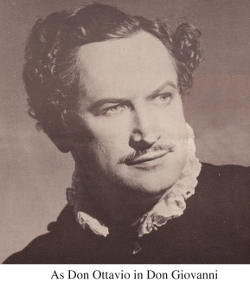
Absent for four years, Gene returned on 12 July 1947 to sing Faust with Mary Henderson, Nicola Moscona and Frank Valentino, while at a repeat on 23 July, John Brownlee sang Valentin. On the 29th he portrayed Rodolfo in La Bohème with Josephine Greco (Mimi), Cora Portaro (Musetta), George Czaplicki (Marcello) and Virgilio Lazzari (Colline) as Paul Breisach conducted. In 1948, naturally the season-opener on 30 June was Faust with Norina Greco, Ezio Pinza and Walter Cassel, Cleva conducting. Then on 15 July he undertook to present Lionel in Flotow’s Martha with Josephine Antoine (Harriet), Thelma Altman (Nancy) and Hugh Thompson (Plunkett) under Breisach’s baton, with a second performance on 28 July. On the 25th he had sung the Duke in Rigoletto with Weede, Hilde Gueden (Gilda), Thelma Altman (Maddalena) and Virgilio Lazzari (Sparafucile). In 1949 he had a hefty season that got underway on 6 July with Faust, his partners being Tajo, Norina Greco and Frank Valentino. On 10 July as Ottavio he sang in Don Giovanni with Tajo (see picture), Lazzari (Leporello), Sara Menkes (Donna Anna) and Irene Jessner (Donna Elvira). Next, as Rodolfo he sang in La Bohème with Norina Greco (Mimi), Laura Castellano (Musetta), Angelo Pilotto (Marcello) and Lazzari (Colline). On 5 August his rôle was Alfredo in La Traviata with Lucia Evangelista and Enzo Mascherini. To serenade Zoo denizens in 1950, Gene sang Pinkerton on 4/7 July with Tomiko Kanazawa as Madama Butterfly and Czaplicki as Sharpless.
Though absent in 1951, he was due in 1952 to sing in Tosca and Faust but instead he went to Buenos Aires. He thus missed a chance to see the Basque Spanish mezzo sensation, the petite but huge-voiced Lydia Ibarrondo, as Carmen. He did visit in 1953, allowing fans that had missed his earlier scheming Duke of Mantua, a fresh opportunity to see him on 30 June with Barbara Gibson, Robert Weede and William Wilderman. A pair of Madama Butterflys followed with Tomiko Kanazawa and Richard Torigi. Arriving in the summer in 1954, he sang inTosca with Kirsten and Czaplicki and a Faust with Moscona and Warenskjold. Eugene Conley was advertised to appear at the May Festival in the American Première of Britten’s Gloriana on 8 May 1955, but as it turned out, he was busy with the Met tour in Dallas on 7 May and in Houston on 9 May, so it would have been virtually impossible for him to attend, and in fact, John Alexander sang instead. Later, he appeared at the Zoo on 25 June in Tosca with Kirsten and Bardelli, followed by a Faust on 20 July with Eva Likova and Moscona. He and Eva would repeat this latter opera in July 1956 with Tajo and Cesare Bardelli.
For fans who had come to hear him, he did not fail as Faust on 12 July 1957 with Nadine Conner, William Wilderman and Napoleon Bisson. A second chance to hear him came two nights later. In 1958 he returned for two operas: La Traviata on 12 July with Eleanor Steber and Frank Valentino and Madama Butterfly on 18 July with Kirsten and Torigi. A second Pinkerton on 20 July proved to be his final appearance in Cincinnati.
Mexico City, A Popular Port of Call
Mexico City also attracted; so in March 1943, Conley visited to sing in La Bohème at the Palacio de Bellas Artes. On the first night, Armand Tokatyan was Rodolfo, Gene’s turn coming two nights later with local prima donna Irma González as Mimi, Eugenia Rocabruna as Musetta and Roberto Silva as Colline with Carl Alwin conducting.
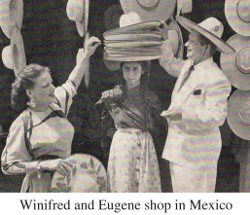
Presumably as a civilian, he returned in 1945 to sing Rodolfo in La Bohème on 21 July with González and Francesco Valentino. Then in August he joined Madame Gonzalez in Madama Butterfly with Concha de los Santos as Suzuki. La Traviata was next with Dorothy Kirsten, followed by another La Bohème on 4 September with Kirsten, Morelli and Ruby Mercer. When he arrived in the summer of 1946, he was faced with a heavy assignment that began on 11 June with Faust with Christina Carroll, Ezio Pinza and Morelli, Jean Morel conducting. Then, on 13 June, he repeated Madama Butterfly, this time with Dorothy Kirsten, Conchita de los Santos and Ivan Petroff. La Bohème followed on 18 June with Stella Roman, Christina Carroll, Morelli and Pinza. Next, on 22 June, he sang Ottavio with Pinza, Stella Roman (Donna Anna), Norina Greco (Donna Elvira), Christina Carroll (Zerlina) and Lazzari (Leporello) with Richard Lert conducting. La Traviata on 9 July with Kirsten and Mascherini concluded his visits to this city.
For a change of pace, he sampled the outdoor concerts at Grant Park in Chicago and with soprano Dorothy Sarnoff, he appeared on 10 and 11 August 1946 in “Ah, Sweet Mystery of Life” and “I’m Falling in Love with Someone” from Herbert’s Naughty Marietta. His voice was described as “robust and of fairly attractive quality,” and his “performance was unpretentious but made a good impression.” Winifred Heidt appeared the following year.
On 25 November that year in Fort Worth, Texas, he was featured in an English language La Traviata with Eloise MacDonald and Melvin Dacus. Then in December he sang a Madama Butterfly with Stella Roman in Newark. At this time, with other musicians, recruited from City Opera, Conley helped form The American Lyric Theatre to give operas in English at the Westchester Church in White Plains, New York.
Gene had little time though for this undertaking as he yearned to venture farther afield. And so, after a concert in Amsterdam, he went to Paris to sing in La Bohème at the Opéra Comique on 12 March 1947 and a La Traviata two nights later, garnering a resounding ovation in each. Back in the USA at Lewisohn Stadium on 22 June, he joined Dorothy Kirsten to sing in memory of Grace Moore, who had died in an airplane crash on 26 January in Denmark. An audience of 13,000 shared the tribute.
Luv Dat Cajun Cookin’!
Next, let us ponder Conley’s apparent love for the delights of New Orleans. As we’ve seen, Fortune Gallo’s San Carlo organization brought him to this fabled Louisiana city in 1942 to appear in La Traviata. Though unable to come in 1943, he did return late in 1944 to sing with the newly created New Orleans Opera Association, his La Bohème performances coming on 25 and 26 November with Nancy Garrotto (Mimi), Eloise MacDonald (Musetta), Rocco Pandiscio (Marcello) and Charles Goodwin (Colline). Again with dual performances of each rôle, he returned in January 1945 as Alfredo in La Traviata with Vivian della Chiesa and Jess Walters, and as Lionel in Martha with Margaret Luft Piazza (Harriet), Betty Baker (Nancy and Robert Brink (Plunkett). In November he sang in La Traviata. Jack Belsom, the New Orleans Opera archivist, who provided these details, attended a performance and wrote: “He was a fine and dependable artist. He was the Alfredo in my first opera – taken by my parents when I was a kid in elementary school. My only recollection of Conley was the Act 2 aria when he had a riding crop in his hand, and of Albanese’s beautiful costume at Flora’s party, and of her collapse in the third act – funny what kids’ remember!” For his next contribution, Gene sang Alamaviva in Il Barbiere di Siviglia with Graciela Rivera (Rosina), John Schafer (Figaro) and Emile Renan (Bartolo). He concluded this visit in December as the Duke of Mantua in Rigoletto with Hilde Reggiani and Ivan Petroff.
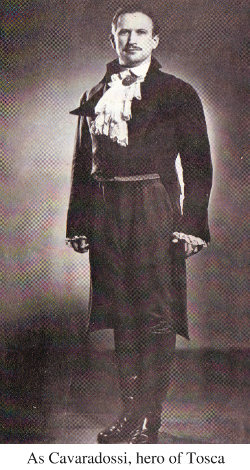
When he returned in March 1946, it was to sing his warhorse Faust with Dorothy Sarnoff and Hines. In November he returned as Rodolfo in La Bohème with Dorothy Sarnoff (Mimi), Rita Caprino (Musetta), Jess Walters (Marcello) and Valfrido Patachi (Colline). In November 1947, he undertook Cavaradossi in Tosca with Sara Menkes and Alexander Sved as well as the Duke in Rigoletto with Graciela Rivera and Weede.
In 1948, he came just once on 7 October to sing Edgardo in Lucia di Lammermoor with Graciela Rivera (Lucia) and Ivan Petroff (Enrico). After skipping a season, he arrived on 16 March 1950 for a rarity, at least for him, Des Grieux in Massenet’s Manon with Bidú Sayão (Manon), Daniel Duno (Lescaut) and Norman Treigle (Comte des Grieux). In 1952, he tacked the Duke in Rigoletto with Hilde Gueden (Gilda), Warren (Rigoletto) and Wilderman (Sparafucile). The second performance on 5 April, a powerful one, is preserved on CD, courtesy of VAI. Until this point Walter Herbert had conducted all operas, but for his last pair, Renato Cellini took charge. In La Bohème on 7 and 9 October 1954, Conley joined Lucine Amara (Mimi), Violetta Russell (Musetta), Cesare Bardelli (Marcello) and Norman Scott (Colline). Then in Tosca on 14 November 1957 with Dorothy Kirsten and Walter Cassel, his Cavaradossi rolled out as “manly and firm voiced” as ever, producing a fine, final exposure on this stage.
New York City Opera Shows Interest
After beginning operations with a Tosca in 1944, the New York City Opera was ready to welcome Gene for its Spring Season the following year. Thus he made his début on 14 April 1945 as Rodolfo in the first of two La Bohèmes with Irma González, Andzia Kozak and John De Surra. The following autumn, eager for more work, he returned to begin with Tosca on 27 September with Dorothy Sarnoff and George Doubrovsky, then Alfredo in La Traviata on the 30th with Rosemarie Brancato, followed by Faust on 5 and 13 October. Finally he spent three evenings wooing Lucille Manners in Bohème.
For their Spring Season in 1946, Gene stayed most of May and on the 9th had the distinction of singing the Duke in the company’s first performance of Rigoletto with Rosemarie Brancato and Ivan Petroff. After another “first” on 15 May with Camilla Williams in Madama Butterfly, he sang three performances of La Traviata, twice with Brancato and once with Dorothy Kirsten, with Enzo Mascherini as Germont throughout. And again he romanced Lucille Manners in La Bohème.
That autumn, he was back, busier than ever with six favourite rôles, usually in multiple performances. Inevitable was the Faust on 26 September with La Bohème, two nights later, Dorothy Sarnoff appearing in both operas. Hilde Reggiani was his amour inLa Traviata on the 28th and in Rigoletto on 13 October. After singing Cavaradossi in Tosca with Ella Flesch, he took on his sixth rôle, Pinkerton with Lucia Evangelista. Interspersed were two performances with the Philadelphia La Scala forces.
For the Spring season in 1947, he had only one rôle, Alfredo in La Traviata with Margit Bokor on 17 and 27 April. For the fall season, he likely began with La Bohème on 26 September with Ann Ayars, followed by an outstanding and imaginative setting of Werther on 2 October with dramatic impersonations for himself and Winifred Heidt as Charlotte. Then on the 5th, he and Camilla Williams united in Madama Butterfly. On 18 October, he became the amorous Duke in Rigoletto with Virginia MacWatters. When City Opera presented its first Don Giovanni on 23 October, Gene sang Ottavio with James Pease, Brenda Lewis as Donna Elvira and Ellen Faull as Donna Anna. The season ended on 16 November as he dallied with Dalisay Aldaba in Madama Butterfly.
He was front and centre on 15 October 1948, as Rodolfo in La Bohème with Ann Ayars, Dorothy MacNeil and Ralph Herbert. Back on 31 October as Cavaradossi, he presented a Tosca with Wilma Spence and Walter Cassel to conclude that season. In 1949, it was back-to-back action on 7 October as Alfredo in La Traviata with Eva Likova débuting as Violetta, followed the next evening by Cavaradossi in Tosca with Suzy Morris. On 16 October as Pinkerton, he helped manoeuvre Joan Hammond through her début as Cio-Cio-San. During a matinée La Traviata on the 23rd, his Violetta was Frances Yeend. On 28 October, he and Joan Hammond sang a second Tosca. After a matinée La Bohème on the 30th, with Yeend, he caroused in Madama Butterfly on 6 November with Camilla Williams. On 18 November as Don Ottavio, he sang with Eva Likova (Donna Elvira), James Pease (Don Giovanni) and Rosa Canario (Donna Anna). Winifred Heidt was active as Carmen and Amneris, but they did not sing together.
He showed up on 1 April 1950 for a Tosca with Wilma Spence and Walter Cassel, followed by La Bohème on the 14th with Ann Ayars and John Tyers. Next, during a matinée Madama Butterfly on 16 April, he teamed once more with Camilla Williams. Don Giovanni on 27 April proved to be his final performance with City Opera.
The Philadelphia Story
Owing to Philadelphia’s proximity to New York, Conley often shuttled back and forth between City Opera and the Philadelphia La Scala Opera Company, and so, on 21 May, 1946 with Scala, he sang in Rigoletto with the legendary Giuseppe De Luca. During a visit to Detroit on 3 October, he sang Faust with Sarnoff and Ugo Novelli and then, back in Philadelphia on 31 October, he appeared in Rigoletto with Mascherini and Elena Danese. Detroit witnessed this cast in the Faust on 28 November to end Gene’s season.
In 1947, he performed with La Scala on 23 January in La Traviata with Claudia Pinza, followed in February by Don José in Carmen with Winifred Heidt as the wayward gypsy and a chorus member who was making her operatic début: Beverly Sills. Madama Butterfly was prominent on 6 October in Toronto’s Massey Hall with Violeta de Freitas and Richard Bonelli and a week later in the Masonic Auditorium in Detroit. The interest in Butterfly continued in 1948 when he sang in Philadelphia on 13 October with Eva de Luca and John Brownlee.
Absent for a spell, the tenor returned to Philadelphia on 7 March 1950 as a member of the Metropolitan Opera, his mission being to don his familiar guise as Faust and be tempted by Italo Tajo as Méphistophélès with Dorothy Kirsten as Marguérite.
In 1951 during a stint with the Philadelphia Civic Opera Company, Conley appeared on 18 October in Rigoletto with Bardelli and Graciela Rivera. In 1952 he made two visits, initially on 7 February to sing La Bohème with Ann Ayars, Bardelli, Vanna d’Oglio and John Lawler, and then on 4 December, for Cavalleria Rusticana as Turiddu with Maria Gasi and Charles Lancaster. In 1953, ten days after the Met première of Stravinsky’s Rake’s Progress, the company brought this opera to Philadelphia together with its stars, including Conley as Tom Rakewell. During a second visit on 15 December, the Met presented Conley in Faust with de los Angeles, Pierre Monteux conducting. With no action in 1954, Civic Opera mustered a Lucia di Lammermoor on 17 March 1955 with Dolores Wilson as Lucia, Conley as Edgardo and Bardelli as Lord Enrico Ashton.
After La Scala and Civic amalgamated that summer to form the Philadelphia Grand Opera Company, Conley decided he would make a single visit per year. On 13 October 1955, as the Duke in Rigoletto, he sang with Frank Guarrera, Lisa di Julio, John Lawler and Sandra Warfield. The next year, in Tosca on 30 November he sang with Eleanor Steber and Cesare Bardelli. On 19 December 1957, he served up another Rigoletto with Eva Likova and Cornel MacNeill. The last hurrah came on 28 November 1958 in La Traviata with Leyla Gencer and MacNeil, Conley’s Alfredo being praised: “(he) sang in a truly splendid tenor, the bright well-focussed cantabile, the ringing top notes” and “held the audience almost spellbound…his singing was flawless.”
The Great d’Andria Caper
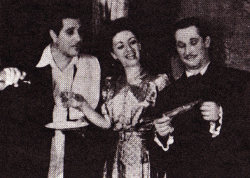
Along with fellow American, Christina Carroll and Chilean tenor Ramón Vinay (see picture – Conley at right), he joined Giorgio d’Andria’s “National Grand Opera Company” for an operatic tour of Italy in August and September, 1947. After Otello, Bohème and Traviata at the Pergolesi Theatre in Florence, they went to Genoa where Conley sang at the Augustus Theatre in Rigoletto on 7 September with Silvia Paliaga and Tito Gobbi. Six nights later he trod the stage in La Traviata with Onelia Fineschi and Pietro Guelfi. The tour continued with seven performances at Teatro Lyric in Turin and four at the Duse in Bologna.
To celebrate d’Andria’s birthday, the company gathered at the Campidoglio restaurant in Florence where Conley sang “Happy Birthday.” Then, when a strolling band stopped to entertain the party, the young lyric tenor broke into ‘Come back to Sorrento.’ Scarcely had the high notes soared into the twilight air when from the adjoining apartment came the famous Italian baritone Titta Ruffo. He excitedly asked to meet “the great voice which has just floated into my windows as I am listening, reminiscing to records by the master, Caruso. So lost am I in the glorious old days at the Metropolitan that at first I think all the singing comes from my phonograph – then I suddenly realized that it is a marvellous trained voice from the outside which sings too – and here I am to pay my respects and congratulate the young American with the superb voice.” He remained for the evening and occupied a box at all of their remaining Florence engagements.
It was time to celebrate on 9 March 1948, for on that day Eugene Conley and mezzo-soprano Winifred Heidt were married in the home of Mr. and Mrs Ezra Sensibar, with the nuptials overseen by Rev. Dr. Leslie T. Pennington of the 1st Lutheran Church of Chicago. Born Winifred Huntoon in Grand Rapids, Michigan, the bride had been married previously and had opted to use her first husband’s surname of “Heidt” during her professional career. The following year the Conley’s gave a concert in London. They would sing together in Carmen, Martha, Faust, Rigoletto and in one or two other operas but not many of them offered rôles suitable for both their talents.
How’s this for a honeymoon? Proceeding to Stockholm, Gene sang with the Royal Swedish Opera in La Bohème on 24 April 1948 and inRigoletto on 26 April, each time with Hjördis Schymberg as the heroine. Two nights later, for his third appearance, he sang Mario Cavaradossi with Brita Hertzberg as Tosca and Sigurd Björling as Scarpia. Brita, a local favourite, was the mother of the later star soprano, Caterina Ligendza.
Convinced by his European experiences that it would be advantageous to acquire a lieder repertoire, Gene turned to Harriet Barrows in Boston for help. Under her guidance, he felt more confident that he was ready to meet any singing challenges that fate might yet hold.
La Scala and Covent Garden Antics
And that next special event came at the famed Teatro alla Scala in Milan, where plans were afoot to present Vincenzo Bellini’s tenor-killing opera I Puritani with Conley as the man of the hour. He sang Arturo in the first of six performances on 12 April 1949 with Margherita Carosio, Cesare Siepi and Carlo Tagliabue, led by Franco Capuana.
Journeying to London, he débuted at Covent Garden on 4 May as the Duke of Mantua in Rigoletto to begin a series of eight performances. Erna Berger, the original Gilda, became indisposed so Elisabeth Schwarzkopf had to learn the part in English on just over a day’s notice. “Mr. Eugene Conley, a visitor to the company, made a convincingly caddish figure of the Duke and, though his voice has not the ardour that may be expected of this licentious nobleman, his singing, especially in ‘Ella mi fu rapita’ was pleasant and musical.” During this visit Conley also shared the rôle of Rodolfo with two other tenors in sixteen La Bohèmes with Schwarzkopf as Mimi.
The I Puritani performances the previous year having been a success, La Scala invited him to repeat the opera with Lina Pagliughi, Paolo Silveri and Cesare Siepi on 11 January 1950 and in four other performances. Then it was back to the US to face a new challenge.
Joins the Metropolitan Opera
Upon his return, he pulled his wife aside and announced, “Guess what, honey, they’ve asked me to sing in the Big House in New York. Yes, even though I am 42 years old, the Metropolitan Opera wants me to sing Faust. And why not? I’ve sung it everywhere!
And so for Faust on 25 January, 1950 an almost completely American cast assembled, Denis Harbour as Wagner and conductor Wilfred Pelletier being the lone interlopers from
Canada. On stage besides Conley were Eleanor Steber as Marguerite, Jerome Hines as Méphistophélès, Frank Guarrera as Valentin, Inge Manski as Siébel and Claramae Turner as Marthe. Jerome D. Bohm reacted: “Eugene Conley is an excellently schooled tenor and his lyric voice not only carried well in the huge auditorium, but its texture actually sounded more persuasive than it had in other years in the City Center and in smaller theatres. He delivered his music in aurally satisfying fashion as well as with a degree of stylistic finish not often encountered here nowadays in French opera.” Irving Kolodin’s reaction differed: “Good looks and manly style were appropriate to Pinkerton and Edgardo, but he was inclined to drive his voice hard with little variation in colour or dynamics.” That spring he sang Edgardo in Lucia di Lammermoor with Patrice Munsel, Frank Valentino and Nicola Moscona and a Faust in Philadelphia as well as making appearances in New Orleans and a farewell to City Opera.
At the Metropolitan, he would give 73 performances in New York and a further 46 on tour. His repertory was somewhat limited, just 13 rôles, the most frequent being Faust with 17, consisting of 7 in New York and 10 on tour, followed by Rodolfo in La Bohème with 16 appearances. Alamaviva in Il Barbiere di Siviglia and Don Ottavio in Don Giovanni each were given 13 times and Alfredo in La Traviata 12 times. Pinkerton in Madama Butterfly, the Duke of Mantua in Rigoletto and Alfred in Die Fledermaus he sang 10 times. Tom in The Rake’s Progress received 8 renditions. Cavaradossi in Tosca was heard 4 times, the first on tour in Cleveland, twice in other cities, with just a single performance in New York. Turiddu in Cavalleria Rusticana was given twice in New York and once on tour. Edgardo in Lucia was heard twice in New York while Des Grieux in Manon enjoyed a solitary outing in New York.
In that summer of 1950, Gene shared a concert at Lewisohn Stadium, New York in June with Jan Peerce and Eleanor Steber and the Philharmonic Orchestra. Then, thanks to his Italian reputation, he sang outdoor performances (29 July and 6 August) of La Bohème at the Arena di Verona with Rina Gigli as Mimi, Maria Huder as Musetta, Scipio Colombo as Marcello and Silvio Maionica as Colline, Angelo Questa conducting.
Finds Challenges in San Francisco
But in the US he was considering options. As the Met occupied autumn and early winter, Gene chose to sign with San Francisco Opera for work when not at the Met. He débuted on 2 October 1950 as Edgardo, betrothed of Lily Pons in Lucia di Lammermoor with Frank Valentino as her interfering brother. With Lily, he offered Almaviva in a pair of Il Barbiere di Siviglias followed by two Madama Butterflys with Dorothy Kirsten to round out the season. That fall, he sang once as the tenor in Der Rosenkavalier on 21 September 1951, perhaps as a fill-in for an ailing colleague, with Stella Roman as the Marschallin. Then, as Alfredo in La Traviata with Lily Pons, he concluded this visit.
For his next Met stint, he faced a parade of “firsts” that he began as Alfredo in La Traviata with Dorothy Kirsten on 15 November 1950 and with Licia Albanese in a subsequent performance. On 17 November he sang Don Ottavio in Don Giovanni with Paul Schoeffler, but in five later performances, Silveri was Giovanni. Next, when Johann Strauss Jr.’s Die Fledermaus was unveiled Conley was Alfred, initially on 4 January 1951. On the 18th he sang Almaviva with Erna Berger in Il Barbiere di Siviglia, then Faust and Madama Butterfly with de los Angeles as female lead in both operas. On tour they pounded the rails to Boston, Cleveland, Atlanta, Dallas, Minneapolis, Chicago and Rochester, Conley singing Almaviva, Alfredo, Pinkerton and Alfred. Then, by a Met agreement with Columbia Records, he recorded his début rôle of Faust with Eleanor Steber, Cesare Siepi and Frank Guarrera.
Milan Again and Florence with Callas
Conley’s Italian forays continued, as reported at the beginning, when he sang Arrigo in Verdi’s I Vespri Siciliani at La Scala on 7 December 1951. Amidst gilded decorations that restored the theatre to much of its pre-war splendour, the production plunged ahead dominated by two operatic titans, Maria Callas as Elena and Boris Christoff as the patriot Procida. For Conley it was not quite what he anticipated: “Eugene Conley struggled hard to keep his head up opposite the taller Callas. His fluid lyric tenor suits parts like Lord Arthur in I Puritani much better than the heavier Arrigo.” Victor de Sabata shaped the fragmentary nature of the orchestral melodies with exquisite care through seven performances. Argeo Quadri conducted the last pair, the final on 3 January 1952.
Moving over to the Teatro Comunale in Florence, Gene sang Arturo on 9 January in I Puritani with Maria Callas as Elvira, Carlo Tagliabue as Riccardo and Nicola Rossi-Lemeni as Giorgio, Tullio Serafin conducting. He was also Don Ottavio in Don Giovanni with Nicola Rossi-Lemeni, Birgit Nilsson (Donna Anna), Gladys Kuchta (Donna Elvira) and Rosanna Carteri (Zerlina) with Serafin again the baton wielder.
Rejoining the Met, he opened in an Opera Guild Student presentation of La Traviata on 19 February 1952 as Alfredo with Delia Rigal, followed on 26 February by La Bohème with Bidú Sayão. Appearances as Turiddu in Cavalleria Rusticana would be rare but his first occurred on 4 March with Regina Resnik as Santuzza. After partnering Graciella Rivera in Lucia on the 14th, he went on tour, but only with one effort as Rodolfo in La Bohème in Atlanta on 3 May with Dorothy Kirsten, Frank Guarrera and Hilde Gueden. Then it was a rush to be transported to Buenos Aires.
At the Teatro Colón in Buenos Aires he arrived in time to sing Des Grieux in the Manon of Massenet on 20 May, earning high praise for himself and the soprano: “As sung by (Victoria) de los Angeles, the rôle had a purity and quality rarely encountered today. Des Grieux was sung by Eugene Conley, also making his début, and he too scored a success.” Felipe Romi was Lescaut and Albert Woolf conducted. Before his next effort, the season was suspended for three weeks owing to the death of Signora Perón. Upon its resumption, Madama Butterfly was given by de los Angeles and Conley with Victor Damiani as Sharpless. Then, before he could depart, Conley was urged to stay on and sing Rodolfo in La Bohème as a replacement for Wolf-Ferrari’s Le Donne Curiose. He did remain and gave his all in the opera with Helena Arizmendi and Renato Cesari.
His next San Francisco assignment began with Tosca on 21 September 1952 with Dorothy Kirsten and Robert Weede. Then, on 4 October, Rinuccio in Puccini’s Gianni Schicchi was an unusual rôle for him that he sang with Italo Tajo and Dorothy Warenskjold. La Traviata followed on 4 October with Pons, then Cavalleria Rusticana with Fedora Barbieri and a Don Giovanni with Rossi-Lemeni. Afterwards he travelled with the company to Los Angeles to sing La Traviata, La Bohème and Rigoletto with Pons in each opera, as well as in Gianni Schicchi. This was followed by appearances in Pittsburgh, Philadelphia, Greenville, South Carolina and finally in New York where the Met was staging a brave but ill-conceived attempt to present La Bohème in English. When the original was restored on 7 January 1953, Conley sang Rodolfo. Later, Licia Albanese provided a truly Italian Mimi in two performances. Perhaps Gene was bothered by a pending challenge, for seven days hence the Met was to present the US Première of Igor Stravinsky’s The Rake’s Progress with him as Tom Rakewell. James Hinton, Jr. wrote in OPERA, “In the title rôle Eugene Conley sang all of the notes in one of the cruellest tests yet devised for an operatic tenor. He also looked presentable.” Curt Weller, also for OPERA, wrote favourably too: “… he left no doubt that he is in the front rank of present day tenors.” According to the New York Herald-Tribune, “Eugene Conley sang angelically … it is not easy to think of a tenor who would have done better dramatically while doing half so well vocally.” Nevertheless it proved controversial and caused pain at the box office. It was not Puccini. Reiner led a goodly run of seven performances though the composer conducted when a recording was made concurrently. Naxos has it on CD.
After the Stravinsky episode, Conley undertook Rigoletto on 22 February with Silveri and Genevieve Warner as well as a broadcast performance on 7 March with Warren and Gueden. He then sang Alfredo in La Traviata on 13 March as well as three with Licia Albanese and Leonard Warren. After a Don Giovanni with George London on 14 March, he travelled with the company to Baltimore to sing La Bohème with Nadine Conner and Robert Merrill. Back in New York, he took part in another La Bohème on 4 April with Licia Albanese. In Cleveland, the first stop on the spring tour, Conley sang in Rigoletto and on 17 April in Tosca with Dorothy Kirsten. Continuing, he sang in Boston (Tosca and Butterfly), Washington (La Bohème), Dallas (Don Giovanni), Oklahoma City (La Bohème), Minneapolis (Don Giovanni), and Toronto (Rigoletto). Seventeen artists, Gene included, gave freely of their talents to cheer hospitalized veterans along the way.
That autumn at the Met, he faced six La Bohèmes with three Mimis: Hilde Gueden, Lucine Amara and Nadine Conner, prompting James Hinton, Jr. to write in OPERA NEWS: “Eugene Conley’s voice seems to have taken on more resonance and body in the middle without losing its ring at the top.” After three Rigolettos, he was rehearsing La Traviata for a first performance that season on 5 December 1953 when he had to withdraw in order to replace Jussi Bjoerling in the Faust matinée that day. When the Swedish tenor’s laryngitis persisted, Conley sang four additional performances with de los Angeles and one with Conner as Marguérite but he did manage a La Traviata on 11 December with Licia Albanese and the brilliant Ettore Bastianini.
Carnegie hall – A Prestigious Place
Not every tenor of stature has an opportunity to sing in fabled Carnegie Hall, but Conley did so on six occasions. On 20 May 1947 for a Pops Concert, he launched a salute to Puccini with ‘Recondita armonia’ from Tosca, ‘Che gelida manina’ from La Bohème and the ‘Vogliatemi bene’ duet from Madama Butterfly with soprano Violeta de Freitas. He must have impressed for at a second Pops on 14 June, he sang ‘Una furtiva lagrima’ from Donizetti’s L’Elisir d’Amore and ‘La donna è mobile’ from Rigoletto with Valter Poole conducting. At this concert he also added three songs: ‘I Hear you Calling Me’, ‘Finnegan’s Wake’ and ‘Beloved’, the latter based on Rubinstein’s Romance, with piano accompaniment supplied by Marcel Frank. His appearance on 12 November 1949 must have been arduous for, though his lyric tenor was hardly suited to Wagner, he took part in a benefit for the Pension Fund of the New York Philharmonic, and sang excerpts from Tristan und Isolde and Siegfried with soprano Mariquita Moll and mezzo Virginia Paris with Leopold Stokowski and the orchestra. The following year after singing Cavaradossi at City Opera, by pre-arrangement, he showed up at Carnegie Hall to sing in Mahler’s 8th Symphony on 6, 7 and 9 April with Stokowski conducting the New York Philharmonic.
In 1953, before embarking on the Met spring tour, Gene joined Arturo Toscanini and the NBC Symphony Orchestra at Carnegie Hall on 28 March to broadcast and record Beethoven’s Missa Solemnis with Lois Marshall, Nan Merriman and Jerome Hines and the Robert Shaw Chorale. It was issued on 2 LPs and later on CDs. During his final visit on 24 April 1957, he joined Leontyne Price and Cesare Siepi in a concert to benefit Haarlem House and the Dutch community, his contribution being Verdi’s Inno dell nazioni with the Collegiate Chorale conducted by Alfredo Antonini.
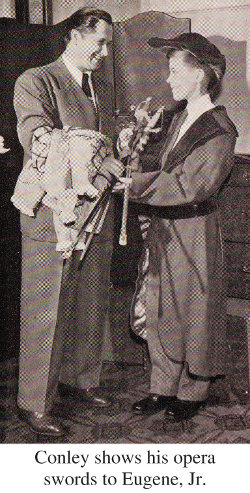
As for Mrs Conley, Winifred Heidt was following up her rôle of marriage broker in a televised performance of Martinů’s The Marriage with an appearance as the Princess inSuor Angelica, also on TV on 7 March 1953. By this time the Conley’s had three children, the eldest bearing his father’s first name so he was Eugene, Jr. Gene Sr. was no stranger either to the media world with frequent appearances on radio and TV. Some idea of the variety of his work can be gleaned from the discography.
That summer, Gene sang in a brief Gala Season in Cuba with leading Metropolitan artists, made possible by a subsidy authorized by the President of Cuba. It drew Havana’s opera-lovers to enjoy four operas between the first and twelfth of June. Singing in three, Conley offering a ‘discreet’ Faust in the first with Ann Ayars as ‘a sweet and youthful Marguérite’ while Dora Carral, a local darling, brought her fans out to see her portray Siébel. Cesare Siepi was Méphistophélès. Next, he joined Roberta Peters and Cesare Bardelli in Lucia di Lammermoor and for his third venture, he sang in Madama Butterfly with a tantalizing Lydia Ibarrondo as Cio-Cio-San.
After a Faust with the Met in Philadelphia on 15 December 1953, Conley took a few days off and courtesy of Opera News, we can look in on the busy revellers: “Eugene and Winifred Conley’s Christmas seems traditionally American. A New England turkey dinner at Thanksgiving is followed on the Conley’s agenda by a traditional duck or goose at Christmas on their western New Jersey farm. Winifred Heidt Conley serves as cook and bottle-washer; the tenor’s mother bakes the three pies that come to the holiday table. The family’s Christmas customs include cutting the Christmas tree from the farm’s woodlands and decorating the house and guest-house with cedar boughs. The gift exchange includes practical presents: a hand sander for refinishing antique furniture, marked for Winifred, a chainsaw for her husband’s wood-cutting.”
But duty called, and in costume on Christmas Eve, Gene sang Rodolfo with Nadine Conner and repeated on 15 January 1954, while all the while, preparations were ongoing for a revival of The Rake’s Progress. Even though the performers were more at ease in their difficult assignments, audiences remained unreceptive and after two performances it was shelved. After singing twice in Don Giovanni in New York, Conley went on tour as Faust in seven cities as well as the Duke in Rigoletto in Chicago with Roberta Peters as Gilda and Almaviva in Il Barbiere di Siviglia in Toronto with Roberta as Rosina.
That summer, a concert in Lewisohn Stadium on Friday evening, 30 July, featured something different, Gene singing excerpts from Les Pecheurs de Perles, the rôle of Nadir surely a rarity for him. For a while the concert seemed in doubt as shortly before 8, it started to drizzle, sending the audience scrambling for shelter. But the rain soon abated and everyone ambled back to let the Bizet programme begin as scheduled.
Returning for the 1954/55 Met season, he faced four Madama Butterflys, literally: Licia Albanese (13 November), Lisa Della Casa (19th), Victoria de los Angeles (27th) and Dorothy Kirsten (6 December). Tosca on the evening of the 25th made for rather gloomy Yuletide fare but Conley sang anyway with Albanese and George London. After the holidays, he journeyed to San Antonio on 6th February for Lucia di Lammermoor with Pons, the petite and charming Lily being her inimitable self. For his part Conley was “a debonair Edgardo, exhibiting ringing high notes and a thorough schooling in bel canto. Ettore Bastianini, a wonderful Enrico, won bravos for his superb, extremely flexible voice as well as his handsome stage presence.” At the Met on 18 February 1955, Gene sang Faust with Heidi Krall and Norman Scott and then on the 27th, his last “new” role at the Met, Des Grieux in Manon with Eleanor Steber. Then he devoted his time to Almaviva in Il Barbiere di Siviglia with Lily Pons and as Don Ottavio in Don Giovanni with Jerome Hines as his evil nemesis. After aLa Bohème on 26 March, Gene went traveling for his fifth and busiest tour, packing in an even dozen performances in eleven communities. It was almost as if he was anticipating the end of a pleasurable activity.
After appearances in Puerto Rico in July 1955, and a concert version of La Traviata under Arthur Fiedler in San Francisco, he retired with his wife to their farm near Flemington, to lay aside his scores and take up a paintbrush. Afterwards only two Met assignments remained, the first being a finale in New York on 17 November 1955 as the conniving Duke in Rigoletto with Peters and Warren. Then, on 25 and 27 January 1956, he appeared with the Houston Grand Opera, and apparently was not in good voice but he plunged ahead in Madama Butterfly with Nancy Winford Blackburn as Cio-Cio-San and Guy Gardner as Sharpless. On 8 May he joined Peters and Warren in Rigoletto during a visit to Birmingham and thus ended his Met career. Fittingly that summer on 28 June in Robin Hood Dell, Philadelphia, he sang Verdi’s Messa da Requiem with Frances Yeend, Regina Resnik and Nicola Moscona with Erich Leinsdorf conducting.
That summer Faust predominated in San Antonio and Cincinnati. In November in Philadelphia, he varied his efforts in Tosca with Steber. Ending the year on an elevating note, he took off to join the San Carlo Opera in Naples and on 15 December he sang Almaviva in Il Barbiere di Siviglia with Gianna d’Angelo (Rosina), Ettore Bastianini (Figaro), Marco Stefanoni (Basilio) and Renato Capecchi (Bartolo) with Armando La Rosa Parodi conducting.
Early in 1957, he appeared in dual rôles with the Cosmopolitan Opera Company in San Francisco, in Tosca with Zinka Milanov and as Almaviva in Il Barbiere di Siviglia with Graciela Rivera and Giuseppe Valdengo. In the summer he flew to Amsterdam for the 10th Annual Holland Festival where The Rake’s Progress, was being given in English on 15 June. Graziella Sciutti as Anne with Otakar Kraus (Nick Shadow) and Mimi Aarden (Baba) all performed brilliantly under Erich Leinsdorf. It was noted that “Eugene Conley has matured in the rôle of Tom Rakewell since he first sang it in New York; he has learned to make Tom a creditable dramatic figure believably drunk in the Brothel Scene, believably craven in the Graveyard Scene, believably mad in the Bedlam Scene.”
Winding Down
The rest of the year was spent in “the good ole USA”: in a Martha in San Antonio with Dorothy Warenskjold, a La Traviata at the Greek Theatre in Los Angeles on 21, 23 and 24 August with Nadine Conner, a Tosca in New Orleans and a Rigoletto in Philadelphia. In 1958, he continued the pattern in Hartford with Faust on 8 February with Eva Likova. Opera lovers in Cincinnati relished him again on 1 March, but apparently not at the Zoo, as Don José in Carmen with Nell Rankin, Nadine Conner and Frank Guarrera. On 11 March, he sang Faust for San Francisco Cosmopolitan Opera with Ellen Faull and Hines.
If Rigoletto on 10 March 1959 with Cosmopolitan Opera was indeed his swan song, Conley left in fine fettle. His Gilda, Gianna d’Angelo drew a rave reaction: “What a magnificent voice! Bright, silvery, amazingly accurate, infinitely varied,” etc. etc., while “Cornell MacNeil proved conclusively in the title role that he merits the acclaim he has received in the east and in Europe.” As for Gene, he “was in far better voice than in recent appearances here.”
In a time for farewells, the old Metropolitan Opera house marked its closing with a mammoth concert on 16 April 1966. Conley was one of three-dozen creaky warriors seated in a semi-circle at the back of the stage where they were almost as enthralling as the artists who sang. It ended at 1:30 in the morning but everyone was loath to leave.
In another form of good-bye, Gene and Winifred parted company, and after the divorce, he married Alvah Odetta Young. Karen Zaremba, granddaughter of Winifred and her first husband, continues the singing tradition and played Mrs. Mullen when Carousel was revived on Broadway with Barbara Cook as Julie Jordan.
With his many triumphs at Cincinnati’s ‘Opera at the Zoo’, it must have been somewhat overwhelming for him at the Farewell Gala on 12 July 1969. Over twenty artists of past and present attended so he could reminisce with former colleagues Licia Albanese, Nicola Moscona, Frank Guarrera, Blanche Thebom and Charles Kullman as well as newcomers Sherrill Milnes, Mary Costa, Barry Morell and others while stepping forth to deliver ‘Recondita armonia’ from Tosca midway through the concert.
Reports became fewer as teaching became his prime concern in 1960 as tenor-in-residence and professor of voice at North Texas State University but he obliged whenever asked to give recitals. Invariably they were pleasing affairs.
His recording of hymns brought cheer to my mother in the mid-1970s when she was hospitalized after a fall. I copied the LP onto a cassette and played it during a visit; then I asked her to record a few words of thanks to send to the tenor. I told him that ‘Softly and tenderly’ was our favourite. When Mom died in 1976, Conley wrote, “I’m sorry your mother had to go but am glad to know my recording was of some happiness to her.”
When he gave a recital on 19 September 1978 at Alice Tully Hall in New York City, “he let everyone know he was still singing, still with youth in his voice as well as in his looks. His singing was quite beautiful, still displaying his high Cs, his performance of songs by Schubert and Strauss being admirable.” That year he returned to private life.
Late in 1980 I received a note at Christmas: “Last June I suffered a stroke and spent the month in hospital. However, I am recovering nicely and walking around. Although my teaching and social activity is curtailed, we are attending the Dallas Civic Opera season.” Eugene Conley died of cancer in Denton, Texas on 18 December 1981. His partner throughout the halcyon years, Winifred, died in Boynton Beach, Florida in 1986.
Along with James Melton and Brian Sullivan, Conley was a member of the generation of American tenors who faced competition from such European greats as Jussi Bjoerling, Giuseppe di Stefano and Ferruccio Tagliavini, while in addition he stood in the shadow of Jan Peerce and Richard Tucker, both revered performers. When he left the Met, exciting newcomers such as Nicolai Gedda, Flaviano Labò and Franco Corelli were charging hard. “He is a typical exponent of an objective form of singing, developed particularly in the U.S. which sets greater store on virtuoso tone production than on the cultivation of individual distinctive vocal timbre. In one respect Conley was superior to most of his contemporaries: his reliability in the exposed high range was phenomenal and was the characteristic for which he was most famous.” His was an amazing career!
Sources
Martin L. Sokol: The New York City Opera, Macmillan Publishing Co. Inc., 1981.
William H. Seltsam: Metropolitan Opera Annals, First Supplement, 1947-1957, The H. W. Wilson Company, 1957.
Quaintance Eaton: Opera Caravan, Farrar, Straus and Cudahy, New York, 1957.
The Metropolitan Opera News, 1949-1956.
OPERA, 1949-1956.
John Ardoin & Gerald Fitzgerald: “Callas,” Holt, Rinehart and Wilson, New York, 1974.
Cardell Bishop: The San Carlo Opera Company, 1913-1955.
Juan Dzazópulos: Carlo Morelli, The Record Collector Vol. 45, No. 1.
Larry Lustig & Richard Lindau: Aroldo Lindi: The Record Collector Vol. 46, No. 4.
Acknowledgements
First of all, I would like to remember Eugene Conley for his kindness and the information he provided. I also deeply appreciate the assistance of Michael Bott who kindly provided the Cincinnati data, helpful contacts and much more. Gino Francesconi, archivist at Carnegie Hall, and Jack Belsom, archivist at New Orleans Opera, each detailed the tenor’s activities in their cities. Father Matthias Montgomery of Hubertus, Wisconsin tracked down a birth record. Stefan Johansson provided cast data for operas in Stockholm. Norman Willey, here in Winnipeg, spent hours exploring the Internet for family details. My niece Linda Waverick in Vancouver also tapped into the Internet. Alfred de Cock in Belgium and Norman Staveley in England sent useful data. I also appreciated the help of the ever-resourceful Larry Lustig who supplied data pertaining to the Gallo San Carlo, Arena di Verona, Mexico, Philadelphia and other ports of call. My sincere thanks to everyone!