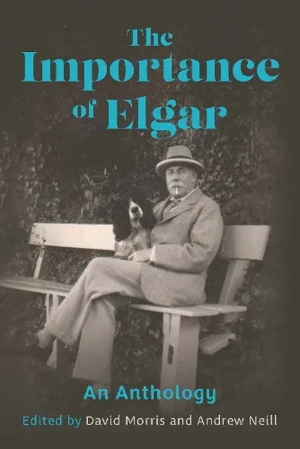
The Importance of Elgar: An Anthology
Edited by David Morris and Andrew Neill
Published 2026
381 pages, paperback
ISBN 9781837653522
Boydell Press
‘Is Elgar, or rather is Elgar’s music, important?’ asks Andrew Neill at the start of this book. Many readers of these pages would, I suspect, consider the answer self-evident – ‘very much so’ – and they would not be alone. In 2024, to mark the 90th anniversary of Elgar’s death, the Elgar Society wrote to a large number of musicians and writers asking if they would consider contributing something to the Society’s Journal under the title of ‘The Importance of Elgar’. The hope was that there would be sufficient submissions to make for interesting reading in the editions of the Journal in that anniversary year. The response received, though, was overwhelming, a resounding answer to that initial question. With quality matching quantity, the decision was taken to present the essays in book form, and this fascinating and handsome volume is the result. It’s more accessible and diverse than, say, The Cambridge Companion to Elgar or the same press’s Elgar Studies, which have been my go-to collections until now, and there’s a unity of warmth and engagement which makes it very welcoming. I read it from cover to cover, and the originality of perspective from each contributor, combined with the relative concision of each piece meant I never flagged – quite the opposite – but you could equally gain a lot by dipping in and taking your own path. I came away feeling as if I’d been at the best kind of conference, where the papers are excellent and the conversations in the margins are just as good.
Most of the book is organised by perspective (living composers, conductors, performers and writers), with a section on The Dream of Gerontius and the religious music at its centre. The last section, reprinted from the Elgar Society Journal, pleasingly mirrors the first: where the book opens with what composers make of Elgar now, it closes with Elgar among the composers of his own day and after, from Parratt to Britten. How to give a picture? I can only choose a few examples from many, though I genuinely learned something from every contribution. There’s some lovely autobiographical writing for a start. James MacMillan, for example, remembering being the only Catholic at his secondary school and observing the general bafflement of his Protestant classmates when studying Gerontius, whilst for him it was ‘the soundtrack of my life up to that point’. Or Nigel Simeone remembering his early experiences of Elgar performances in the 1970s and making you wish you had been there. And Antonio Pappano writes revealingly about how his early experiences of language, accent and place helped when working with the Santa Cecilia Orchestra, who were utterly unfamiliar with Elgar’s idiom. Then there are numerous historical insights, my favourite perhaps being Kate Kennedy’s recounting of cellist Beatrice Harrison’s famous 1924 duet with a nightingale. BBC engineers crouched uncomfortably in the bushes waiting to capture the bird responding to Harrison’s playing. After two long hours it did, and listeners worldwide heard the first birdsong broadcast on the radio. Harrison remarked later that it was the Elgar Cello Concerto, of all the pieces in her repertoire, to which the bird most readily responded. I also enjoyed Lani Spahr on his experience of digitally restoring the surviving recordings from Elgar’s personal library and feeling he was in the same packed room with Elgar and his musicians. Many MWI readers will of course have heard for themselves the extraordinary results Spahr has obtained and how they complete our picture of the composer in the most vivid way possible.
Perhaps the greatest pleasure the book gave me, though, lay in the synaptic connections it affords. For example, reading Robert Saxton on Elgar’s method of writing scraps and fragments of a composition, only to find an illustration of one aspect of that method by David Owen Norris later in the book. This is the visit of W.H. Reed to Elgar to play sketches from the Violin Concerto, where Reed described sheets all over the room with different versions of the same passage, and the cadenza literally in pieces which were gradually ‘knitted together’. Or Elgar’s obsession with conveying on paper how the music should sound. Edward Gardner writes about how Elgar’s scores are ‘saturated’ with markings and how overwhelming they can be, whilst Rupert Marshall-Luck gives a telling example of the trouble Elgar went to in the Piano Quintet to ensure a sudden change from f to pp was realised in performance exactly as he wanted it to be. Place is another strand: Ian Venables writes touchingly of finding himself living and working in Worcester and what the Elgarian connection meant to him. Worcester falls within the Catholic Archdiocese of Birmingham, whose Archbishop, Bernard Longley, writes about Gerontius and the other religious music in the context of the churches there. Christopher Morley writes about the relationship between Elgar and Birmingham, using his vast experience as an arts journalist in the city to engaging effect.
Both Archbishop Longley and Morley mention the Birmingham Oratory, the church in Edgbaston founded by Newman, which houses the original score of Gerontius. I was at the school which was for many years adjacent to and connected with the Oratory. Getting ready to sing in services as part of the choir, I’d stare at the score, and it became a familiar artefact some time before I actually heard the work performed. Partly because of that early memory I feel I have a special relationship with the piece, but it’s obvious from The Importance of Elgar that many people do, such is the extraordinary charge it carries. Indeed, Gerontius is the single biggest piece of connective tissue in the book. David Cairns writes about how the music of Gerontius carries a strong feeling ‘of having been given…almost as though it did not have to be composed but was always there’. Personally, I think this is because Elgar understood so well the two key elements of Newman’s poem, its structure and its sound, and was able to capture both in his music. Morley recounts Elgar’s discussions of the poem with the Oratory fathers before setting it. I wonder whether those conversations helped him to hear the music which was ‘always there’.
Whatever the reason, it’s one of those pieces from which one always comes away feeling as if something has been gained. Perhaps that wasn’t the experience at the Birmingham premiere (Morley reminds us of the catalogue of disasters, including the semi-chorus somehow making its first entry a semitone flat — any singer will tell you that’s really quite difficult to do), but I think I’ve heard more fine performances of Gerontius than of any other piece of music. A couple of them are mentioned here. Roderick Williams writes memorably about singing in Simon Rattle’s riveting 2015 Proms performance with the Vienna Philharmonic. I’d assumed that the pairing of orchestra and work was a typically astute Rattleian juxtaposition, but it turns out that it was the orchestra’s choice. Archbishop Longley mentions the 2010 Gerontius given in Birmingham Town Hall the day before Pope Benedict beatified Newman in Cofton Park. He doesn’t comment on the performance by Ex Cathedra, the Orchestra of the Age of Enlightenment and Jeffrey Skidmore, but to say they rose to the occasion would be a woeful understatement in my view. The bass soloist that evening was also Roderick Williams.
In a penetrating essay, Andrew Neill traces Benjamin Britten’s path to Gerontius. At 13, Britten left a Proms performance of Elgar’s Second Symphony, conducted by Elgar himself, after the third movement, ‘so bored’; by 1971 he was taking the utmost care over recording Gerontius at Snape. He’d come to recognise, as he told Arthur Oldham, chorus master of the LSO Chorus, that ‘if you strip off all the encrustations which have accumulated over the years…there is really a very good piece underneath’. Oldham took him to mean the Barbirolli ‘tradition’, by then the norm for performances of the work. Our own John Quinn, in an excellent and informative survey of Gerontius recordings earlier in the book, affirms Britten’s thoughtfulness and grip on the piece and rightly praises his use of the Choir of King’s College, Cambridge, for the semi-chorus, an innovative and inspired decision. John’s survey is one of those pieces that you read with elation and despair. Elation that there are so many recordings out there and despair that there are so many recordings out there (and there have been at least three more since the submission deadline for the book). But the volume and quality of what’s been committed to disc surely reflects the work’s specialness, rightly stressed throughout.
In his Introduction, Neill expresses the hope that the book will encourage more Elgar to be performed, especially abroad. Internationally, performances of Elgar have been centred on a small number of compositions, with the Cello Concerto leading the way. But Neill notes that performances in Germany are increasing, and as anyone who saw or heard the superb performance of the Enigma Variations by the Berlin Philharmonic and Kirill Petrenko at this year’s Proms will testify, that’s a good thing all round. I don’t know to what extent this book might realistically help continue the trend, but as a reminder of the stature of one of the defining figures of English music, it’s a magnificent achievement. The writing is the thing, of course, but a lot of care has been taken with the presentation, which includes a number of photographs from the collection of Arthur Reynolds, many of which were new to me.
There’s a moving quotation in the Introduction that stayed with me as I read, and which, as much as anything in the book, speaks to Elgar’s importance. His friend Frank Schuster attended a performance of the First Symphony shortly after suffering a bereavement and wrote to Elgar, ‘As long as I have it I can bear my losses, although I thought when I went into the hall today that I couldn’t. I felt then…that life was not worth the living…Then came your symphony — and in a moment I knew I was wrong.’
Dominic Hartley
Buying this book via the link below generates revenue for MWI, which helps the site remain free