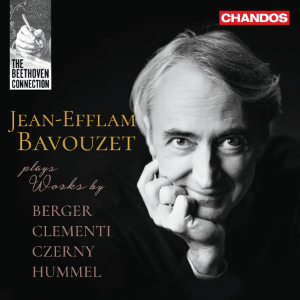
The Beethoven Connection Volume 2
Johann Nepomuk Hummel (1778-1837)
Grande Sonate Op 13 (1805)
Muzio Clementi (1752-1832)
Sonata Op. 32 No 2
Ludwig Berger (1777-1839)
Grande Sonata Pathétique, Op. 1
Carl Czerny (1791-1857)
Funeral march for Beethoven, Op.146
Jean-Efflam Bavouzet (piano)
rec. 2025, Potton Hall, Dunwich, Suffolk
Chandos CHAN20355 [76]
This is the second Volume of Jean-Efflam Bavouzet’s series of connections through Beethoven. In Volume One the composers included Joseph Woelfl, Muzio Clementi, Johann Nepomuk Hummel and Jan Ladislav Dussek. Hummel, the closest of these to Beethoven, makes a reappearance in this volume, where he is joined by Ludwig Berger, Muzio Clementi, and Carl Czerny. Bavouzet himself has likened Beethoven to a high, Himalayan mountain. It may be the highest peak, he says, but that doesn’t mean that the mountains that surround it aren’t impressive!
All four of these composers were piano virtuosos in Vienna when Beethoven arrived in 1792. The oldest of the three was Clementi, who was eighteen years older and survived him by five years. By 1798 they had met many times, mainly in Clementi’s role as music publisher. By 1804 he had published a great deal of Beethoven’s work and three years later, the composer signed an important contract with him.
Berger, Hummel and Czerny were all younger than he. Hummel became good friends with him, whereas Clementi’s pupil Berger never actually met him but composed a sonata inspired by his own Pathétique. Czerny of course was one of Beethoven’s chief pupils and wrote a great deal about his memories of him.
Hummel’s Grand Sonata No 2 in E Flat major Op 13 was dedicated to Haydn, but the opening of Bavouzet’s performance here is not remotely grand, instead favouring a delicacy of touch, while portraying all the hurried urgency required in its first movement, a bright allegro con brio, titled Alleluja. This music is immediately likeable, music in a hurry, and Bavouzet only adds to the delight with his perfectly controlled driving pace and flashes of delight. The second movement is even more gently done; its expansiveness coming naturally out of the original chords. It’s marked as an adagio with great expression, the music becoming steadily more intense and passionate. The finale is an allegro con spirito, and there is no shortage of that spirit in the way that Bavouzet plays this delightful end to a delightful piece. He leaps and springs and ripples, and that’s following an initial hop, skip and jump. Indeed, the whole feeling of this sonata is one of joyful delight, but because it is Bavouzet, that joy is conveyed with delicious, controlled lightness. When, however, the marked grandness of the piece needs to come through, that is there, too.
Clementi’s Sonata in G minor, Op 34, No 2 is an entirely different beast, with its opening mood a lot darker. It’s initially marked as a sustained largo, leading into a fiery allegro. Like so many classical symphonies, the dark opening is merely a springboard to something lighter. It’s an interesting contrast to the Hummel sonata, as there is far more emphasis in the bass, which continually fires in its warnings while the treble tries desperately to let go. Once again, it’s the pianist’s characteristic light touch which stands out here. Even the stern bass chords are played with just the right amount of force, and overall the feeling remains of a battle between parent and child.
The second movement is marked un poco adagio, and this small adagio is the shortest part of the overall sonata. Its mood is again gentle and playful with occasional lurching interjections from the bass. The finale begins with the sort of joyful rippling and springing which has gradually become the overall mood of the piece. All this time Bavouzet delights, totally in control of all the piece’s shifts and moods, while never being overloud or bombastic. He wears his skill so lightly that you can forget how effortless he makes it seem.
If the last piece seemed to begin with a growl, then the growl in the third sonata on this disc is even more pronounced; a proper bear disturbed in its hibernation. This is the opening to Berger’s Grand Sonata Pathétique Op 1, and unlike the Hummel sonata, this really does begin grandly. However, it soon settles down into a long, twelve-minute movement. It begins and ends with an adagio, with a sprightly allegro taking up the body of the time. Of course, there are two important things to note about this sonata before going any further. The first is that it is dedicated by Berger to his teacher Clementi. More important is that; as becomes clear the more you listen to it, it was composed as a deliberate homage to Beethoven’s own Pathétique sonata. The grand opening betrays this, as does the central section of the allegro. It is not quite a series of variations on the actual Beethoven sonata, but perilously close at times. Bavouzet adeptly joins in with all of this fun, as he does with the seven-minute second movement, an adagio which is marked as being in the manner of Mozart. It is surely a piece which would grace one of Mozart’s own late concertos and the pianist treats it like a masterpiece, again allowing the expressive nature of its simple theme to gradually establish itself. Then, without warning, we are plunged into a passage, which is both thoughtful and dark, before Mozart returns. The final rondo passes through several moods, but in the ultimately this feels to me to be a strange hybrid of a piece where the composer seems on the one hand to be paying a playful homage to two composers he reveres, and on the hand trying to ‘find’ the music of his sonata. When all is said and done, that music, when it is unearthed, is delightful and probably couldn’t find a better advocate than Bavouzet.
The final, short piece brings Carl Czerny to the party, with his C minor funeral march to commemorate the death of Beethoven Op 146, composed on the 26th March 1827. The pianist does studied solemnity as well as he does everything else in a piece which has distinct echoes of another famous funeral march, the one by Chopin in his Sonata No 2.
Apart from the delightful touch and intelligence of a seasoned interpreter like Efflam Bavouzet, the music of composer/pianists ‘around’ Beethoven is a treat indeed. Ignoring the more deliberate attempts to emulate or celebrate Beethoven, it’s the Hummel and Clementi which delight me the most in their own right.
Stephen John Wray Gladwin
Buying this recording via the link below generates revenue for MWI, which helps the site remain free