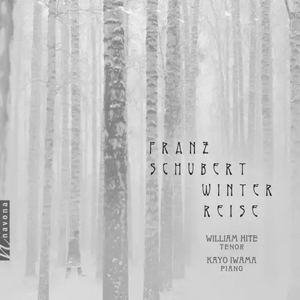
Franz Schubert (1797-1828)
Winterreise
William Hite (tenor), Kayo Iwama (piano)
rec. 2023, Brattleboro Music Center, Brattleboro, USA
German texts and English translations included
Reviewed as a download
Navona Records NV6897 [76]
William Hite has had a long career in the USA, singing in operas and oratorios from the Baroque and Early Music periods, but also in contemporary works. Lieder recitals have also been a regular part of his activity, and recording Winterreise is therefore a logical step.
Winterreise (Winter Journey) is of course a monument in the area of Lieder, considered as Schubert’s masterpiece and one of the best song cycles that exist, based on the cycle of poems of the same name by Wilhelm Meister, Schubert’s contemporary. This remarkable series of songs goes well beyond the sufferings of a heartbroken lover to plumb depths of existential loneliness and desolation, and no doubt owes its mood in part to the composer’s very poor health in 1827; he was to die the following year.
It is obviously a challenge for the performers, both for the singer who has to express remarkable depth of emotion, and for the pianist, since the accompaniment is far from simply that, evoking different facets of nature and a range of feelings. The cycle has of course been recorded by many highly respected singers: sopranos (e.g. Margaret Price), mezzos (e.g. Christa Ludwig), baritones (e.g. Fischer-Dieskau, Thomas Quasthoff), and basses (e.g. Martti Talvela, Kurt Moll). Ralph Moore discusses many of them in his survey here. A good many of the singers who have made a good job of this work have rich operatic voices; one can wonder whether a singer like Hite, whose career has been built mostly on the Baroque repertoire, has what it takes to tackle this cycle successfully.
Hite’s voice immediately strikes me as tidy, without any wobble or intonation problems. I have no grumbles with his German. The singer seems to me to be recorded very close; the piano is rather in the background, sometimes slightly muffled, and at other moments with a little too much reverberation for my ear. There is much expressive singing, particularly in the piano passages,as in Rückblick or the following Irrlicht, though for me the emotion is conveyed more through intelligent use of the text than through colouring of the voice. In several songs, like Das Wirtshaus, the approach is simple but effective, and the melody can be sung very sweetly, as in Der Wegweiser. But there are times when the voice seems just too light to do justice to the situation, as in Mut.
It is when comparing Hite’s (and Iwama’s) performances to those of some other tenors (to take just the same voice-type) that it can be found wanting. Jon Vickers (1983, with Geoffrey Parsons), or Jonas Kaufmann (2013, with Helmut Deutsch) get so much more out of the songs, making Hite sound not poor, but just rather ordinary. The latter’s forte on “Die kalten Winde blasen” in Der Lindenbaum, for example, sounds distinctly forced, whereas Vickers and Kaufmann can bring extra intensity into such moments without giving an impression of strain, or even, necessarily, of a striking increase in volume. Compared with them, Hite’s voice seems simply not rich or varied enough for the task in hand, and Iwama, despite her excellent playing, doesn’t really bring out enough emotional variety in the piano part, compared with, say, Parsons or Deutsch. Listeners who prefer a lighter tenor voice might well find what they are looking for in Ian Partridge (1987, with Richard Burnett playing a fortepiano); personally, I find Vickers’ and Kaufmann’s versions extremely moving.
David James
Buying this recording via the link below generates revenue for MWI, which helps the site remain free