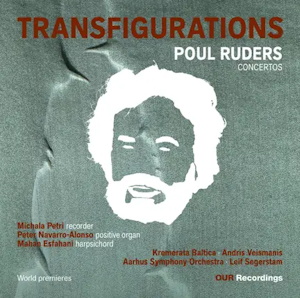
Poul Ruders (born 1949) Transfigurations
Transfigurations: A Double Portrait for Recorder Solo and String Orchestra (2022)
A Movable Concerto: Five Short Pieces for Positive Organ and Strings (2023)
Michala Petri(recorders), Peter Navarro-Alonso (positiver organ), Kremerata Baltica/Andris Veismanis
Concerto for Harpsichord and Symphony Orchestra (2019)
Mahan Esfahani (harpsichord), Aarhus Symphony Orchestra/Leif Segerstam
rec. 2020 in Symphonic Hall, Aarhus, Denmark (harpsichord concerto); 2025 in Paliesius Dvaras, Lithuania (other works)
OUR Recordings 8.226937 [59]
Ruders is a leading Danish composer, best known for his cycle of six symphonies, which have recently been issued in a box (review) and for his opera The Handmaid’s Tale, which has had several productions and a recording. Under the title Transfigurations, here we have three concertos for what might be considered fringe instruments: recorder, positive organ and harpsichord. Yet, Ruders being who he is, they are all interesting and worthwhile works.
The title Transfigurations belongs properly to the first work here, subtitled A Double Portrait for Recorder Solo and String Orchestra. There are two movements, each of which begins with the same material but then sets off in a different direction. That is one kind of transfiguration. The other is that the soloist plays on different sizes of recorder, moving from tenor to soprano to sopranino and then back. The first movement opens with long slow notes by the soloist with complex harmonies on the strings. There is a sudden increase in both pace and pitch, with the soloist moving up to the smaller and higher instruments with an equally sudden reversion to the more tranquil mode. The second movement moves differently but still predominantly slowly, and the whole is very mellifluous.
The second work is titled A Movable Concerto with the subtitle Five Short Pieces for Positive Organ and Strings. A positive organ is a small pipe organ with a single manual and it is portable. It is the kind of instrument Handel used to play between movements of his oratorios, and Ruders says that we would not be wrong in detecting ‘a whiff of Handel’ in this work. The five movements are nicely contrasted. Actually, I did not detect a whiff of Handel as much as one of Hindemith, with its energetic counterpoinmt and good humour.
The third concerto is for harpsichord and symphony orchestra – note, not just strings as with the other two works. Ruders used tio play the harpsichord and is well aware that its heyday was before symphony orchestras appeared, although he is also aware of modern harpsichord concertos. He asks the soloist to be amplified so as to hold its own against the orchestra. There are the three traditional movements of a concerto, respectively fast-slow-fast with the outer movements agitated and active and the middle one quiet and contemplative. I must admit to finding this work less interesting than its two predecessors.
The performances are accomplished and polished; Ruders has attracted soloists of the calibre of Michala Petri on the recorder and Manuel Esfahani on the harpsichord. I had not previously heard of the organist Peter Navarro-Alonso, but that is my ignorance: he is well-known on the Scandinavian organ scene. The orchestral playing is good, as is the recording. There is an informative booklet, in English only. This is perhaps minor Ruders, but worth hearing by adnmirers of the composer.
Stephen Barber
Buying this recording via the link below generates revenue for MWI, which helps the site remain free