
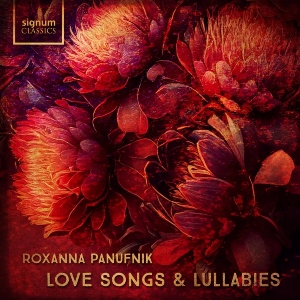
Roxanna Panufnik (b. 1968)
Love Songs & Lullabies
rec. 2022-2025, All Saints East Finchley, St Paul’s Boys School & Latymer Upper School, London & Royal Northern College of Music, Manchester
Texts and translations provided
Reviewed as a digital download
Signum Classics SIGCD974 [56]
Beginner musicians will often excitedly say that ‘music is a universal language’. Of course, this is not really the case. One does not need to venture very far geographically or chronologically to find music that works entirely differently from our own. A superb violinist trained in the western tradition will not inherently understand any of what is being expressed in a performance of Balinese Gamelan or Indian Raga.
Nevertheless, there does seem to be something about music that lends itself to cross-cultural fusion. Afro-Cuban Jazz, Bossa Nova, Raga rock, Reggaeton, K-Pop … the list of examples is endless. Classical music history, too, is replete with cross-cultural fusion. I’d wager that nearly any pair of countries you can name has at least one musician trying to bring their respective musical traditions together.
There is, however, a tension that comes into play when national traditions fuse. One of the virtues many listeners associate with a given folk music is its (perceived) ‘authenticity’, and when we make a new hybrid it, definitionally, cannot be authentic in quite the same way.
When I was younger, I used to love listening to albums on the Putumayo label, which specialises in these fusional contemporary folk musicians. But I have to acknowledge that the label’s critics have a point; someone who genuinely loves, say, Egyptian music, doesn’t want to hear a ‘sanitised’ or ‘watered down’ version prepared for a western audience. Even worse – what if it’s bad for us? What if, by doing this, musicians and labels are smoothing away the differences between genres and homogenising music? If you’re not being exposed to the ‘genuine article’, are you doing a disservice to your own capacity to appreciate different forms of art, and thus, to understand different people?
I cannot speak for every listener, but the move I recommend is to see fusion as an art in its own right. When done well, it can be an avenue for delightful and original music – and that is precisely what Roxana Panufnik has accomplished here with Love Songs & Lullabies.
Roxana Panufnik might be known to readers for her excellent choral music. The Westminster Mass of 1997 was one of her first runaway successes (review), a warm, bright, playful setting of the Mass. More recently, she was one of twelve composers tapped to write a movement for the coronation of King Charles III, and she was subsequently given a Damehood. Perhaps this implies that her Sanctus met with approval.
Love Songs & Lullabies is a project that began during Covid lockdowns. Panufnik writes in the booklet that she briefly considered giving up composing and returning to her teenage ambition of ambulance-driving (which, incidentally, was Maurice Ravel’s post during the first World War). Instead, Panufnik used those difficult months to plan a series of collaborations with musicians from across the world, something she had always wanted to do. Here we are, five years later, with that album.
The first piece is an arrangement for cello and piano of a gentle Croatian lullaby ‘Lluljaj mi, Sine’ (“Rockabye, my son”). The rippling accompaniment in 7/8 is played by Turkish pianist Zeynep Özsuca, while Matthew Barley elegantly dispatches the melody on his cello. There is a slightly elegiac character to this arrangement, and I can easily imagine it as an encore after a programme of, say, the Faure cello sonatas.
Lyra’s Lullaby is attributed to ‘Trad. arr. Roxana Panufnik and Jem ‘Stone’ Panufnik’’ but I have been unable to trace any geographic origin. The booklet says that it began life as a collaboration between Roxana and her brother, a dance music producer. (I’ll just mention in passing that their father, not featured on the album, was the Polish conductor Andrzej Panufnik.) I say ‘dance music producer’, because that’s how the booklet identifies him, but this particular track has something of a film noir feeling, opening with eerie chiming bells, jazzy brushed drum strokes, and the smoky timbre of Peter Moore’s trombone. In the middle section, Lyra’s Lullaby becomes rather slower and spacier, before returning to the opening tempo again. I am of the opinion that there are not enough showpieces for the trombone, so this is a welcome addition.
We’re off to China next, for an arrangement of ‘Xiǎo hé tǎng shuǐ’ (here translated as Flowing River). In this folk song from the Yunnan province, the narrator sees the moon, and imagines her distant beloved looking at the same moon – all somewhat Rusalka. Confusingly, this is Flowing River Part II, with Part I appearing later on the album. Part II is arranged for three pitched percussion players (the Aurora Duo plus Julian Kiln) and Emily Coatsworth who provides some humming. It has the character of an interlude, or a palette cleanser. Part I takes the tune significantly slower, and drops down to just two percussion players on, I believe, the same instruments as in Part I. The Aurora Duo display some dazzling talent in this piece. They are capable of so much nuance, colour, and speed that there were moments where I thought I was listening to someone playing plucked strings, like a lute.
Track four, My Man, marks the entry of the human voice into the album. This is, I believe, an arrangement of the movement ‘Mój mężczyzna’ from Panufnik’s 2018 oratorio Faithful Journey: a mass for Poland. The text comes from Anna Świrszczyńska, a nurse in Warsaw writing during the 1944 uprising; it is a poem wherein she wishes she could hide her beloved inside her belly like an unborn child. It is sung in English first, then Polish. Panufnik at the time made use of the Polish melody Gdzie ty jedziesz, Jasiu? (“Where are you going, Jasiu?). Here it is arranged for soprano (Mary Bevan), piano (Zeynep Özsuca) and the Brodsky string quartet, an ensemble readers may know for their Shostakovich cycle, and crossover work (review). Taking into account the subject matter, the sparse, luminous piano accompaniment, Bevan’s soaring voice, and the deep groaning of the Brodsky strings, it is almost impossible not to make comparisons with Górecki. I found it sincere and touching, with enough heft to avoid becoming melodramatic.
From here, we move on to a string of Panufnik originals. The first two of these are When it’s Over (parts 1 and 2). Part 1 is performed by jazz-classical singer Lucy Dixon and pianist David Gordon, with Zoe Mitchell playing, I believe, some crystal bowls. She is credited in the tracklisting as ‘sound healer’, so there is always the chance I have misunderstood her contributions. The music is quite lovely – almost a typical jazz ballad, or something you might hear in a Golden Age musical, but occasionally just a bit more contemporary. The poem I would prefer to ignore; it’s already dated to the Covid era and rather mawkish (musing that ‘we are now imprisoned for our sins/Is now the time to question why?’), but luckily, one can ignore the words and focus on Dixon’s dulcet voice. Part 2, which, in this case, follows Part 1, was inspired by Gordon’s piano improvisations on the theme of Part 1. Ben and Max Ringham contribute some ‘sound design’, which consists of birdsong, bees buzzing, bells chiming, and other ambient effects. I think it’s done rather well, and it doesn’t outstay its welcome despite having really only one idea. A lot of this comes down to Gordon, who paces his piano playing perfectly. It’s languid and dreamy without stagnating.
When I Wake Up was originally written for Panufnik’s 2022 opera Dalia. In this scene, mother Aisha and daughter Dalia, two refugees from Syria, are reunited in a detention camp in Dover. Both of the roles’ creators reprise it here; Jude Abueisheh as Dalia, and Merit Ariane as Aisha. They are accompanied by Özsuca on piano and Baha Yetkin on the oud. The lyric sheet refers to a character named ‘Maya’ but they are uncredited in the booklet. The piece begins with a long intro for oud and vocalises in an Arabic style with lots of melismas, although the lyrics are in English. It is undoubtedly affecting, poignant, and cathartic, performed to perfection here. It is hard to imagine a dry eye in the audience.
We get one more Panufnik piece beginning with ‘When…’, this time, When You Appear. This is a sort of ‘song without words’ inspired by Pablo Neruda’s La Reina for trombone and piano, with Moore and Özsuca both returning. Panufnik selects a thematically appropriate (meaning, Chilean) cueca dance rhythm, but slows it down, in part to suggest the hesitation in the poem itself. I love that you can hear references to guitar music of Chile, and the trombone, for all that it is sometimes stereotyped as brash and military, is really capable of creating quite a sultry atmosphere.
But then, why not something for guitar? Panufnik gives us one next: an arrangement of the Portuguese carol ‘José embala o Menino’ (Joseph Rocks the Baby). Panufnik wrote a whole set of variations on this theme for Diogo Carlos, but here we get just the theme itself. This beautiful melody sounds totally natural on guitar. Panufnik has structured it something like a nocturne, with calmer outer sections and a more excited middle section.
We conclude with an arrangement of the Ukrainian carol Spy, Isuse, spy (Sleep, Jesus, Sleep), and here, Panufnik pulls out all the stops. Ukrainian soprano Inna Husieva sings the melody, Soul Sanctuary Gospel Choir supports her, and Afghan tabla player Sulaiman Haqpana decorates the rhythm. There is an organ playing, but it is uncredited. Still; what a melody, and what a beautiful arrangement.
It would have been easy enough for this disc to have plenty of individual highlights, but to fail at cohering as a musical unity. Perhaps the thing that surprised me most, however, was that this album feels exactly right. The sequence from start to finish has a shape and a unified character. It is a thoroughly lovable project for anyone who likes a bit of variety in their music.
The sound engineering has been done remarkably well; again, every instrument, voice type, and combination has been presented to its best advantage, as you’d expect from Signum. The booklet is very good; texts and translations have been provided. It’s a minor point, but I even think the album art is classy and well-picked. In short, this is a winner.
Aidan Gray
Contents
Trad, arr. Roxana Panufnik (b. 1968)
Rockabye, My Son
Trad, arr. Roxana Panufnik and Jem ‘Stone’ Panufnik’ (b. 1969)
Lyra’s Lullaby
Trad, arr. Roxana Panufnik
Flowing River Part II
My Man (2018)
Roxana Panufnik
When It’s Over Part I
When It’s Over Part II
When I Wake Up (2021)
When You Appear
Trad. arr. Roxana Panufnik
Joseph Cradles the Baby
Flowing River Part I
Sleep, Jesus, Sleep (2023)
Artists:
Peter Moore (trombone), Sulaiman Haqpana (Afghan tabla), Julian Kiln (percussion), Zeynep Özsuca (piano), David Gordon (piano), Matthew Barley (cello), Baha Yetkin (oud), Diogo Carlos (guitar), Max Ringham (sound design)
Mary Bevan (soprano), Inna Husieva (soprano), Jude Abueisheh (singer), Lucy Dixon (vocals), Merit Ariane (Arabic singer), Emily Coatsworth (humming), Zoe Mitchell (sound healer [crystal bowls])
Aurora Percussion Duo, Brodsky Quartet, Soul Sanctuary Gospel Choir
Buying this recording via the link below generates revenue for MWI, which helps the site remain free













