
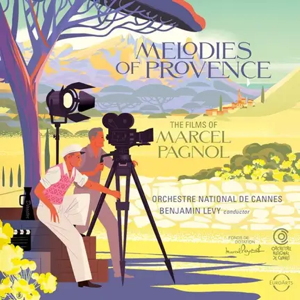
Melodies of Provence: the films of Marcel Pagnol
Orchestre national de Cannes/Benjamin Levy
Arrangements Cyril Lehn
rec. 2025, Salle des Arlucs, Cannes, France
EuroArts 8024210857 [67]
Like many others I was seduced in 1986 by Claude Berri’s two films, Jean de Florette and Manon des Sources, adaptations of Marcel Pagnol’s two-volume ‘The Water of the Hills’ (‘L’eau des collines’). The Provençal setting – baking heat, deception, village life, the life-giving stream – allowed for a rich array of types, complex family histories, and, of course, landscapes to rouse the emotions. Pagnol, novelist and filmmaker, had already filmed Manon des Sources back in 1952 – the second part is called Ugolin after one of the characters in the drama – and it was the films that led him to expand their scripts into novels. So, when this disc of music from Pagnol’s films arrived, I didn’t hesitate.
The verdant colour of the cover promises much, with its Provençal landscape and cameramen ready for action. What one doesn’t get, though, is any music from the 1952 Manon des Sources. Instead, there are numerous examples from the mid-30s onwards, much of the music for which has been lost – an occupational hazard for film music – and is heard here, for the most part, in new arrangements made by Cyril Lehn. Pagnol much preferred to work integrally with composers and wasn’t an admirer of post-production musical inserts and I think this assists in the narrative fluidity of many of the examples here.
The opening piece is by the Hungarian Francis Gromon, represented by a brief slice from Marius and an interesting example of ‘international’ writing not specifically rooted in southern France. A frequent musical collaborator, however, was Vincent Scotto who, like another musical associate of Pagnol’s, Henri Tomasi, was born in Marseille, close to Pagnol’s birthplace of Aubagne. Aided by Lehn’s arrangements we can savour the jaunty march themes of the six-minute example from Fanny, with some luscious romantic writing, as well as the jaunty ebullience of Jofroi et Cigalon. Festive brass briefly irradiates Angèle whilst César comes from a film set in Marseille and draws from Scotto a lively piece of scene-setting complete with swinging rhythms and a stirring climax.
One piece here that is known is Adriano’s recording of Honegger’s Regain (‘Revival’), released on Marco Polo. In EuroArts’ disc we have the first suite of 1937, which opens with a pounding rain scene that develops into a rather stirring theme, a March shadowed by dissonance, a nature depiction, a warmly succulent Spring movement, and – probably the most novel music – a one-minute wildly lurching panel. The suite ends with a noble scene lasting two minutes.
Pagnol favoured evocative localised scenic writing of this kind for his films but would certainly, where necessary, encourage contemporary elements such as in Casimir Oberfeld’s music for Le Schpountz, which offers a natty piece of dance band swing. Scotto returns for his orchestral suite La Femme du boulanger et la fille du puisatier which arranger Lehn has ‘opened out’ to include numerous thematic elements from the film in a five-minute package – a fanfare, march, and further attractive lyrical evidence of Scotto’s excellence. After the war Scotto and Tomasi collaborated on Naïs which has an antique feel as well as blustery, forceful writing, and Paul Misraki is represented, albeit briefly, by a lively segment from Le Rosier de Madame Husson. Finally, we hear extended extracts from Tomasi’s score for Les Lettres de mon moulin, music bathed in Provençal folklore but framed in an ultra-sophisticated way. The longest scene is the last, which opens quietly and ominously but develops an unstoppable burlesque drive – a near-cousin of our old friend, Dukas’ The Sorcerer’s Apprentice.
So, this is a sunny salute to the films of Marcel Pagnol and the music that saturated them so warmly. Much credit goes to the tireless Cyril Lehn. There are helpful notes from Julien Ferrando. The Orchestre national de Cannes is directed very astutely by Benjamin Levy and if I have any criticisms – they are of the carping type – they concern the rather flat acoustical perspective which does somewhat limit the melodies from blossoming to the maximum, and that turns the strings – which don’t sound that numerous – a touch glassy. Whilst I can imagine more opulent orchestral sounds, I don’t envisage such a stirring act of retrieval as this in the near future.
Jonathan Woolf
Buying this recording via the link below generates revenue for MWI, which helps the site remain free

Contents
Francis Gromon: Marius
Vincent Scotto: Fanny: Jofroi et Cigalon: Angèle: César: La Femme du boulanger et la fille du puisatier
Vincent Scotto and Henri Tomasi: Naïs
Arthur Honegger: Musique pour Regain
Casimir Oberfeld: Le Schpountz
Paul Misraki: Le Rosier de Madame Husson
Excerpt, Henri Tomasi: Les Lettres de mon moulin













