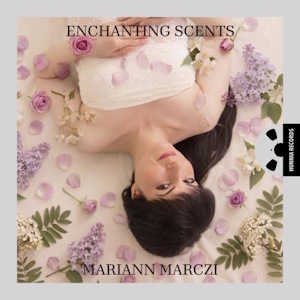
Mariann Marczi (piano)
Enchanting Scents
rec. 2026, Hamburg, Germany
Reviewed as a download
Hunnia Records HRES2616 [50]
Enchanting Scents marks Hungarian pianist Mariann Marczi’s third album. Her first, Splinters, was released in 2013 (review). That album consists of twentieth-century pieces written for piano by Hungary’s most celebrated composers. In Enchanting Scents, Marczi takes inspiration from a Hungarian poem by Lőrinc Szabó about the flights of fancy that the poet experiences when he smells the unique perfume from each of his seventy-seven small vials. As Marczi explains when describing the album’s concept, it ‘explores the evocative connection between fragrance, nature and memory through music associated with tress, gardens, lilacs, roses and flowers’. As this suggests, Enchanting Scents is an eclectic album. At first, it may seem that the combination of works transcribed for piano by eight different composers would result in ‘a furcsa gyüjtemény’ (‘a strange collection’), to quote from Szabó’s poem. But, through Marczi’s careful selection of Romantic and Post-Romantic European repertoire, the result is a pleasing combination of pieces that work well as a single CD.
Marczi largely performs adaptations of well-known works, such as Schubert’s ‘Der Lindenbaum’ from Winterreise (transcribed by Liszt in 1839), Delibes’s ‘Flower Duet’ (transcribed by Auguste Bazille in 1883), and Tchaikovsky’s ‘Waltz of the Flowers’ from The Nutcracker Suite (transcribed by Sergei Taneyev in 1892). In my recent interview with Marczi[E1] , she explained that it was ‘not an intentional choice’ for most of the pieces on the album to be transcriptions, but that she ‘grew to love how these arrangements allow us to bend the gates of time’.
The album begins with Sibelius’s ‘Five Pieces for Piano’, Op. 75 (1914, with No. 5 revised in 1919), more commonly known as The Trees. Marczi gets the French-influenced impressionistic lyricism just right in ‘The Birch’ (No. 4), but it is ‘The Spruce’ (No. 5), which I have returned to most often. This is Sibelius’s most well-known piece from this set, and it is essentially a slow waltz that evokes the dark Northern forests of the composer’s native Finland. During the risoluto section, there are cascading arpeggios which can get lost with excessive pedalling, but Marczi’s performance allows for a thicker sound to emerge whilst preserving clarity and a sense of freshness. In this way, Marczi evokes the texture of the coniferous spruce.
Interestingly, Marczi herself transcribed ‘Rose…Rose…Rose…’ from Joseph Kosma’s operetta Les Chansons de Bilitis (1954), itself inspired by Pierre Louÿs’s sapphic verse. In the album booklet, Marczi describes finding the sheet music for this operetta at a second-hand bookshop in Paris. Indeed, this piece transports us to the Parisian salon, which is appropriate given that Kosma was influenced by French composers Debussy and Charles Koechlin, who also set Louÿs’s poems to music. Kosma is best known for composing the jazz standard Autumn Leaves (originally titled Les Feuilles mortes, 1945) and film scores. ‘Rose…Rose…Rose…’ recalls the mood of the Roaring Twenties and the Art Deco style that suffused the Parisian streets at that time. During this period, Kosma was the artistic director of the Cikk-Cakk (‘Zig-Zag’) theatre company in Budapest, which embodied a late fin-de-siècle and early avant-garde style. Later, when he moved to Paris in 1933, Kosma wrote chansons for popular cabaret singers. Though composed much later, in 1954, ‘Rose…Rose…Rose…’ belongs to this bygone world of rendezvous in plush salons. Marczi’s tone is appropriately nostalgic and, thankfully, not overindulgent or sentimental.
The final piece on the album is also worth mentioning here. It is Johann Strauss the Younger’s Concert Paraphrase on Tales from the Vienna Woods, Op. 325, composed in 1868 and transcribed by Eduard Schütt in 1889. The original piece belongs to a waltz cycle which features the zither and, as the title suggests, it was inspired by the folk music of the forest area surrounding Vienna. At just over eight minutes, this is the longest piece on the album. It is also one of the most virtuosic, replete with dense chordal sections, rapid scale runs, and elaborate textures. During these passages, Marczi demonstrates her impressive flare, but she never loses sight of the heart of this piece: it is a waltz, intended to entertain.
This is not music for the concert hall, nor is it intended to be. Rather, this music belongs to the salon. The atmosphere is intimate and delicate. The mood is nostalgic. And Marczi’s performance perfectly encapsulates this largely bygone world.
Lucy Jeffery
Availability: High Res Audio
Contents
Jean Sibelius (1865-1957)
Five Pieces for Piano, Op. 75 “The Trees” (1914)
Sergei Rachmaninoff (1783-1943)
‘In My Garden at Night’, Op. 38, No. 1 (1916)
‘Lilacs’, Op. 21, No. 5 (1902; transcr. 1902, rev. 1941)
Louis Spohr (1784-1859)
‘Die Rose’, Romanzeaus der Oper Zemire und Azor, S. 571 (1819, transcr. Liszt, 1876)
Franz Schubert (1797-1828)
The Rose D. 745, S. 566/1 (1822, transcr. Liszt, 1833, rev 1838)
Winterreise D. 911, No. 5, ‘Der Lindenbaum’ (1827-28, transcr. Liszt, 1839)
Joseph Kosma (1905-1969)
‘Rose…Rose…Rose…’from Les Chansons de Bilitis (1954, transcr. Mariann Marczi, 2026)
Léo Delibes (1836-1891)
Lakmé Act 1, ‘Flower Duet’ (1883 transcr, Auguste Bazille)
Pyotr Ilyich Tchaikovsky (1840-1893)
‘Waltz of the Flowers’ – The Nutcracker Suite, Op. 71 (1892, transc.r Sergei Taneyev, 1892)
Johann Strauss II (1825-1899)
Concert Paraphrase on Tales from the Vienna Woods, Op. 325 (1868, transcr. Eduard Schütt, 1889)
Interview with Mariann Marczi